Veteran Congress leader and currently President of India's biggest opposition party, Mallikarjun Kharge faced the Sangh brigade's hate-filled casteist mindset in Uttarakhand. The Sangh brigade conducted a 'shuddhikaran havan' (purification ritual) at Ramlila Maidan in Haldwani after Kharge had delivered a speech. Kharge ji flagged this issue in Parliament and subsequently Leader of Opposition Rahul Gandhi rightly demanded a police case against this shocking case of caste discrimination under the SC/ST Prevention of Atrocities Act. The so-called purification exercise was nothing but practice of untouchability by other means.
Ironically now Rahul Gandhi himself faces the allegation of caste discrimination with an FIR lodged against him at the Haldwani police station! How can demanding justice against the practice of untouchability be construed as an atrocity?
Ever since Rahul Gandhi challenged the Manusmriti mindset, first in the context of women's freedom in his Pune meeting and then condemning the Haldwani episode in a subsequent press conference, we can see palpable discomfort and even anger and ridicule in the Godi Media and a veritable 'Save Manusmriti' campaign by certain sections.
The mention of Manusmriti as a patriarchal and casteist code of slavery and institutionalised or ritualised injustice is being projected as selective 'anti-Hindu prejudice'. Ram Madhav described Manusmriti as an ancient moral code which has little relevance in today's era of the Constitution.
Nobody would have been discussing the Manusmriti today had it really been just an ancient scripture or archaic code without any connotation for India's contemporary social and cultural milieu. It is instructive to remember that twenty-two years before the Constitution of India was adopted by the Constituent Assembly, Babasaheb Ambedkar had publicly rejected and burnt the Manusmriti on 25 December 1927. The journey of the Indian Constitution had begun with the explicit rejection of the Manusmriti.
The antagonism between the Manusmriti and the Constitution did not end with the adoption of the Constitution. In fact, the RSS had reacted to the Constitution by editorially rejecting it in its mouthpiece Organiser, calling it a document with nothing Indian about it and describing the Manusmriti as India's authentic and ideal constitutional foundation. The ban on the RSS was lifted by Sardar Patel only after the RSS gave written assurance to accept the Constitution and the National Flag.
The relentless subversion and violation of the Constitution by the Modi government and the Sangh brigade and the continuing celebration of the Manusmriti mindset whether by way of rewarding of rape convicts or conducting of purification rituals to insult leaders of Dalit origin however tell us that the war between the Manusmriti and the Constitution is far from over. In this context, it is also pertinent to take note of the meeting between Union Minister JP Nadda and leaders of the anti-reservation movement.
Only a complete and firm rejection of the patriarchal and casteist moral code, call it the Brahmanical order or the Manusmriti mindset, can advance India towards a true fulfillment of the Constitutional goal of a sovereign socialist secular democratic republic and the motto of justice, liberty, equality and fraternity.
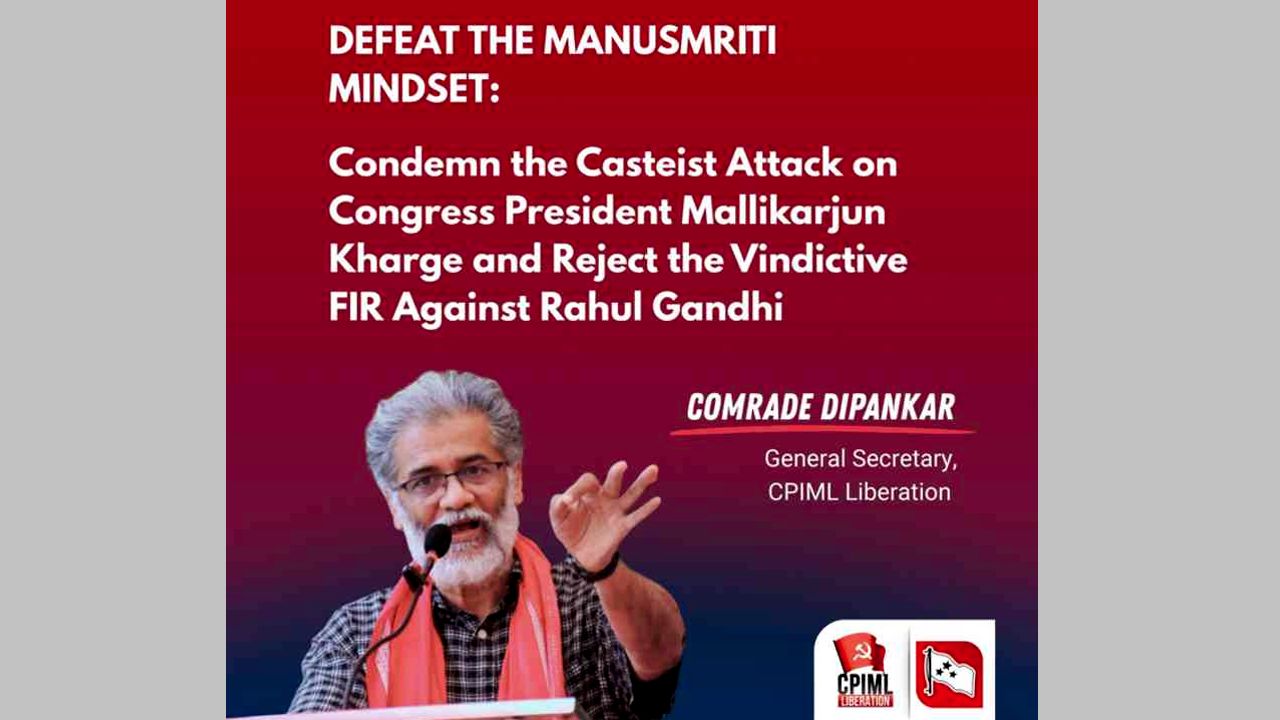
– issued by Dipankar Bhattacharya, General Secretary, CPI(ML) Liberation (September 1, 2026)