


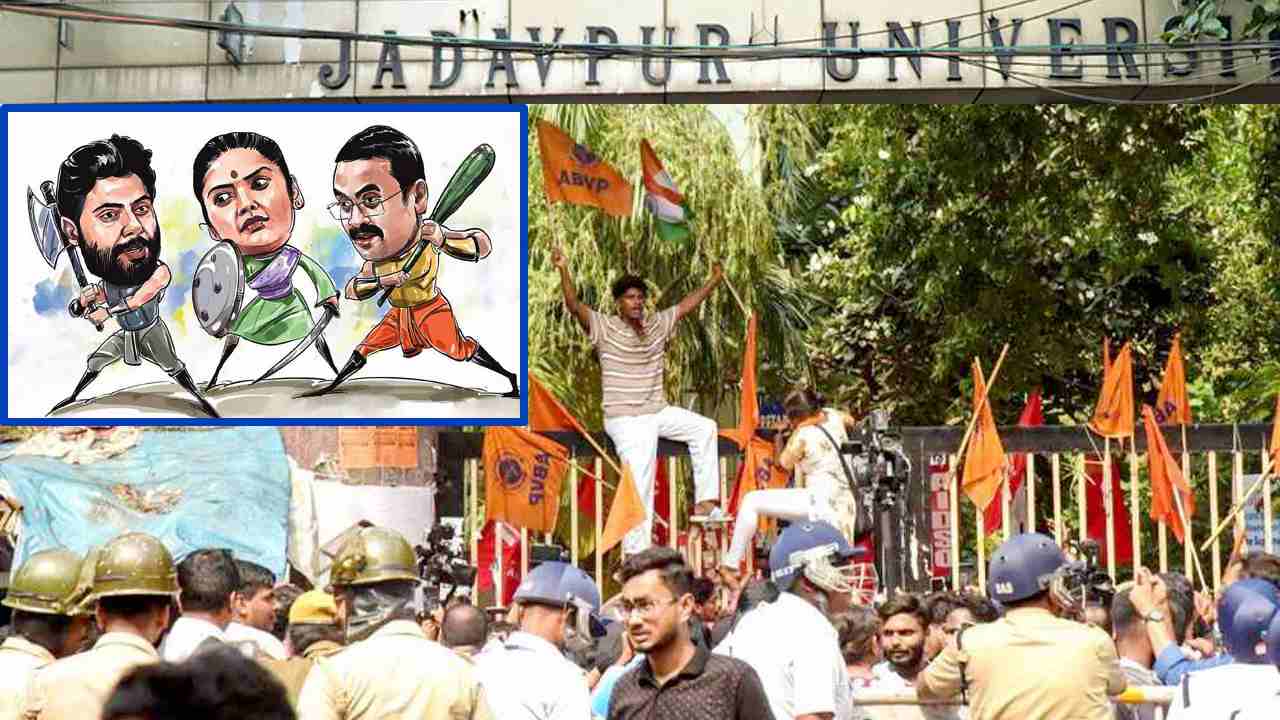
Narendra Modi rang the alarm bell on Instagram about young women protesters abusing him and his mother. It triggered a deluge of threats and abuses, both online and offline, directed against India's vocal Gen Z women. Narendra Modi then used his Independence Day Lal Qila address to call for immediate identification and isolation of Dimagi Naxals. The result was a spate of physical attacks on activists trying to inspect and audit India's schools and a midnight 'tandava' or violent storming of Kolkata's celebrated Jadavpur University by a mob of Sanghi vandals led directly by the newly elected BJP legislator from Jadavpur. Clearly, Modi's dog whistles are not empty rhetoric, they are 'carry out' commands for his followers. It seems the Modi government is determined to reinforce its fading authority by applying greater doses of coercion and violence than before, but then the biggest message of Jantar Mantar has been young India's declaration of freedom from fear.
The midnight Sanghi attack on Jadavpur University reminded us of the attacks on Jamia Milia Islamia and Jawaharlal Nehru University in Delhi during 2019-20. The BJP is yet to make the kind of inroads among the Jadavpur University community - the faculty, students or employees - that it has succeeded in making in JNU, and hence the attack had to be orchestrated primarily from outside. But with the police giving a free hand to the attackers and the local BJP MLA leading it from the front, there could be no mistaking the lethal intent and power of the attacking mob. There was only one collapsible gate that saved the students from the stormtroopers who had already breached the main gate. A couple of days ago a similar crowd had assembled outside the main gate with the purpose of smashing a statue of Lenin, blaming him for the partition of India which happened twenty-three years after Lenin's death.
The Sanghi thugs vandalised and trampled over the Jadavpur University emblem which had been designed by the great artist Nandalal Bose who had also illustrated the copy of the Constitution of India adopted by the Constituent Assembly. The public opinion of West Bengal has however been prompt and unequivocal in its condemnation of the Sanghi attack on Jadavpur University, a premier institution of academic excellence with a great historical legacy since the days of the freedom movement, forcing the BJP to backtrack for the time being. The state president of the party refused to take any responsibility for ABVP, calling it an unrelated organisation, and the very BJP MLA who had threatened a nightlong campaign of destruction ('tandava' was the exact word used) attributed the violence the next day to TMC mischief-makers using BJP flags! Chief Minister Suvendu Adhikari however continues to demonise Jadavpur University as a bastion of anti-national ideas and forces vowing to establish the supremacy of 'nationalism' in the campus within six months!
How does the BJP judge a university's commitment to nationalism? The Modi government has started weaponising Vande Mataram in its little known longer version as the latest test of patriotism. It was none other than Tagore who had set novelist Bankim Chandra Chattopadhyay's original poem Vande Mataram to music and sung it in a Congress session and it was again Tagore who had suggested that only the first two stanzas of the poem were suited to be used as a national song. In fact the original version of the poem had only these two stanzas, the longer version resulting from the adaptation of the poem to the needs of the novel Ananda Math. The Modi government now seeks to weaponise the longer version as India's national song and subject the whole country to this new test of patriotism. After Rahul Gandhi's open questioning of Manusmriti for its blatant misogyny, the BJP may now well weaponise Manusmriti as a 'civilizational test' even as India is just a year away from the observance of the centenary of the public burning of this code of slavery by Babasaheb Ambedkar.
While the Sangh brigade wages war on education, academic freedom and campus democracy, student protests against institutional apathy and injustice continue to intensify. The 'School Thik Karo' (fix the school) slogan has started growing into a nationwide campaign for urgent educational reforms. Massive protests have erupted in Delhi IIT over the mysterious death of second year student Rishikesh Kumar. The number of student suicides in IITs, IIMs and other premier institutes has risen alarmingly in recent years. More than 160 student suicides have been reported across IITs in last two decades, more than 70 in the last five years alone. And beyond the campuses of India lie 8.7 crore young Indians dubbed NEET by the government's own NITI Aayog. NEET here designates young Indians in 15-29 age group who are Not involved in any kind of Education, Employment or Training. 8.7 crore out of a young population of 37 crore means one out of every four young Indians. The government may weaponise Vande Mataram and Manusmriti, the people of India will fight on till there is universal quality education for Gen Alpha and secure and dignified employment for Gen-Z.


