The outcome of the Assembly elections in the five states of Assam, West Bengal, Kerala, Tamil Nadu and Puducherry marks a major advance for the BJP in its expedition towards maximising its centralised political control over all parts of India. The BJP's capture of power in West Bengal in particular brings a tectonic shift to the political landscape of the state where the party remained a marginal player till as recently as 2019. The party's own direct gains in terms of vote share and seats has not been significant in Kerala, Tamil Nadu and Puducherry, but the resounding defeat of the DMK, one of the most vocal ideological opponents of the Modi government, marked a major gain for the BJP in the south of India.
In Assam, the BJP had already consolidated its prospects by a very targeted and skewed delimitation exercise; and the revision of the electoral roll, even though not as 'special' and 'intensive' as in other SIR-scarred states, especially West Bengal, further reinforced it, resulting in a massive majority for the BJP-AGP-BOPF coalition. Coupled with the BJP now having its own Chief Minister in Bihar, its Assam and West Bengal victories will give the Sangh brigade a much greater domination in the entire eastern region. The BJP's 2026 victory in West Bengal is thus certainly its biggest electoral gain since the ascent of the Modi government in 2014.
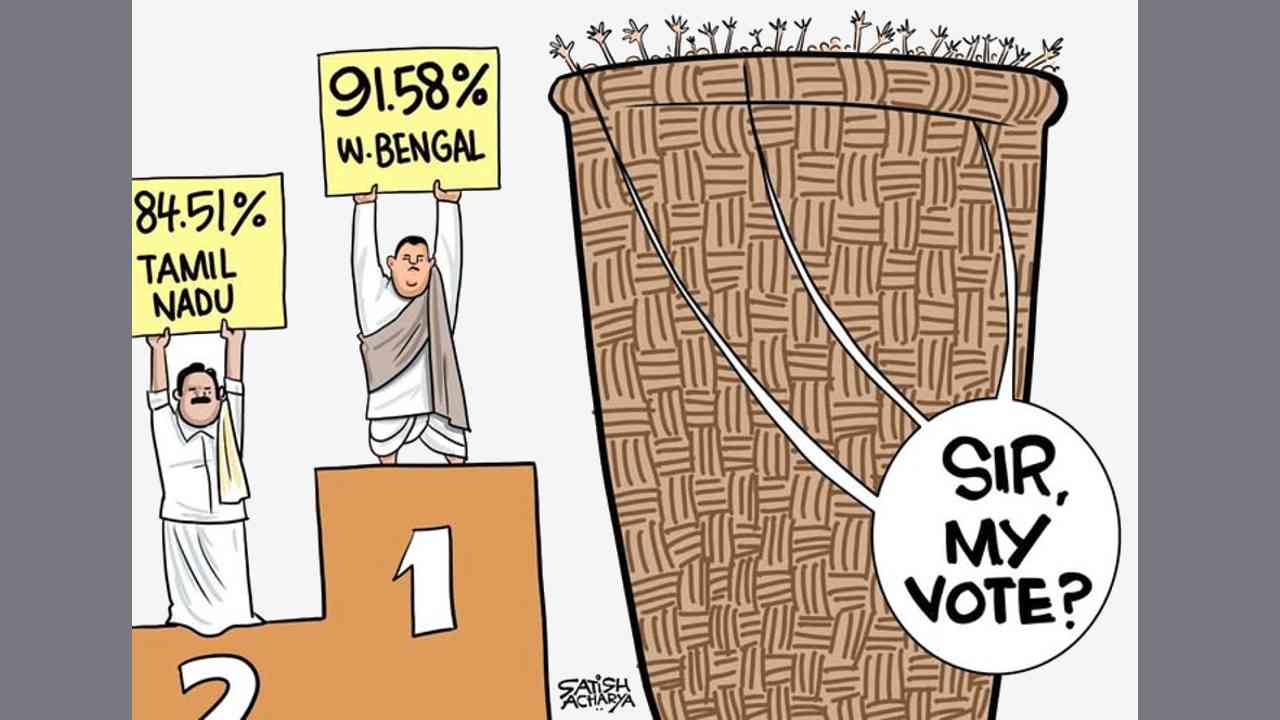
The victories have been achieved not by the standard and familiar electoral rules of the pre-SIR era. In West Bengal, it took a mass disenfranchisement of nine million electors, especially of nearly three and a half million names pending before the tribunals of which only 139 names were cleared before the first phase and 1,468 before the second phase, to produce this result. The first round of deletion of six million names wiped out the BJP's 2021 deficit of six million votes (when it had polled 2,29,05,474 votes as against the TMC's total vote of 2,89,68,281) while the targeted exclusion in the name of 'adjudication' and arbitration by tribunals created the BJP's 2026 lead of a little over three million votes (2,92,24,167 over the TMC total of 2,60,13,379 votes).
This surgical electoral purge executed in the name of the SIR laid the ground on which the BJP has scripted its unprecedented victory in West Bengal. Complementing this statistical surgical strike was the actual conduct of the election process right up to the phase of counting when the Election Commission shed every notion of neutrality and central paramilitary forces were brought in on an unprecedented scale. The complaints of irregularities in the polling and counting process coming to light from various constituencies, most notably from Mamata Banerjee's own constituency Bhabanipur where she was leading till round 14 before BJP leaders allegedly disrupted the proceedings with full support of the central forces and duty officials, are serious and both the BJP and the EC itself must be held to account. The TMC has complained about large-scale electoral fraud and as a mark of protest, Mamata Banerjee has refused to step down.
In terms of the political messages emanating from the overall poll outcome in five states, the results from Kerala and Puducherry may be seen to be in conformity with the established electoral patterns. Kerala has an alternating or rotational pattern where governments usually change every five years. The LDF had defied that trend in the 2021 election held in the wake of the Covid pandemic and a change of guard was perhaps overdue. However, it is significant that the LDF figures have fallen to their lowest level since 1982 in terms of both vote share and number of seats. In Puducherry, the NR Congress has effectively replaced the Congress and has retained power as a stable ally of the BJP in the NDA bloc. The opposition on the other hand was a divided house between the DMK and the emergent TVK blocs.
More than Kerala and Puducherry, the results from Tamil Nadu, Assam and West Bengal surely merit much closer attention. The phenomenal rise of TVK (Tamilaga Vettri Kazhagam or Tamil Victory Party) as a new force rallying around the charismatic film actor Joseph Vijay Chandrasekhar was on display for the last couple of years, but few could have predicted the intensity of the build-up and the result it produced.
The new party has tapped spectacularly into the simmering anger of the people against the entrenched domination of the DMK and the popular yearning for change away from the DMK-AIADMK duopoly of last six decades. With the overwhelming support of the youth and women, the TVK emerged as the largest party with a tally only marginally short of the majority mark. It now remains to be seen how the TVK actually fares in terms of its professed commitment to 'people-centric politics through concrete welfare-driven actions' and what social and political realignment it triggers in Tamil Nadu.
The Assam and West Bengal outcomes have been scripted around a more or less shared narrative of 'saving Hindus from the threat of infiltration of Bangladeshi Muslims'. While the BJP invoked this anti-Muslim hate to overcome anti-incumbency in Assam, in West Bengal, it mixed anti-Muslim hate with the accumulated anti-incumbency of an increasingly discredited fifteen-year-old regime. In Assam the delimitation of constituencies had already been carried out in such a way that significantly diminished the power of the minority vote (both religious and linguistic minorities) by spreading it thin. The electoral roll revision process further dented the opposition prospects. Chief Minister Himanta Biswa Sarma ran a virulent, hate-driven campaign targeting the Bengali-speaking Muslims of Assam and won an unprecedented tally of 102 seats (80 percent strong majority) in a house of 126 in alliance with the AGP and the Bodoland People's Front.
Suvendu Adhikari in West Bengal ran an equally shrill anti-Muslim campaign, portraying Muslims as the internal enemy and a permanent threat to the existence and interests of the majority Hindu community. Because of the BJP's open disowning of the Muslim community (the party almost as a rule does not field Muslim candidates or nominate Muslim ministers wherever it is in power), Muslim representation is now concentrated in the opposition camp. For instance, 18 among the 19 Congress MLAs in Assam now belong to the Muslim community. In West Bengal, 32 of the 38 newly elected Muslim MLAs belong to the TMC, which is 40 percent of the party's reduced strength in the Assembly. Suvendu Adhikari now bluntly celebrates the BJP's victory as a victory of Hindus, pledges to work only for Hindus, and asks Hindus supporting opposition parties to switch to the BJP for further Hindu consolidation and Hindu-Muslim polarisation.
This level of open communal mobilisation is unprecedented in West Bengal. Targeted disenfranchisement of Muslim voters, systematic marginalisation of elected representatives from the Muslim community and open call for ethnic cleansing and communal consolidation - this is the new plane of communal politics in this era of SIR and systematic theft of adult suffrage and other citizenship rights from India's minorities and marginalised groups. From periodic riots and attacks on places of worship to mob lynching and now mass disenfranchisement, communal fascism is busy developing a template of permanent electoral domination though a sinister subversion of India's electoral system.
Against the backdrop of the powerful anti-corporate farmers' movement, the welcome 2023 victory of the Congress in Karnataka had served as an impetus for an energised unity of the opposition. The unity took shape under the all India banner and framework of INDIA. The environment and understanding generated by the INDIA initiative successfully reduced the BJP's 2024 Lok Sabha tally to 240. With its string of victories from Haryana and Maharashtra to Bihar and now West Bengal, the BJP has tried its best to disintegrate the emerging unity of the opposition. The opposition needs to regroup again to foil this bid before the next round of elections in UP, Uttarakhand and Punjab. Also we need to focus urgently on the bread and butter issues of the common people, and take up the challenge of their survival amidst growing economic crisis and political disempowerment, and to simultaneously confront Hindutva’s brand of fascism and its supremacist ideology head-on and uncompromisingly. This is the only way to defeat the game plan of the BJP and its attempt to obliterate the opposition in India's electoral system.
Intriguingly enough, Amit Shah not only deployed an unprecedented 2.4 lakh CAPF personnel for the two-phase West Bengal elections, 70,000 of them were asked to stay on in West Bengal for a period of two months after the elections. Even as votes were being counted on May 4, reports of attacks on TMC and other non-BJP counting agents started coming in from many counting centres. Reports of attacks on party activists and offices and on Muslim shops and localities, including bulldozer demolitions accompanied by mob violence, while the central forces stood by are also being heard from many places. Progressive forces must step in to stop this terror and insist on peace, communal harmony and the protection of minorities from persecution, without allowing any leeway to the vandal brigades of the saffron camp. Freedom fighters, cultural activists and communist-led struggles of workers, peasants, students and women had played an extraordinary role during the traumatic period of Partition of Bengal. Today when the BJP is desperate to reopen the wound of Partition and fling the state back into communal fascist violence, the communist movement must once again rise to the occasion with the banner of communal solidarity and political liberty, to keep, in Tagore’s words, the mind without fear and the head held high.