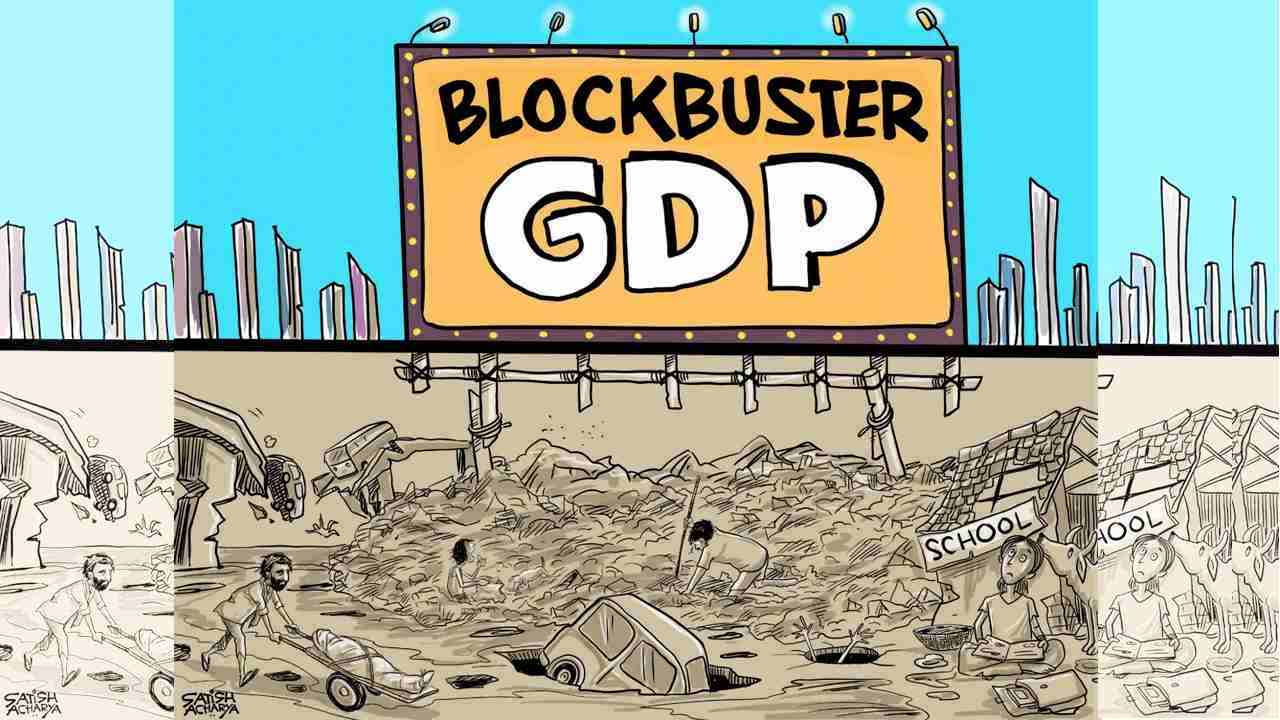
September in India began with two big boasts, both quite stunning. The Modi government's claim of 7.8% GDP growth in the first quarter of the current fiscal year (April-June 2026) exceeded even the RBI's own prediction of 7%. No wonder Narendra Modi was quick to project it as a great achievement in the face of the global trade disruption and energy crisis caused by the US-Israel war on Iran. Even as economists were debating the veracity and implications of this claim, a podcast went viral on social media wherein a 21-year-old Hindutva 'influencer' from Patna, one Swatantra Bharadwaj, claimed to have got away without any punishment after breaking the skull of a man in Jantar Mantar, all thanks to a phone call from Delhi BJP Minister Kapil Mishra and his own close links with other NDA bigwigs from Chirag Paswan to Narendra Modi.
Both claims naturally merit close attention. The GDP claim is however harmless, since by now we have got so used to empty claims and false promises that India is no longer shocked by such boasts. It is the Bharadwaj boast and its unfolding aftermath that should alarm everyone about the growing police-criminal-terrorist nexus in the Modi-Shah era. In one of his interviews before being arrested, Bharadwaj thanks Modi for giving the order to 'identify and isolate Dimagi Naxals' and warns us that in the coming days we will be flooded with videos showing Dimagi Naxals being treated in a variety of ways - from being whipped by belts to being shot by kattas or country-made guns. And the next day, which happened to be "teachers' day", we heard Narendra Modi return to the Dimagi Naxal label in his Shri Ram College of Commerce Centenary address. Modi called it a homeopathic dose to identify 'Dimagi Naxals', keeping conspicuously silent about the non-homeopathic violent brigade empowered by his government.
The dominant economic discourse in India has always been obsessed with GDP, never really paying attention to per capita GDP which is a much more meaningful indicator for a country mired in not just economic backwardness but also massive social and economic inequality. When we talk about GDP, India ranks sixth in nominal terms (behind the US, China, Germany, Japan and UK) and third in purchasing power parity terms (behind the US and China), but if we shift our attention to per capita GDP, India ranks 144-149 out of 200 countries in nominal terms and 121-125 in terms of purchasing power parity comparison. The 7.8% growth figure refers to a quarterly quick estimate which in all likelihood will come down when we look at the final annual estimate. But what has made the 7.8% claim particularly dubious are the two props supporting it - the assumed impact of inflation and the GDP of the last comparable quarter (April-June 2025).
Former Finance and Economic Affairs Secretary, Subhash Chandra Garg, has rightly pointed out that the 2025 first quarter GDP has been revised drastically downward to ₹80 trillion from the initial estimate of ₹86 trillion. Without this drastic downward revision of the 2025 first quarter figures, the rate of growth of nominal GDP would have been only around 2.6% and almost nil in real terms. It is therefore this drastic downward revision of 2025 figures that needs to be explained first before we can trust the current growth figure of 7.8%. Likewise, the deflator used to derive real GDP estimates is also much lower than the actual inflationary impact on prices and incomes. From SC Garg to Raghuram Rajan, Kaushik Basu to Arvind Subramanian, eminent economists who are questioning the data and the lack of transparency in the entire exercise, are all people with high level experience of running India's economic administration in recent years, and only a government that does not care for credibility or accountability can arrogantly dismiss such questions.
To return to the boast of Swatantra Bharadwaj, it would be foolish to ignore it as an isolated example of a young man's loudmouth self-promotion fantasy. His close connections with the Delhi Police, with the BJP/NDA top brass, and his 'guest presence' in events like the PM's swearing in or Independence Day address are all documented as are his detailed accounts of violent assaults on Jantar Mantar protesters. By all accounts he was part and parcel of a violent Hindutva brigade busy meting out various doses of 'punishment' to people identified as internal enemies by the Modi government and the Sangh brigade, ‘Dimagi Naxals’ constituting the most recently identified targets. The mention of a civil defence force for the purpose of internal security by PM Modi in his latest Independence Day address from the ramparts of Lal Qila, widespread reports of men in plain clothes beating up protesters coming in from Delhi and several other cities, and shocking revelations of alleged participation of prisoners in Jantar Mantar violence raise serious concerns that Swatantra Bharadwaj and his ilk comprise a veritable private army akin to the Brown Shirts of Mussolini's Italy or Black Shirts of Hitler's Germany or the Sangh brigade's very own Bajrang Dal.
A desperate regime asking the people to celebrate spectacular economic growth in the face of soaring prices, declining income and vanishing jobs, and squads of private armies attacking and threatening people protesting against the government on India's streets mark two sides of the same coin. The more the government fails and loses support on the ground, the more the failed regime will resort to lies and violence, both state and private or in the PPP mode. The RSS supremo delivering liberal-sounding speeches for the international audience will no longer be able to camouflage this fascist aggression. We the people of India must stay firm and united in the course of democratic protests to foil this fascist design.