Cockroaches and parasites. These were the words used by Chief Justice of India Surya Kant while referring to unemployed youth and lambasting those who become “media”, “social media”, “RTI activists” and “activists” and who dare to “attack the system”. The invocation of insects and parasites for human beings is the language of dehumanisation, historically seen in fascist hate speeches since the days of Hitler, where people who question power are first stripped of dignity before being marked as enemies of the system. After massive outrage on social media against these unconstitutional and derogatory comments, the CJI claimed that the media had misquoted him and that his reference was only to people with fake and bogus degrees.
These derogatory observations by the CJI against the youth and the Gen Z generation are not isolated incidents, but part of a wider pattern of institutional contempt against people who dare to raise questions, organise struggles, defend rights or imagine a better and more democratic society. Recently, on May 11, in a case concerning environmental concerns, the CJI slammed “environmental activists” saying that such litigations are filed only to stall development projects when the country is progressing well. Earlier, on January 29, 2026, in Penn Thozhilalargal Sangam v. Union of India, the CJI said that “jhanda unions” are “largely responsible for stopping the industrial growth in the country.”
What we are witnessing here is not merely a remark from the bench, but the convergence of judicial arrogance with the wider political culture of contempt to the democracy cultivated in Modi’s India. While the CJI uses the language of cockroaches and parasites, the Prime Minister calls protesters “andolanjeevi” and asks youth crushed by skyrocketing unemployment to sell pakoras in the streets in the name of self-employment, even as everyday street vendors face bulldozer demolitions of their livelihoods.
Amid the derogatory and privileged rhetoric of those in power or occupying positions of authority, we also witness criminal silence and complete lack of accountability when the lives and hard work of millions of youth are thrown into chaos. The recent NEET UG paper leak has not only pushed tens of thousands of youth into despair, but has once again exposed how institutions under the Modi regime have repeatedly damaged the future of the youth. Again, this is not an isolated incident. A staggering 89 incidents of paper leaks have been reported in the past 10 years. From JEE Mains 2021, NEET UG 2024, UGC NET 2024 and several other examinations, Modi’s dubious private agency NTA has proven its incompetence and utter disregard for students’ education and hard work. Year after year, the saga of paper leaks continues across competitive examinations, but no serious action has been taken by the government. Instead, the corrupt and incompetent NTA is shielded and provided political immunity.
At least four students have died by suicide since this paper leak, including a 22-year-old from Jhunjhunu who expected high marks. These young lives lost to systemic corruption now add to the already horrifying suicide crisis among students, with a record high of 14,488 student suicides in 2024, marking a 4.3 percent rise from 13,892 cases in 2023. As investigations dig deeper and Rajasthan emerges as an epicentre, the names of big coaching centres and a BJP leader, Dinesh Biwal point towards a deeper nexus between the private coaching mafia and people close to the BJP.
In the face of this assault on their future, the students and youth of the country have rightly demanded that Union Education Minister Dharmendra Pradhan must take direct accountability for this failure and resign. They have also reiterated that NTA must be disbanded and the long-standing demand to end the centralised NEET examination system, which has repeatedly undermined federalism and equal access to medical education. Furthermore, they have demanded that the role of the private coaching mafia be exposed and those responsible be held accountable not only for the series of paper leaks, but also for their role in the systematic destruction of public education.
The same regime that refuses accountability for destroying the future of students does not hesitate to jail youth and activists who question the system. We already have the cases of Umar Khalid and Sharjeel Imam, incarcerated under the stringent and draconian UAPA for more than five years merely for questioning a system of religious bigotry and majoritarian politics. Recently, when young workers in Manesar, Noida and other places rose up demanding labour rights and minimum wages, resisting the modern slavery and exploitative conditions that the Modi regime has been selling as “ease of doing business”, hundreds were arrested, put behind bars and branded as conspirators. In fact, the exact number of workers arrested is still not clear, and many have faced humiliation and custodial torture. Several have been charged under another draconian law, the National Security Act, including 25-year-old Aakriti Chaudhary, a history graduate from Delhi University who hails from Durgapur in West Bengal, for standing with the workers’ struggle.
While the CJI minces no words in slamming youth and activists again and again, we see complete silence when it comes to the repression unleashed by the state against those merely asking for a better future for all. In fact, on May 17, the Supreme Court bench comprising Justices B V Nagarathna and Ujjal Bhuyan rightly questioned the denial of bail to Umar Khalid and Sharjeel Imam, where a two-member division bench of the Supreme Court had earlier rejected bail and failed to properly follow the larger bench ruling in the 2021 K A Najeeb case, which recognised prolonged incarceration as grounds for bail. The BJP government has been using these draconian laws as a political weapon to keep dissenting voices, youth and even workers asking for their labour rights incarcerated for years.
What we clearly see is the seepage of fascist narratives and rhetoric across institutions, along with complete contempt for the voices of the youth. It seems that for the regime and those occupying positions in institutions that are supposed to be independent, any youth who is not part of the gangs of street hooligans spreading communal-fascist poison, or assaulting the poor in the name of region, food, dress or religion, is not their youth. The system being created is one that despises those who dare to question and defend democracy.
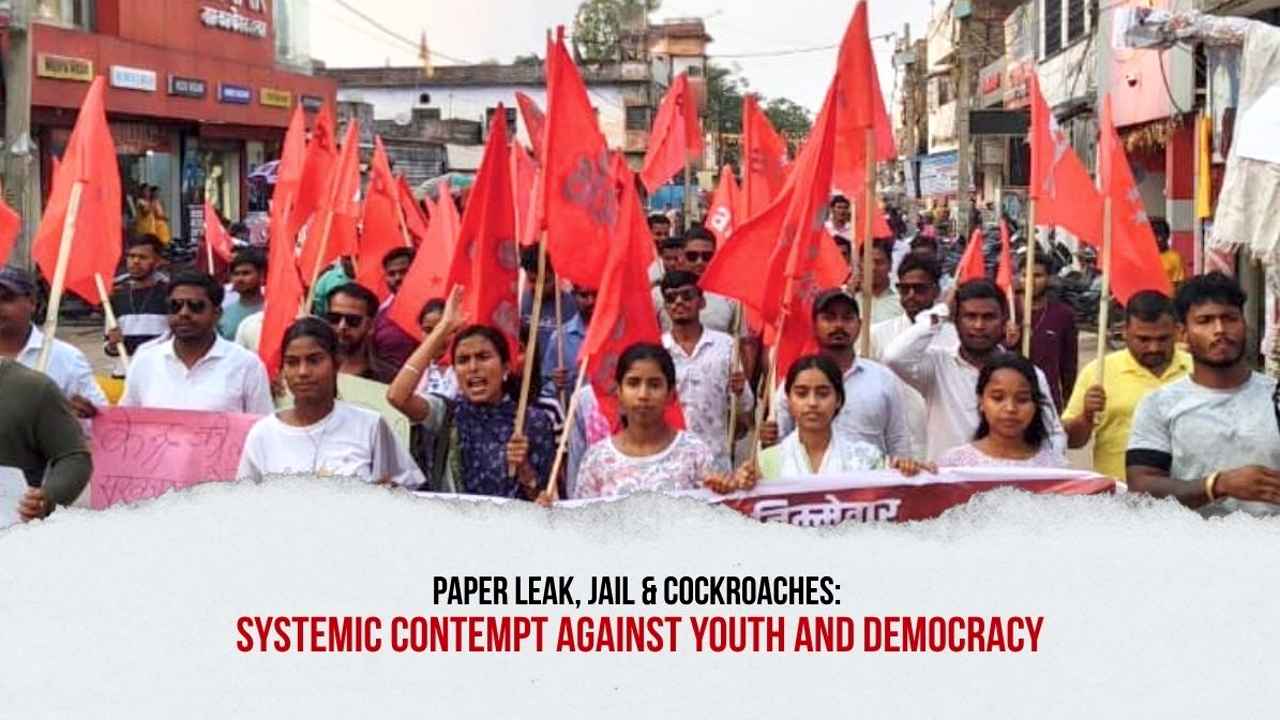
At the same time, it is reassuring to see the youth vociferously resisting, whether against the NEET paper leak, workers’ rights violations or the dehumanising rhetoric of the CJI, both in the streets and on social media, refusing to bow to this contempt against democracy.