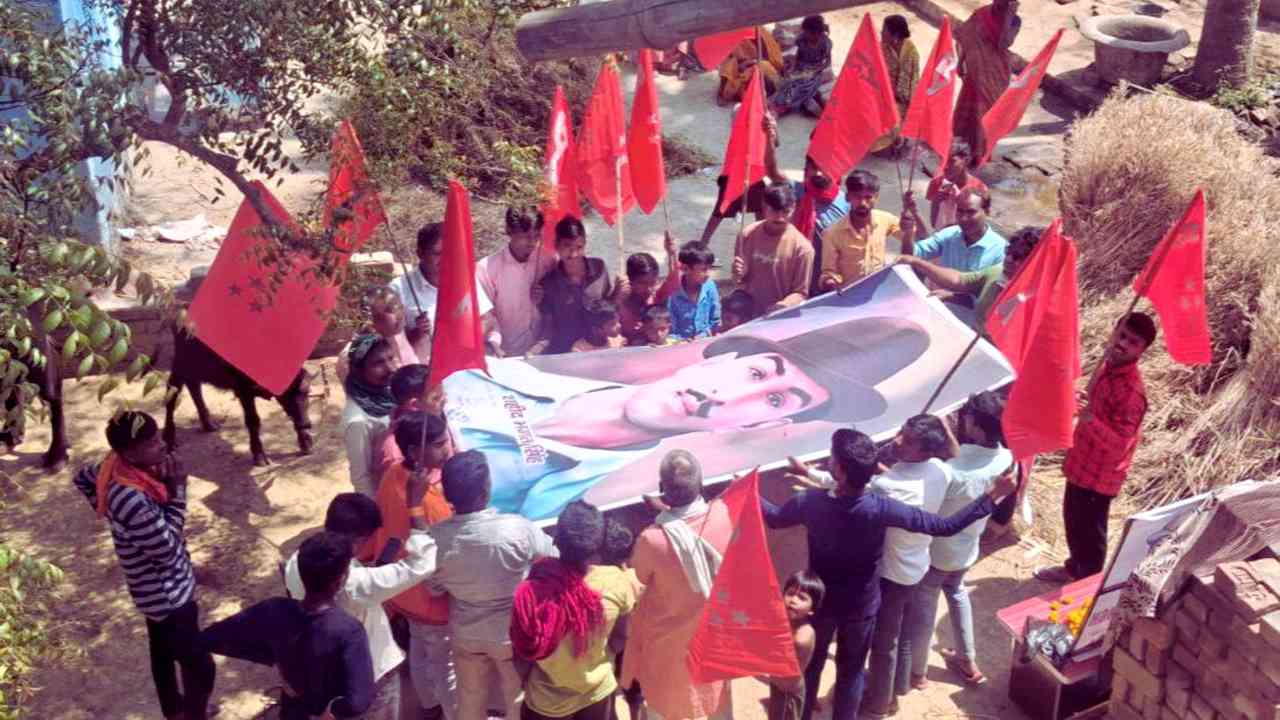
It is now ninety-five years since the martyrdom of Bhagat Singh, Sukhdev and Rajguru that had galvanised India in the struggle for complete independence from British colonial rule. A lot of water has since flowed down the river Ravi. Lahore, the city where Bhagat Singh bid goodbye to his beloved motherland, has been part of Pakistan since 1947. But the message of Bhagat Singh continues to resonate ever more eloquently, whether in today's India or Pakistan. The chant of 'Inquilab Zindabad' (long live revolution) and 'Samrajyavad ka Naash ho' (down with imperialism) speaks to our current situation with ever greater relevance and urgency.
Bhagat Singh was a pioneering revolutionary of his times. As a young boy of twelve, he saw the most brutal face of British colonial rule in Jallianwalabagh. The year he was born, his uncle Ajit Singh led a peasant upsurge in Punjab with the clarion call 'Pagri Sambhal Jatta' (take care of your turban, oh farmer). Much like the farmers' movement against the Modi government's pro-corporate farm laws in 2019-20, the pagri sambhal jatta movement, which marked the 50th anniversary of the great 1857 war of independence, succeeded in forcing the British rulers to repeal three colonial farm laws. And in Kartar Singh Sarabha, the young Ghadar Party revolutionary who was hanged at the age of 19 in Lahore jail after a failed attempt at organising an anti-colonial revolt during the First World War, Bhagat Singh found his role model.
The impulses of the freedom movement came from across India, from the fields and factories, villages and towns, gathering strength from every quest for dignity and liberty in the face of all kinds of oppression, exploitation and bondage. Bhagat Singh and his comrades were also driven by the tremendous inspiration and hope generated by the victorious Russian revolution under the leadership of Comrade Lenin. Their patriotism was not just about freeing India from the clutches of British colonial rule, it was about establishing socialism in India and gaining real power and freedom for India's toiling millions. They knew India could not become really free in a world dominated by imperialism, hence their politics pulsated with the spirit of socialist imagination and anti-imperialism.
Bhagat Singh's message for India's youth in the 1920s has a special resonance for us in today's juncture. Political power in India today has been completely taken over by the 'bhure angrez' against whom Bhagat Singh warned us, corporate profiteers and their political partners who are busy grabbing the resources of the country and mortgaging the interests of the people to the US-Israel imperialist axis of aggression and war. This has pushed the country into a state of deep uncertainty and crisis. Nearly ten million expatriate Indian workers are trapped in various corners of war-torn West Asia, while the whole country is reeling under the disastrous impact of fuel shortage, trade disruption and soaring prices. The trade deal with the US threatens to deliver a debilitating blow to India's agriculture by exposing India's crisis-ridden small and marginal farmers to an utterly unequal competition with the heavily subdised and mechanised farm lobby of the United States.
It is time to reinvoke Bhagat Singh’s spirit of anti-imperialist patriotism and resist the sellout of India's national interests and strategic autonomy by India's fascist rulers in the name of turning India into a Hindu Rashtra. By subordinating Indian foreign policy to the interests of the US-Israel axis, India has invited only increased isolation in the international arena. Already alienated from neighbouring countries in South Asia, India now also stands isolated from Iran, one of its traditional friends in the Islamic world.
Notwithstanding the bankruptcy and betrayal of the Modi government, the present juncture signals the possibility of triggering the eventual decline of the hegemonic power of US imperialism. If Trump had thought that a regime change in Iran would prove to be as swift an operation as in Venezuela or Iraq, Iran has proven him completely wrong. The idea that a war on Iran would reinforce the unity of the western alliance around the US-Israel axis as during the Iraq war has also been exposed to be misplaced. The NATO allies have not only refused to get dragged into the Iran war, they have even started vacating their military bases in Iraq. When cracks begin to appear in the imperialist camp and anger mounts globally against the US-Israel axis, and the policies of a fascist government land India in acute economic distress and increasing international isolation, it is time for the heirs of Bhagat Singh to rise to the occasion.