1. English
  2. |
  3. हिन्दी
  4. |
  5. বাংলা
  6. |
  7. தமிழ்
  8. |
  9. ಕನ್ನಡ
  1. CONTRIBUTE
CONTRIBUTE
  • Home
  • Books
  • Authors
  • Publishers
  • ENGLISH
  • हिन्दी
  • বাংলা
CONTRIBUTE
×
×
×
×
×
×
×
×
×

India And The IMF Loan :: Sold For A Few Dollars More!

Second Edition; June, 1992
Published by
Dipankar Bhattacharya
General Secretary
Indian People's Front

THE NEMESIS :

(1) Bull, Boom, Bust!
(2) Operation SAP I: Free Market Farces
(3) Operation SAP II: Grave New World
(4) Dollar-Rupaiya, Bhaiya-Bhaiya?

THE GENESIS :

(1) Calendar of Capitulation
(2) “IMF Lao, Desh Bech Aao”
(3) Flashback 1981
(4) Liberalisation : The 21st Century Fix
(5) Sabse Chhota Rupaiya!
(6) India Pepsified
(7) Budget 1991: Quack, Quack!
(8) The Way Out
(9) A Crow in Peacock Feathers?
(10) No Passaran!

A great leap forward, a long-awaited liberation and indeed a revolution! Last year when the Narsimha Rao government launched its propaganda blitzkrieg to present its sellout to the IMF as a veritable national nirvana, our booklet was a stubborn attempt at calling their bluff.

On the first anniversary of the Structural Adjustment Programme as the goons of globalisation continue vandalising decades of hard-won Indian sovereignty, we are back with the second edition of the booklet.

We have added four new chapters besides updating figures and facts. Also included is a pullout of a snakes-and-laddersgame which symbolises the struggle of the common Indian 'consumer' to survive the onslaught of the 'snakes' lurking at every step.

Our first attempt at questioning, criticising and even lampooning the new economic policies had received an inspiringly enthusiastic response. We would like to thank all those who helped make this booklet possible and its sale successful.

(1). Bull, Boom, Bust!
(2). Operation SAP I: Free Market Farces
(3). Operation SAP II: Grave New World
(4). Dollar-Rupaiya, Bhaiya-Bhaiya?

APRIL 2, 1992. On the morrow of All Fools' Day, the 'Ayodhya' of Indian capital, the Bombay Stock Exchange, revealed the first ugly chinks in its armour. The BSE's high-profile broker, 'Big Bull' Harshad Mehta, was raided by tax officials. After two months of incessant boom, the share market went on a tailspin. By April 28 the chinks had grown into a gaping chasm full of scandals unprecedented in Indian financial history.

What had been proclaimed to be the beginning of the Indian economic miracle proved to be the end of the first hot-air balloon floated by the Narsimha Rao regime.

And what a spectacular balloon it was! The pre-budget Economic Survey of the government had painted a grim scenario – fall in exports, decline in industrial output, stagnation on foodgrains front, drop in economic growth, double-digit inflation. ... But came the budget and defying all economic sense the Bombay stock market went mad. Just two hours of frenetic trading immediately after the presentation of budget saw a sharp 200-point rise in the Sensitive Index of the country's premier Stock Exchange in Bombay. What more proof could you demand to confirm the popular enthusiasm unleashed by Manmohan Singh's revolutionary budget! The claims grew louder and louder as the BSE Sensex, which had begun the year at around 2,000 reached a record 4,467.32 points by April 22.

The mesmerised media had little ears for the critics who pointed out that the boom in the stock-market did not reflect any spurt in real economic activity or fresh industrial investment. The trade had been largely in old scrips and that too with little consideration for the profitability of the companies concerned. Even equities of loss-making sick units rose enormously. But now we know that what lay behind the soaring share prices was not just reckless speculation but intricate manipulation by an unholy bank-broker-big business nexus.

Even as the full dimension of the stockmarket scam waits to be fathomed out, it is clear that Mehta's speculative forays were financed by thousands of crores of rupees of public funds. Apart from the State Bank of India, United Commercial Bank and National Housing Bank – a fully owned RBI subsidiary – the needle of suspicion also points to 17 other public and private sector banks and three foreign banks. What had all these months been touted as the indisputable evidence of public support to the new economic policies has thus turned out to be only so much of orchestrated hype.

CORNERED BY the scandalous revelations from Bombay, the government is now trying to put up a brave front. We are being told that it was a case of “systems failure and irregularities” with “evidence of collusion on the part of some bank officials” and that, in fact, “No official, big or small, is going to be spared”. The question, however, is not just of punishing Harshad Mehta or a few officials, howsoever big. For the BSE scam is no aberration. It epitomises the essential falsity and fraudulence of the new economic policy itself which through clever propaganda has glamourised our abject external dependence as the ultimate status symbol. The illusory euphoria of the stockmarket and the hard economic reality of all-pervasive stagnation are but two sides of the same coin. Now a look at the other face of the reforms.

Economic Growth: The GDP growth rate has come down to 2.5% as against the average growth rate of 5.6% in the previous 11 years. For the first time in last ten years, industrial output registered an absolute decline of 0.9% between April and December 1991. The decline was sharpest in the manufacturing sector – over 2.6% – while that in mining was 0.6%. Production of foodgrains also fell from 176.2 million tonnes last year to 172 million tonnes, a shortfall of 10 million tonnes from the year's targeted output. The government would have us believe that the whole thing is a temporary problem, caused by a difficult foreign exchange position and consequent restrictions on imports. But in reality, the steady scaling down of public investment and the entire planning process has taken a heavy toll of the infrastructural sector, particularly in core areas like power, transport, shipping and telecommunication, cutting at the very roots of our economic base. The fall in agricultural output has also taken place in a year of normal monsoon which can only signify the setting in of a long-term stagnation.

Prices: The promise was to roll back prices of essential commodities within 100 days of Congress(I)'s return to power. Prices have instead kept soaring higher and higher. The official rate of inflation hovers around 13%, while for the common consumer at the retail market prices are going up at anything above 20%. And no group of commodities is exempt from this inflationary onslaught. With the government trying to reduce deficit by enforcing an across-the-board rise in excise duties, jacking up issue prices of foodgrains and administered prices of all infrastructural goods and services and slashing subsidies and imports being rendered costlier through devaluation and partial convertibility of the rupee, there seems no escape from the clutches of runaway inflation.

Job Opportunities: According to a Planning Commission estimate, 3.5 million job opportunities were lost in the first year of the programme. As a result, the backlog of open unemployment (the shortfall in generation of new employment opportunities) has increased to 17 million jobs this year from about 13 million last year. In addition, the threat of joblessness looms large over nearly a million workers in sick units. According to independent estimates the structural adjustment programme will result in the unemployment of four to eight million people in 1992-93 and four to ten million more in 1993-94. Experts also warn that the increase in unemployment will be particularly felt in the informal sectors while in the organised industrial sector, there will be increasing casualisation of labour.

Poverty: A study by the pro-reform Indian Council for Research in International Economic Relations has revealed that in the first year of structural adjustment, another 22.5 million additional persons were pushed down the poverty line. With rise in foodgrain prices and reduction in food subsidy, the public distribution system (PDS) has been pushed to the brink of breakdown. The revamped PDS campaign launched in January this year covering some 1,700 remote rural blocks will remain a hoax unless prices are brought down and supplies increased. The phenomenon of starvation deaths is no longer confined to drought-hit Kalahandi. Hunger-related deaths are now as common among weavers in Andhra Pradesh and sick industry workers in West Bengal as among toiling tribal masses in Orissa and Madhya Pradesh, Tripura and Maharashtra.

Exports: Between April 1991 and February 1992, exports in dollar terms fell by 2%. The disintegration of the Soviet Union and the traumatic transition of Eastern Europe from the Soviet camp to market-friendly global capitalism have caused big jolts to Indian foreign trade. The prospect of enhancing exports to the recession-ridden industrial economies of the western world too remains quite bleak. And if the Dunkel proposals and penal duties imposed on Indian drug exports to the US under the Special 301 provision are any indication, Indian exporters will continue to face an extremely rough weather in the global market, and all this despite devaluation and faithful adherence to the Fund-Bank prescriptions.

FOREX Reserves: The foreign exchange position of the country is of course no longer as precarious as it had been a year ago. From a bare 975 million dollars in July 1991, the reserves reached a rather comfortable 5,631 million dollars by March 1992. But this recovery is however not due to any upswing in export performance or any narrowing down of the trade gap, which stands at a staggering 2.3 billion dollars. Apart from last year's import curb measures, the improvement can only be explained in terms of high-cost, high-conditionality fresh borrowings contracted from IMF and other sources. The debt-burden has consequently shot up to a phenomenal 74.75 billion dollars, i.e., Rs. 2,25,000 crore, while our annual debt-servicing obligation has exceeded the alarming Rs. 10,000 crore mark.

Report Card of Reforms

T - 1

HAVING ALREADY carried out or at least firmly initiated the core of the structural adjustment programme, namely, devaluation and partial convertibility of the rupee, removal of almost all checks on imports, freedom for private domestic and foreign capital to enter and expand in every sphere of the national economy, reduction ('rationalisation') of taxes for the wealthier sections and legitimatization of all their speculative and black income, and lowering fiscal deficit by slashing the quantum of subsidies and public investment and the degree of state's intervention in the economy – the government and its Fund-Bank consultants are now shifting their focus to the following issues which are likely to prove much more contentious than the above reforms.

Exit Policy: Ostensibly, the idea is to facilitate free closing down of all 'non-viable' industries and enhance the mobility of capital. But as in the case of all black laws which are enacted with a selective scope and then gradually generalised, the exit policy is also bound to be used in a sweeping way against workers in all branches of production. For, as a World Bank paper on “Regulation of Labour and Labour Relations” puts it, the essential argument is that the stagnation in employment growth in India is because of 'excessive labour protection' and that to overcome it, the 'highly privileged' organised labour should be subjected to 'competition' from the millions of unorganised workers.

In all likelihood, the government will try to realise the exit policy through a series of amendments to various existing labour-related laws. Among the salient recommendations made by an Inter-ministerial Working Group on Industrial Restructuring are:

(a) abolition of Sections 522 to 527 of the Companies Act to rationalise the liquidation and winding up proceedings of a company,

(b) setting up of registered auction and debt realisation centres around the country to speed up the process of liquidation of sick units,

(c) empowering the Board for Industrial and Financial Reconstruction (Board for Industrial Funeral Rites!) to issue final orders for liquidation of companies without reference to any higher court, and

(d) investing employers with much greater authority to retrench or lay workers off.

Already, the Sick Industrial Companies Act has been amended to extend the purview of the BIFR to sick public sector units as well. As many as 58 sick PSUs have already been referred to the BIFR and 47 of them are reportedly marked for closure. A National Renewal fund has also been launched with World Bank assistance, ostensibly to provide a measure of economic security and redeployment facilities to the affected workforce.

Privatisation: In India, this phenomenon is unlikely to proceed in the straightforward manner it has happened in Britain or nearer home in Pakistan. What we are witnessing here is a kind of gradual and backdoor privatisation: selling of public sector shares to private hands, converting public sector units into joint sector by allowing massive private and foreign equity participation – to the extent of 49% and even 51% in some cases, farming out or sub-contracting public sector production and services increasingly to private hands and so on. Also by encouraging private sector entry into areas reserved earlier for the state sector the relative importance of the latter has been subjected to a steady erosion.

To reform the banking and insurance sector, the government has already come up with the Narsimham Committee report. Instead of direct denationalisation of public sector banks, the government seems to be opting for an indirect way. The gameplan is that private and foreign banks will be allowed to freely expand their operations and the proportion of priority sector lending by public sector banks will be progressively brought down to as low as 10%. The subversion of the priorities and objectives of public sector banks will thus be complete even without formal denationalisation.

Curbs on TU Rights: Efforts are on to curb trade union rights by amending acts like the Industrial Disputes Act and Trade Unions Act and emasculate and sanitise the trade union movement by limiting the number of trade unions in every industry and raising the requisite membership strength for awarding registration to new trade unions and derecognising the struggling unions wherever possible. In his Republic Day speech this year the President called fora two-year 'voluntary' embargo on strikes and lock-outs.

Incidentally, even without any explicit general ban on strikes and other militant forms of trade union struggle, the government and big capitalists have been quite effective in enforcing industrial 'peace' on the workers. A recent study of industrial conflicts in the country shows that in 1990, the incidence of industrial disputes, workers involved and mandays lost were only 40%, 50% and 61% respectively of the 1970 level. More strikingly in the 80s the number of mandays lost due to lockouts has overtaken that due to strikes, indicating the employers' aggressive bid to cow down workers with threats of closure.

De-subsidisation and marketisation : The World Bank has long been pressing for a drastic reduction in subsidies so that prices of all goods and services, essential and luxury alike, are determined 'freely' at the market through an unregulated interaction of the forces of demand and supply. The 1992-93 Central Budget and various State Budgets have already gone a long way towards accommodating this cardinal Fund-Bank principle. Railway and bus fares, electricity rates, milk prices, educational fees, all have been revised upward. The University Grants (Graves?) Commission has asked the universities and colleges to generate their own resources for even paying dearness allowances to teachers and funding basic facilities for the educational community. Proposals ordering fresh hikes in petrol and diesel prices and scrapping food subsidy for the urban middle class are reportedly awaiting the government's green signal. And the list is endless. ...

Budget 1992 : The SAP Strap

IF last year's budget had announced the launching of the notorious Structural Adjustment Programme (SAP) under the Fund-Bank tutelage, Budget '92 only tightened the SAP strap around the nation's neck. The rupee was devalued once again, this time through the backdoor, as the budget declared 60% of all foreign currency inflow convertible in the open market. The inflationary toll has already begun with the prices of all imported inputs skyrocketing. Also stoking the inflationary fire were steep hikes in excise duties of almost all essential commodities.

Keeping in tune with IMF diktat to reduce the overall fiscal deficit, Budget '92 has complied fully with the brunt of both expenditure cuts and revenue mobilisation borne entirely by the poorer sections. So while concessions are heaped upon the rich with cuts in wealth tax, expenditure tax and even income tax in the higher brackets, the common man is left to contend with a slash in food subsidies as well as health, education and rural welfare spending (see table).

The budget also revealed its skewed priorities by announcing wideranging reduction in custom duties and all sorts of red carpet schemes to coax smugglers, hawala traders, and tax evaders of all shades to part 'legally' with money made illegally. The gold bond scheme introduced for converting black money into gold with no questions asked is an incentive only to tax evaders who are delighted to have a government that whitewashes their crimes instead of punishing them.

T2

* = comparison between Budget estimates of 1991-92 on the basis of 12% inflation rate

NOW LFT us note some of the major political implications and lessons of the new economic regime. Firstly, the changes in economic policy are supplemented by a matching shift in foreign policy. Rarely in the four decades of Indian Independence has our foreign policy been marked by such a blatant pro-Americanism stretching from India's blanket support to US positions and actions on every international controversy to joint naval exercises on Indian Ocean. The traditional rhetoric of “non-alignment” and “South-South cooperation” is being increasingly replaced by the phraseology of “global integration” and “North-South interdependence”. And as far as the ruling classes are concerned, this transition from “Nehruvian socialism” to market-friendly capitalism has been nothing more than shedding a long worn-out mask.

Admirers of Nehru in the Left may still feel haunted by the nostalgic memories of his alleged 'socialist, anti-monopoly economic orientation' and 'anti-imperialist' non-aligned foreign policy of the Nehru-Indira era, but barring a few discordant notes here and there, there has been no serious dissension within the Congress over the new policies. In fact, the new policies have also added a new dimension of collaboration to the traditional rivalry between the two main parties of the Indian Right, the Congress and the BJP. Any effective opposition to the new policies must also be able to counter this unity and consolidation of the Indian Right with a matching unity of purpose and action on the part of the Indian Left.

Secondly, while it is true that the Indian ruling classes have to come to terms with a growing neo-colonial offensive, we must not take a simplistic view of the whole situation. The new economic policy is not just something imposed by the IMF-World Bank lobby on a reluctant Indian ruling elite, it is more of a joint venture of the Indian rulers and their imperialist partners. Naturally, while the formulation and execution of the new policies are marked overwhelmingly by concurrence and collusion between the two, conflicts and frictions, though of secondary importance, are also integral features of this collaboration. The whole argument of the neo-swadeshi advocates pitting 'Indian' goods and industry against goods produced by Indian subsidiaries of foreign multinationals negates this complex integral relation and assumes a simple and false dichotomy between Indian big business and their foreign collaborators.

We must remember that even though the new economic and foreign policies have taken a heavy toll of our limited bargaining strength in the global economy, it is perfectly possible that on specific issues of the new package some Rightwing leaders or maybe even the government itself adopt an oppositional stand. But that does not mean that we should single out the foreign aspect of the new economic design and run after a broad-based all-party national opposition to the neo-colonial offensive. The time has come to reject the old false and self-defeating concept of patriotism or swadeshi which fights foreign capital only to sacrifice the working people at the altar of its Indian counter part. Today's new patriotism must establish-the paramountcy of the well being of working India. Instead of denouncing foreign capital in the abstract it must take on the integrated Rupee-Dollar nexus.

And last but not the least, there is the question of providing an alternative economic policy. The biggest argument of Narsimha Rao is his plea of 'helplessness': there is no other alternative, IMF is the only option and naturally we will have to comply with some of its conditionalities, of course, only in our best national interest! Obviously, just as the old model of command economy and state socialism has proved incapable of standing up to the latest challenges of world capitalism, in India we cannot fall back upon the old slogans and practice of planning, public sector and self-reliance to resist the Fund-Bank model. Economic modernisation and a drastic overhauling of the public sector are clearly an urgent agenda of reform that no one can ignore.

But our experience with ten years of economic liberalisation and especially with last one year's structural adjustment programme shows equally clearly that on the existing institutional basis no amount of reforms can convert India into a real economic success-story. It can only give us more foreign debt and financial scandals. These days, it has become fashionable among Indian policy-makers to cite the growth experience of the newly industrialised smaller Asian economies like South Korea, Taiwan, Malaysia, Thailand and even port-states like Singapore and Hong Kong! The comparison is misplaced on more counts than one – firstly, India is too big, too complex and too different from these countries, and secondly, even in a country like South Korea, the reforms have been implemented in a much more selective way and on a much more sound infrastructural footing.

The bankruptcy of our new economic policy is best exposed when we compare our economy with China's, the only real comparable experience. The more our policy-makers try and justify the reforms here by drawing parallels with the Chinese reforms, which appear not only similar but even much bolder at times, the more the Chinese experience stands apart by virtue of its incomparably superior results (see box). Evidently, while China with her sound economic infrastructure and a much more modern and developed institutional framework has found her own suitable course of reforms, we are still a hostage to our colonial legacy, looking for prosperity through blind imitation of others' experiences and faithful implementation of Fund-Bank prescriptions.

The fight against the new economic policy is ultimately a struggle for an economic road suited best to our specific conditions and national interests. And whatever mode of transport we may take, the following direction is a must – radical agrarian reforms as the key to all economic development and modernisation; revamping of state sector in core areas with particular emphasis on democratic management; decentralisation of ownership in industry; incentive to native entrepreneurship; and top priority to investment in people with emphasis on development of skills and democratisation of social life. Any other path, however glamorous, can only lead to the dead end of endless dependence.

India's Debt-Servicing Burden

(In Rs. Crore, calculated on the basis of Rupee-Dollar Exchange Rate in the wake of July 1991 Devaluation)

chart

* = cited in CAG Report, 1992, on Union Govt., Account


Chinese Economy

Neighbour's Envy, Owner's Pride!

AS Indian policy makers go hunting around the globe in their quest tor free market models to ape, right at their doorstep an economic miracle awakens. Putting the market mechanism and material incentives to creative use, Socialist China is an example of what rapid growth can really mean given the right socio-economic base and leadership. Conner the fads:

During the Eighties, China
  • Doubled her per capita income,
  • More than doubled her GNP,
  • Trebled exports from $ 18.1 billion to $ 62.1 billion,
  • Increased foodgrain output from 300 million tonnes to 435 million tonnes,
  • Raised production of steel from 37.12 million to 66.04 million tonnes, coal from 620 to 1,080 million tonnes, and cement from 80 to 203 million tonnes,
  • Increased generation of electricity from 300 to 618 billion kwh and crude oil production from 106 to 138 million tonnes.

Today China is the world's fourth largest producer of steel, chemical fibre and non-ferrous metals. It is also the single largest producer of foodgrains, cotton, meat, textiles, cement and machine tools. And all this was achieved while keeping the inflation rate down to a little over 1 per cent till the end of the decade.

The rapid expansion of exports has been achieved through a qualitative change in its entire export structure with manufactured goods now accounting for 70%, of this capital goods alone form 34%, the rest being readymade garments, consumer electronics, telecommunication equipments, toys and machinery.

Among the developing nations, today China has the most comfortable indebtedness position with external debt standing at 43.9 billion dollars and with a debt-servicing ratio of just 9%.

The transformation has been most momentous in the Chinese countryside where small and medium entreprises have sprung up by the millions providing employment and checking migration to urban areas. In 1989 these entreprises exported over 10 billion dollars worth of goods and services.

While these dramatic developments have not been without negative social fallout like the weakening of social welfare measures and growing commercialisation of life the lessons for a country like India are obvious. First get rid of all medieval vestiges, carry out land reforms, develop the skills of the masses and then aspire for the moon.

OVER two centuries after a motley caucus of treacherous princes, merchants and feudal lords sold the subcontinent to the British, their present-day progeny have done one better by selling the nation to the entire world. The new economic order being ushered in by the Congress(I) government as part of the IMF package can be described as nothing else but a blueprint of mindless economic and political self-destruction wrought on the nation by a bankrupt ruling class. Here in this booklet, the Indian People's Front exposes the disastrous implications of the new economic package for Indian sovereignty and democracy and presents the radical way out.

(1) Calendar of Capitulation
(2) “IMF Lao, Desh Bech Aao”
(3) Flashback 1981
(4) Liberalisation : The 21st Century Fix
(5) Sabse Chhota Rupaiya!
(6) India Pepsified
(7) Budget 1991: Quack, Quack!
(8) The Way Out
(9) A Crow in Peacock Feathers?
(10) No Passaran!

IMF’s Ten Commandments

1. Thou shalt worship me as thy only money god.
2. Thou shalt not see any other means of raising thy foreign exchange.
3. Thou shalt devalue, first, thy currency and then thy self-respect.
4. Thou shalt open up thy economy and allow us to seal your fate forever.
5. Thou shalt not deny our multinational ‘angels’ the right to sell toothpaste and potato chips to thy people (and also gas them to death occasionally if required).
6. Thou shalt allow us to purchase thy real estate now and thy state later.
7. Thou shalt never commit ‘defaultt’ery and shalt continue, to service thy debt till thou droppeth dead.
8. Thou shalt not covet thy neighbours’ low debt-service ratio or self-reliant growth.
9. Thou shalt appoint my men as thy policy-makers.
10. As a general principle thou shalt crawl when thou art asked to bend.

The Bible of Debt

  • JUNE 21, 1991. Pamulaparti Venkata Narsimha Rao is sworn in as the Ninth Prime Minister of India. Heading a minority Congress(I) government at the Centre. The Finance portfolio goes to Dr. Manmohan Singh, former Governor of the RBI, former economic adviser to the government, former IMF World Bank consultant. The same evening, a grim-looking Rao in his first televised address to the nation warns about the difficult crisis facing the Indian economy and about the “harsh, unpopular but unavoidable steps” his government may soon have to take.

  • July 1,1991. RBI announces a 10 per cent fall in the value of the Indian Rupee vis-a-vis the US Dollar, the British Pound, the Japanese Yen and the German Mark. The ruling party describes it as a “routine RBI operation”. The big lie is soon exposed when another 10 per cent devaluation is declared on July 3.

  • July 4. Commerce Minister P Chidambaram declares a new trade policy. All residual restrictions on imports are lifted with a single stroke of the pen. Rao again goes on the air and says, “complex maladies call for drastic remedies”.

  • July 4, 7, 11 and 18. The government airlifts a total of 46.91 tonnes of gold to London as security against a short term loan of $400 million from the Bank of England.

  • July 24. The government announces the new industrial policy. The word monopoly is banished from India's industrial dictionary. Licensing hassles are removed for all but eighteen industries. Most industries are also granted automatic approval for foreign technology agreements and 51% participation of foreign equity. And the territory of private sector is extended to all but eight industries.

The same evening, we have the long-awaited budget. Fertiliser prices are raised by 40% (later the hike is brought down to 30%) and ration sugar declared dearer by a rupee per kg. Petrol and cooking gas are rewarded a 20% price-hike. Other less fortunate commodities attract only a 5% hike in excise duty. The campaign for privatisation is declared open with a Rs. 2,500 crore sale of 20% equity of selected public sector undertakings.

Meanwhile, all through July New Delhi keeps playing host to successive teams of IMF and World Bank representatives. Official propaganda is of course not allowed to get polluted with minor details like the agenda and outcome of these meetings. But thanks to the print media, we all know the state secret that the government is negotiating a $5-7 billion loan from IMF, in lieu of its commitment to carry out a typical IMF package of “structural reforms.”

WHAT ARE the official excuses and arguments being touted in defence of this drastic move described as a 'revolution' of sorts by the media? Let us take you to one of those numerous paid or honorary peddlers of our 'new economic order'.

“Well, to begin with, the country badly needs a fund of foreign exchange (forex) to tide over its acute balance of payments crisis. The Guff War, you see, has delivered a damaging blow to our forex reserves. In fact, we do not even have the forex stock to foot the import bill for a month.

“Secondly, our credit-rating has fallen considerably in the global market. And we also have to repay our old debts along with the due interest. But, few would today risk lending money to us, even our own non-resident Indians have started withdrawing their short-term deposits in India. So if we are to defend our dignity as a debtor, a loan from IMF's the only option. It would also serve as a good-character certificate and improve our creditworthiness.

“Did you ask about the conditionalities? Yes, conditionality is inevitable, but we will not accept any condition which is inconsistent with our fundamental national interests. Moreover, you see, the whole world is doing it. No fool would today dispute the virtues of free trade, free market, free competition and free growth of capital.

“Of course, since we have got used to the culture of subsidies and spoon feeding and the habit of full pay and no work, the adjustment would hit us in the beginning. But never mind, the government is arranging a safety net for the vulnerable and poor.

“And after all, no price could be too big for the economic miracle that awaits us at the end of the tunnel. In three years, the economy will start turning around and we will be rubbing shoulders with South Korea and even Japan! Must we not bear with the hardship of today's rehearsal for tomorrow's grand show?”

DID YOU find anything new in these arguments and assurances? Didn't you hear the same clamour in 1981 when we had our first big brush with the IMF and more so in 1985-86 when every day Rajiv Gandhi was taking us into the Twenty First Century?

The 1981 IMF loan came in the wake of the second oil shock. Between 1979 and 1981, the Organisation of Petroleum Exporting Countries had raised the global price of crude from $13 per barrel to around $ 35 per barrel.

However the forex position of the country was nowhere near as bad as it is today, thanks to hefty remittances from Indians toiling in the Gulf. Moreover, with the breakthrough in Bombay High, our own production of crude oil was fast picking up. Yet, overriding all opposition, Indira Gandhi went to the IMF and by November 1981, we had an IMF loan of $ 5.3 billion (Rs. 5,500 crore in terms of the then exchange rate of the rupee).

All criticism of the loan at that time was dismissed as 'so much of false alarm'. On the face of it, the situation too seemed to corroborate the official position. There was no immediate and palpable capitulation to IMF conditionalities. On the contrary, we were treated to a 'reassuring demonstration of the inherent resilience of the Indian economy' when the government boastfully turned down the third instalment of $ 1.8 billion that was due in June 1984. And it was with this exuberance of renewed confidence that the new 'Palmolive-look' Rajiv government, armed with the biggest ever parliamentary majority in Indian history, launched its first big drive towards economic liberalisation. Could anyone then dare suspect any organic linkage between the 1981 IMF loan and the 1985 campaign for 'long overdue economic reforms'?

But today as the government approaches the IMF for a still bigger loan, the emperor has no clothes on.

  • India today ranks third after Brazil and Mexico in the list of borrowing nations in the Third World.

  • Our total external debt has risen by $ 50 billion in 10 years, from $ 20 billion in 1980 to $ 70 billion in 1990. In rupee terms, it's a 10-fold jump in 10 years.

  • In per capita terms, every Indian has a foreign loan of over Rs. 2,000. In other words, every Indian family of five has a debt-share of Rs. 10,000.

  • Viewed nationally, today our external debt equals a quarter of our national income, while debt-servicing claims nearly a third of our yearly exports.

  • While in 1980 our total external debt was of the order of Rs. 15,000 crore, In 1991-92 debt-servicing itself will be over Rs. 13,000 crore. Interest alone will claim a huge Rs. 7,000 crore or 1.25% of GDP.

  • A loan of even $ 7 billion today from the IMF would be just sufficient to service our debt burden for only another year or so.

Deceitfully, in 1981 the IMF and Government of India had assured the country, “The level of debt and its servicing burden would remain manageable. ... Total interest payments on external debt would at no time reach as high as 1% of GDP. And the ratio of outstanding debt to GDP would be no more than 13% towards the end of the decade.” Will the IMF-WB or the Government of India take the responsibility for their false promises and our real disasters?

Far from it. Leave alone accepting that they led the country up the garden path, they are not even prepared to pause for a review. We are told that the liberalisation we have had so far has been tar too hesitant and hatting to deliver the goods. It is therefore time we gave up this path of measured and gradual reform and switched on to the hectic course of shock treatment – bold, rapid-fire, drastic changes.

Latin Amrica

US Backyard, IMF's Graveyard?

BRAZIL and Argentina. Faraway lands that conjure up images of Pele, Maradona and magic-like football. Tragic as it sounds; that is exactly what these counties have been reduced to in the playgrounds of international finance – footballs kicked around by global bankers, creditor nations, IMF and World Bank 'experts'. And their crime? Mindlessly straying into the 'offside' debt-trap carefully laid for them, and ending up as bankrupt nations unable to pay even the interest on the debt burden, leave alone the principal amounts. Reeling under astronomical rates of inflation, falling national income, runaway unemployment, these nations are frightening samples of the economic misery once prosperous nations can be reduced to due to the collusion of a corrupt ruling elite and international loan sharks. It was just two decades ago in the 70s that these countries were being touted as 'success stories' of the borrow-and-grow variety. Came the oil shock of the late 70s and these highly import dependent economies collapsed as spectacularly as they had boomed on the borrowed gunpowder.

groth

The truth about these economies was clear for all those who cared to see it. Enticed by the cheap credit offered by foreign banks flush with petrodollars from the Middle East, the ruling elites in these nations had recklessly splurged national resources on reaching the high road of 'export-led growth' which really meant building up a vast consumerist middle-class market and inviting multinationals to grab it. But then it took just a few sharp jumps in the international price of oil, a minor recession in the advanced nations and an increase in bank interest rates to break the backs of these economies.

Threatened and pressurised by the international banking community these countries swallowed the same pill of structural reforms that the IMF has doled out to India now, namely, devaluation, opening up, privatisation, job and wage freeze. A decade later, the results show that these structural adjustments (with a human face, of course) have only further aggravated their debt burdens, rates of inflation and dependence on imports and virtually forced them into a classical colonial situation as suppliers of cheap labour and primary raw materials to the advanced nations of the West.

The lesson for India is clear : it is extremely dangerous to rush into the playfield of global fiance without a sound economic base. We must remember that the IMF and its team do not follow rules of any game – they simply play foul.

'SHOCK THERAPY' may be the buzzword for the 90s, but the fixation with the mantra of liberalisation is already a decade-old affair. All through the 80s, especially the latter half, we have seen the government relax and scrap one after another the so-called controls it had imposed on domestic industry and foreign trade over the first thirty years of independence. What has been the net outcome? The self-congratulatory official answer is that the country has notched up an impressive 5.6% average annual growth rate in the 80s, which is almost double the 3.1% that marked the stagnant 70s.

But like most economic data, this general graph of growth too conceals more than what it reveals. On a closer sectorwise view we find that this overall growth rate of 5.6% splits up into

  • an agricultural growth rate of just 3.7% and a foodgrains growth rate of only around 2%, the net result being a stagnant or even declining per capita availability of cereals and pulses,

  • an average 6.3% annual swelling of the largely unproductive but highly decorative services sector comprising categories like defence, administration, trade, transport, banking, insurance, travel, tourism and so on,

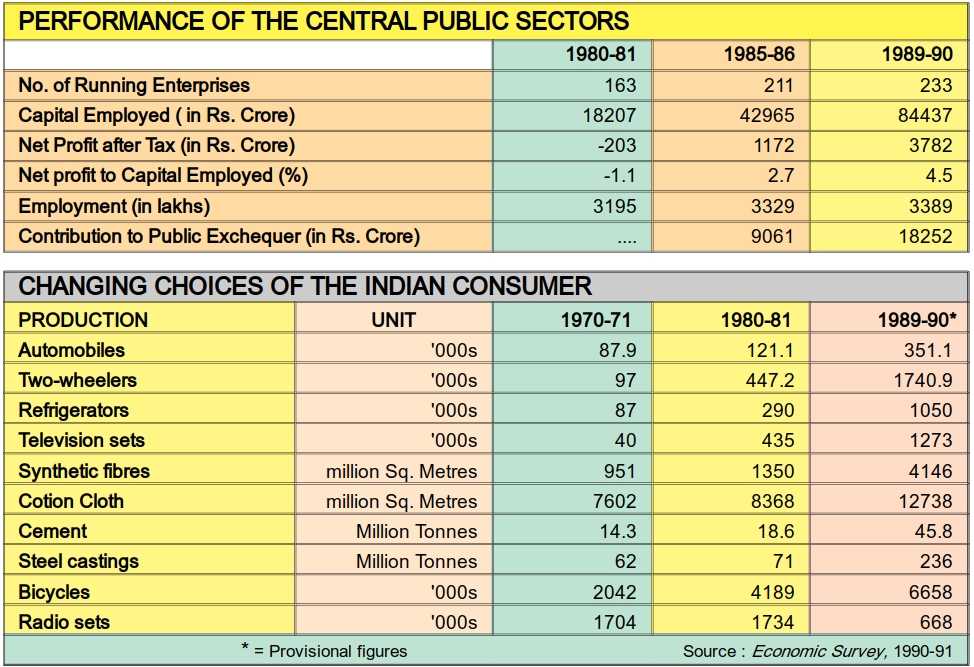
  • an annual rise of 6.9% in industrial output, propelled primarily by consumer durables (23.9%), while machine tools and transport equipments reported as lower growth in the latter half of 80s, cotton textiles stagnated with a 'growth' rate of 1%, and

  • what is most alarming, employment recorded an average annual growth rate of less than 2% in the public sector and an average annual fall of 0.12% in the private sector.

'High Technology' of Imperialism!

high
For a more comprehensive picture let us look at some more details.
The chart below will tell its own story.

'Qrowth' During the 80s

Qrowth 

So, this is the true face of growth under liberalisation – capital-intensive and labour-displacing, pro-affluent and anti-poor, imported and borrowed. And today even as the intoxication of this wonder-drug wears off, we are being advised yet another dose of the same, and a stronger one at that!

LET US start with the first salvo fired by the new Finance Minister – devaluation. With two strokes of the pen, the Indian rupee, and hence Indian goods, have been made 20% cheaper in the international market, while major foreign currencies and hence foreign goods have become that much dearer. The government says this will inhibit imports and encourage exports. But what does our experience say? What has really been the relation between the value of our currency and our foreign trade?

  • Between 1947 and June 1966, the value of Indian rupee was held constant vis-a-vis all major world currencies. During this period our exports grew by 100%, imports grew by nearly 175% and trade deficit by 500%.

  • Between June 1966 and 1989, the Indian rupee underwent a total devaluation of nearly 400% vis-a-vis the US dollar, i.e., the dollar became nearly four times dearer, while exports grew by 300%, imports grew by 200% and trade deficit by 1,200%.

  • As for our share in global exports, it is steadily declining. From around 2% in late 40s, it fell to nearly 1 % in mid-60s and further to less than 0.5% by the late 80s.

Clearly then, on a long-term basis, devaluation has certainly not helped either promote exports which depend more on other factors like the quality of products and the international trading environment or check imports which are governed primarily by the thrust of the domestic economic policies.

True, there was a temporary positive impact of the drastic June 1966 devaluation on our trade front when our imports remained largely constant while exports grew culminating in a rare trade surplus of Rs, 104 crore in 1972-73 before it was all wiped out by the first oil shock of 1973. But here it must be remembered that while imports were curtailed due to growing self-sufficiency in foodgrains, the growth in exports was confined to our traditional strongholds of raw materials and primary products like tea, jute, cotton and mineral ores which we have been sending out of the country since the days of Queen Victoria – surely not a healthy sign.

Now after the present devaluation, the question we are facing is how to increase our exports to a level where our overall earnings would more than offset the fall in prices. Let us look at the factors that are likely to affect our export prospects today.

  • Domestically, due to the already rising prices of raw materials as also the hike in the bill for imports (due to the same devaluation) required by Indian industries, our exports, especially items with a high import-content, may not necessarily become cheaper abroad.

  • Whatever positive impact devaluation is supposed to have on a country's exports is only when there is a boom in worldwide trade. Under the present situation of falling demand in global markets coupled with strong protectionist barriers put up by 'free trade' champions like the US and stiff competition from other Third World exporters, we may as well end up selling less and selling cheaper!

And on the import front, it must be remembered that unlike in June 1966 this time devaluation has taken place in a climate of total import liberalisation. According to the new trade policy, every exporter is entitled to import anything worth 30 to 40% of his export earnings no matter whether such imports have any bearing on his exports. Earlier, this import-for-replenishment facility was restricted only to selected exports and that too to an extent of 5 to 20%. The Budget has also done its bit of import promotion by giving a concession of Rs. 822 crore in customs duty. Evidently, with no limits on external borrowing and the huge funds the corporate sector is flush with, just making imports costlier cannot check imports. If anything, devaluation will only hike the import bill and leave the burden of trade deficit far more menacing.

So, at the end of it all we are likely to be left with the same import and export trends continuing unabated. In other words, the deficit soars and we have a highly inflated debt burden. Already, the latest two-step devaluation has raised our debt burden by nearly Rs. 35,000 crore!

ALONG WITH devaluation and trade liberalisation, the third crucial component of the present package of structural reforms is the new industrial policy. Backed up by the budget and supplementary provisions for small-scale industries, the new policy

  • removes licensing requirements for all but 18 industries and also the stigma of 'monopoly' from all industrial houses regardless of the level of their assets, thereby allowing a free expansion, growth and operation of Indian big business;

  • restricts the exclusive domain of the public sector to eight strategic industries concerning defence, atomic energy, coal, mineral oils, mining and railways and that too with plenty of loopholes for the private sector to make increasing inroads even into this so-called 'prohibited zone';

  • clears the way for automatic approval of foreign technology agreements and foreign equity participation upto 51% and even more in virtually all but a few industries;

  • signals the formal beginning of the privatisation campaign with transfer of 20% public sector shares to private hands and legitimises the indiscriminate closure of 'unviable' industries by launching a token renewal and rehabilitation fund for the affected workforce; and

  • provides easier and greater avenues for big houses and foreign capital to penetrate into the small sector and take full advantage of its lax labour laws by raising the investment limits for small-scale industries to Rs. 60 lakh and for ancillary and export-oriented units to Rs,75 lakh and allowing 24% target sector equity participation in the small sector.

You may be wondering about our coinage of the phrase, Pepsification. Well we feel in more ways than one, this term gives a more accurate description of the emerging shape of the Indian economy than such conventional terms as privatisation or the jettisoning of the so-called 'Nehruvian model'. Against the facile, compartmentalised way of viewing the Indian industry in terms of public vs private and domestic vs foreign sectors, Pepsi symbolises the increasingly open and aggressive alliance between Indian big business, foreign multinationals and the state and perhaps we may also note the indirect inclusion of the rising farm lobby.

Consider the sheer contrast between what Pepsi Foods, a food-processing unit located in Punjab and sponsored jointly by PepsiCo International (a US agrobusiness giant), Voltas (a Tata company) and the public sector Punjab Agro Industrial Corporation had committed to achieve during its clearance two years ago and what it has delivered since then.

What Pepsi had promised

The agreement with Pepsi was that while spending just Rs. 37 crore in foreign exchange over 10 years – including capital good, raw materials, technology costs and dividend, – it would earn Rs. 194 crore of foreign exchange through high value-added exports, thereby bringing scarce foreign exchange to the country and providing a profitable commercial outlet for the Punjab farmer. Half of its turnover would be exported and 80% of its exports would come from its own plants.

What Pepsi has delivered

Since inception, Pepsi has shown a threefold rise in its project cost. Complaining of all sorts of teething troubles, it has secured loans from the parent PepsiCo International, which are now to be converted into additional equity for the parent firm. The entire exports claimed by Pepsi-rice, fish and tea, apart from being traditional items that certainly do not need a multinational to export them – are proxy exports. While no advanced food-processing research is going on in its plants, Pepsi has already cornered a good share of the domestic soft drinks and potato chips market with imported know how. And the Punjab farmer is now left at the mercy of Pepsi, for the kind of tomatoes he has started growing according torts specifications are difficult to market elsewhere in India.

We have singled out Pepsi, whose arrival two years ago was a clear indication of the Indian industrial policy completing a full circle since the throwing out of Coca Cola in the late 70s, only as the most striking symbol of our 'new industrial order'. Like Maruti, Pepsi is also a telling example of the guiding role played historically by the Indian public sector in fashioning new alliances with foreign capital and technology. This is in perfect continuation of the 'commanding role' played by the public sector in propping up the private sector with infrastructure, subsidised raw materials and intermediate goods, and by providing the bulk of share capital and cheap credit.

Pepsi also brings out the true pattern of Indian industrialisation catering to the booming market of the emerging middle class. And, of course, Pepsi brutally explodes the myth of export-led growth and foreign investment in selected high-priority areas. As the chart (in the matter caption 'High Technology' of Imperialism!) shows, it has joined the long list of multinationals in India which with meagre investment largely in the consumer goods sector have year after year siphoned off huge quantities of precious Indian resources through all sorts of channels.

'Privatisation' Begins at Home

THE 'private' vs 'public' debate is back. But while on earlier occasions, it used to be for or against nationalisation of sick private enterprises, now the agenda is privatisation of healthy public sector units. Or only 'partial disinvestment of the share capital of selected public sector concerns to the broad investing public', as the finance minister puts it.

However, in India, this has always been more of a false debate hinged around unfounded assumptions. Historically, the Tatas and Birlas with their 'pioneering' Bombay Plan have been among the first to articulate the need for an extensive public sector to provide infrastructural support and key inputs to private industrialists. Nehru and Indira Gandhi draped this bars economic reality with the colourful camouflages of 'socialistic pattern of society' entirely to suit their own political convenience.

A second and more basic point is that the public sector occupying the so-called 'commanding heights of the economy' here has been anything but public. A more appropriate term for it would be state sector, for barring a few exceptions the public sector in India is hardly distinguishable from the rest of governmental bureaucracy with all its characteristic features of ad-hocism and arbitrariness, delay and wastage. The private sector too is a misnomer. It is a sector which is generally controlled on narrow family lines and operates within the feudal framework of authority, but in terms of share capital and credit inflow, there is very little private about it. The contribution of the controlling families generally amounts to only around 5 to 10 per cent, while the 'public sector' financial institutions and banks have an average stake of not less than 50 per cent. In fact, had the government's intention been just to raise funds through disinvestment, the more profitable 'private sector' shares should have been the most ideal candidates.

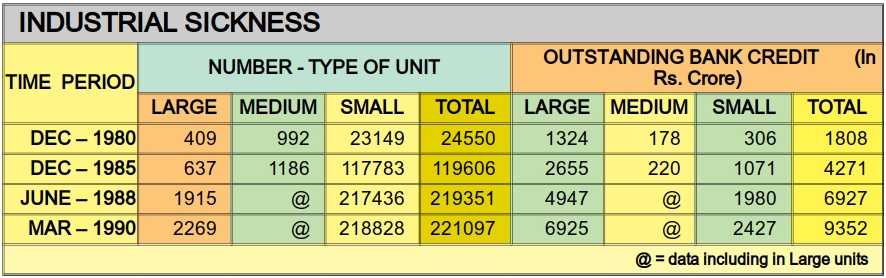
The plea that privatisation would promote efficiency is a big black joke. Inefficient and corrupt management is identified as the key factor behind the ailment of at least 75% of over two lakh sick units in the private sector. The real game plan behind the privatisation campaign is one of hitting two birds with one stone – transferring massive assets built with decades of public money and labour to the private empire of big business and tightening the screws still harder on the Indian workers.

This gameplan cannot be countered on the old plank of 'public sector zindabad'. The legacy of arbitrary bureaucratic control over the public sector must go. The point is to take the battle right into the enemy's camp and fight for a greater public control and workers' say in industrial ownership, management and policy-making and bringing about a modem democratic industrial culture in place of the present family-controlled and bureaucratic set-up. In the face of the ongoing onslaught of capital, the Left trade union movement must also pay increasing attention to the emerging agenda of 'privatising the private sector'.

WHILE ANNOUNCING its unabashedly market-friendly new policy package, the government has also added a footnote that care will be taken to provide a safety net for the vulnerable sections of society. Even in this age of 'market worship', none can dare deny that the market remains particularly hostile to the toiling masses. Theoretically speaking, the budget could be used to create a major safety net to correct the inherent distortions and imbalances of the market mechanism, and our ministers, establishment economists and the mainstream media would have us believe that such is indeed the character of the latest budgetary exercise. But can the budget go against the whole thrust of the policy package? Can the footnote challenge the main text? Let us examine the official claims and media hype about the budget.

• 'The poor have been given relief.'

There could not be a bigger falsehood. While food subsidy has been raised by a meagre 7% (Rs. 150 crore), fertiliser prices have gone up by 30% and to compensate the farm lobby for this rise in input cost, the government has assured it of a sufficient rise in procurement prices of foodgrains. This would immediately nullify any possible impact of the increased food subsidy. Moreover, far from expanding the public distribution system (PDS) to the villages and including a most essential item like pulses, the budget has only raised the PDS sugar price by nearly a rupee a Kg.

• 'It's a soak-the-rich budget.'

On the contrary, it is yet another soak-the-poor-and-save-the-rich budget. The rise in excise duty on luxury items like motorcars, colour TV sets, VCRs and refrigerators – on which ground sections of the mainstream media have labelled the budget a soak-the-rich one, is slated to yield only a modest Rs. 325 crore in an estimated total excise rise of Rs. 2,277 crore.

• 'The accent is on direct taxes.'

False again. The estimated additional yield from income and corporation taxes is only around Rs. 1,300 crore, or just one-fifth of the corresponding figure for indirect taxes. True, the government has reintroduced the interest tax thereby raising the estimated yield from direct taxes by another Rs. 535 crore, but this will increase the nationalised banks' cost of lending, a rise which in the case of corporate sector will be directly passed on to the consumers through increased prices, while in agriculture and small sector, it will disrupt operations and depress wages.

• 'It's development-oriented.'

Totally false. The budget has refused to add a paisa to the meagre allocation for rural development. There is simply no thrust on rural employment generation programmes while the defence budget has been granted another hike of Rs. 600 crore. Also, while the largely unproductive non-plan expenditure is projected to rise by 15%, expenditure on assets has been allowed to 'grow' by a measly 2%.

• 'It will mobilise black money for national use.'

A better term would be legitimise and not mobilise as black money holders have been granted a total amnesty for all deposits made in the National Housing Bank. Of this only 40% will go to a national housing fund while the rest will be washed white and restored to the owners. In another sinister move, the budget also grants NRIs a free entry into the lucrative real estate business. Going by our past experience with similar offers to black money, the first scheme is only likely to prove a damp squib while the second will help black money holders pump a part of their unrepatriated wealth back home.

Significantly, while all talk of providing a safety net has turned out to be a cruel joke, the budget has dutifully fulfilled the commitment made to the IMF to bring down the overall fiscal deficit to 6.5% of the GDP. This has been accomplished by slowing down the expenditure on creation and maintenance of assets and selling off 20% equity in selected profit-making public sector undertakings. On the other hand, major items of the government's expenditure including the fund earmarked for payment of dearness allowances to large sections of government employees have not been adjusted for the July devaluation, railway fare and freight hike, and the higher rate of inflation. Whether it is just another accounting trick to understate the deficit or the government's way of indicating an impending DA freeze for central government employees will be revealed in the coming months.

Coming Soon !

'The Debt Trap'

An Uncle Sam Production

Sponsored by IMF


ONSLAUGHT OF 'SHOCK THERAPY'

Rumblings of Discord

FATING the cake and having it too is a habit very hard for the Indian big business to give up. After years of sheltered growth under the benevolent 'socialistic' dispensation of the Nehru-Indira era, almost all sections of industry were of late lobbying hard for 'opening up', 'decontrol' and a more 'competitive' market. But with the new economic package meting out equal and in cases more favoured treatment to foreign capital – for example, an Indian industrialist would need a licence for import of capital goods worth more than Rs. 2 crore while foreign industrialists have no such bar – The Federation of Indian Chambers of Commerce and Industry, considered more representative of domestic industry, has struck a discordant note questioning the wisdom of exposing the domestic market to unbridled foreign influence. The Associated Chambers of Commerce (ASSOCHAM), generally regarded as the voice of the foreign lobby and the main rival body against FICCI, has of course extended a hearty welcome to the new measures. Sections of Indian engineering and electronics industries are also quite wary of the new package.

While the industry has expressed its reservations, the farm lobby has taken to the streets and has successfully forced the government into a 10% retreat on fertiliser rates. The rumblings of the farm lobby are quite audible within the ruling party too, not to speak of the Janata Dal and its regional allies. Even the BJP, the most ardent champion of the 'tree trade, free market' philosophy, cannot remain totally insensitive to such rumblings. But given the essentially collaborationist character of Indian big business and the close economic and political nexus among the farm lobby, big business and foreign capital, such frictions cannot be considered as something fundamental. It must be remembered that V P Singh was a key architect of the first phased economic liberalisation in the mid-80s and only last year his government had also tabled an essentially similar industrial policy which was put off at the end for reasons of political expediency.

The real resistance to the shock therapy of structural reforms has to come from the worst hit people – workers, peasants, and other sections of the rural and urban poor – and the democratic and Left forces who are really concerned with national dignity and public welfare.


STRUCTURAL REFORMS;

The Hidden Persuaders

“Quite honestly we need the support of the IMF to restore international confidence in our economy at this juncture and to convince international commercial banks as well as non-resident Indians that India is a viable entity.” Speaking these words was none else than Finance Minister Manmohan Singh while defending the budget on the floor oi the Parliament. So forty-three years of 'independent economic development' later, the country needs a certificate from a global lending institution to convince the world of its 'viability'.

Interestingly, along with the loan and the accompanying package of structural reforms, the Fund-Bank experts have also provided their Indian clients with free tips as to how to carry out the conditionalities. In the pedagogic parlance of the World Bank, it is called the 'art of reforms'. The Bank's 1991 World Development Report discusses details of the 'art' like the timing, speed, scope and sequencing of the reforms.

Consider the following excerpts from the Report: “The timing of reforms involves political considerations. New governments are in a strong position to initiate reforms. ... Economic and political crises are opportunities for radical change. In Indonesia, reformers designed their plan for liberalization well before the crisis of 1983. When the choice came to implement it, the homework had already been done.” More explicitly, “Rapid action can improve the political sustainability of reform. … Bold changes are especially necessary if a government lacks credibility. ... Adjustment usually occurs in a climate of crisis. Governments do well to capitalize on the broad, potentially snort-lived mandate for reform that crisis confers by front loading the reform programme."

So it is not sheer coincidence that the weakest of Congress governments since independence has mounted the biggest ever onslaught of economic liberalisation from day one. Evidently, during the whole eighteen months of Singh-Shekhar governments, while the country was treated to the Mandal-Mandir opera and the longest ever elections, somewhere some people were busy with the 'homework'!

ONLY IMF! That is the current slogan of the ruling political, economic and intellectual establishment in the country. And the attempt is to desperately evolve a popular national consensus around this slogan.

But are we really in such a desperate condition? The fact is that we are not going to the IMF because of any specific national or international development. We have not suffered any great natural calamity or any disastrous crop failure. We have not been at war. We are going to the IMF today because we went to the IMF in 1981, because we are hooked to following the economic line of IMF, because it has become a habit for the government to go to IMF to assure not just outsiders but also itself of its own viability.

And naturally any suggestion of an alternative approach is treated with a mocking disbelief and even sheer derision. For instance, the note on an alternative policy approach circulated by the West Bengal Government was rejected outright. True, for reasons best known to it, the Left Front government of West Bengal places an unfounded optimism about reversing the outflow of NRI money through a 'strong appeal', for it is well known that the big NRIs generally serve as fronts for commercial lenders and carry on proxy operations on behalf of the manipulative multinational capital. But nevertheless the note did raise quite a few valid and sensible points.

Here we present what could be the outline of a short-and-medium-term way out of the current economic mess and avoiding the lethal IMF package which is being thrust down our throats as the 'only option'.

IMMEDIATE STEPS

  • Ask for a rescheduling of our outstanding debt-servicing obligations, failing which declare a moratorium on repayment of alt debts for the next two years.
  • Stop all imports of luxury consumer goods, drastically reduce the import of armaments, check import of capital goods also produced domestically, and hold down bulk imports to a minimum.
  • Confiscate the assets of major economic offenders, bring back all Indian money stored abroad.

THE MEDIUM-TERM COURSE

■ Clamp Down On Imports.

Contrary to popular impression, the chief culprits behind the unprecedented inflation of our import bill are not oil and petroleum products and other essential consumption items like cereals, edible oil, pulses and sugar. The real villains are capital goods, export-related items and a vast number of assorted products dubbed in the import bill under the mysterious title “others”. A sample of 'essential imports' in this list includes perfumery, cosmetic, soap and polishes (Rs. 25 crore in 1986-87), watches and clocks (Rs. 47 crore in 1987-88), foreign liquor (Rs. 200 crore) and so on!

And then there is the import of armaments which is not even shown in official import statistics, but the Stockholm-based International Peace Research Institute reports that in the latter half of 80s India has emerged as by far the largest Third World importer of arms. During 1986 to 1988 Indian import of arms was very close to the combined arms purchase of even a warring Iraq and Iran. This absurdity must stop. In fact, the partial import curbs implemented by the Chandra Shekhar government, though half-hearted, did nevertheless bring about a marked improvement in our forex reserves without triggering off a recession in industries as prophesied.

Oil arid fertiliser imports can also be minimised by effecting appropriate shifts in our transport and energy policies and choosing cost-effective and resource-efficient technology for our industry. Over the years individualised, small and private transport have been promoted to the neglect of railways, a much more fuel-efficient and economical mode of transport. Neglect of electrification has led to a massive proliferation of diesel pumpsets and diesel-based captive power-generators. Then we flare up natural gas worth Rs. 2,000 crore a year, which could be effectively used as a fuel in many industries, for electricity generation in power plants, and as a feedstock in fertiliser and chemical industries. Many of the petro-based inputs now being used in chemical and other industries could also be easily replaced by coal-based inputs, for our coal reserves are far more comfortable than oil.

■ Declare War On Black Money

The amount of direct taxes raised in India is scandalously low. Its share in total tax revenue (Centre, states and local bodies) has steadily declined from a reasonable 35% in 1950-51 to an intriguing 14% in1988-89. Viewed in terms of GNP, while the share of direct taxes has declined from 2.5% to 2.4%, that of indirect taxes has risen sharply, from 4.6% to 14.5%. The picture of income tax collection can be best visualised from the following figures. In 1938-39 we had 2,72,000 people reporting an annual income above Rs. one lakh. And fifty years later, in 1988-89 we have only 21 lakh people with a declared income of over Rs. one lakh. This when the value of the rupee has declined dramatically and when we are witnessing a veritable consumerist explosion in the market. More incredibly, while in 1938-39, we had 17,841 people with a declared income above Rs. 5 lakh and 4,438 people above Rs. 10 lakh, in 1988-89 there were only 1,639 and 493 Indians respectively in these high-income brackets.

Amazing, but this is the state of affairs in the country. What is still more shocking is that while the government manages to deduct income tax directly from the salaries of employees and collect indirect taxes from every purchase made by the common man, large business houses get away even with a default of hundreds of crores of rupees, not to speak oi the huge evasion of taxes. In 1990-91, there was a shortfall of Rs. 1,314 crore in direct tax collection while in the case of indirect taxes the shortfall was only of the order of Rs. 303 crore.

Another telling commentary on the nature of tax revenues is that the contribution of the agrarian sector has fallen from 7% in 1951-52 to a pathetic 1.3% in 1988-89. On a global comparison, the Indian performance on the direct tax front (13.5% of total government revenue) stands out to be one of the poorest whether we Compare it with Thatcherite Britain (38.8%) or Reaganomic US (52.5%), or nearer home the Asian success-stories of Japan (67.2%) or South Korea (34.8%). Evidently, there is tremendous scope for raising our direct tax revenue through a better assessment and collection of existing taxes and new levies like taxes on ostentatious consumption, inheritance tax, emigration tax and the like.

■ Reorient Government Expenditure

There exists a very strong case for a reasonable reduction in the currently unsustainable level of expenditure on defence and internal security through a more sensible and realistic diplomacy with Pakistan and China, emphasis on finding political solutions to the problems in Punjab, Kashmir and North-East, improving the communal situation through an early negotiated settlement of the Ayodhya dispute, stopping the use of army in civilian affairs A lot of saving could also be brought about by curtailing the overt and covert subsidies benefiting the affluent and the corporate sector, and both economy and efficiency could be enhanced by promoting decentralisation of the operation of government departments and public sector undertakings and devolution of more power to the local bodies, fostering better formulation and implementation of development schemes.

The additional resources thus raised both through increased revenues and economisation of expenditure need to be urgently channelised in a big way to fund large-scale programmes of rural development, irrigation and rural employment generation, especially through schemes like food-for-work so as to reverse the growing budgetary tilt towards non-plan, non-productive expenditure and accelerate the pace of creation of real income-generating assets. According to a Planning Commission estimate a nationwide employment guarantee scheme in 1990 would have cost the exchequer Rs. 13,000 crore. And think of it, this is just around 15% of the total black money accumulated every year!

OUR GOVERNMENT of course does not accept the very existence of any IMF-laid debt trap or the fact that a package of IMF conditionalities is being imposed on us. Obediently implementing the IMF-World Bank blueprint of shock therapy, it is absorbed in capitalising on the climate of crisis and 'the potentially short-lived, but broad mandate' the crisis is assumed to have conferred on the government to thrust structural reforms down our throats. And the 'reforms', we are promised, would usher us into an era of rapid export-led growth and awaken all the slumbering potential of industrialisation in India to pitchfork the country from its present company of low-income economies to the prestigious club of the newly industrialised Asian countries like South Korea, Taiwan, Singapore and Hong Kong!

It is tragic that instead of comparing India with China, the only Asian country with which we can naturally and logically compare ourselves, Indian rulers have started bracketing the second largest country of the world with city-states like Singapore and Hong Kong! We say the comparison with China is both natural and logical because of our broad similarity in terms of population size and most other basic socio-economic indicators, and also because of the fact that our two countries have followed two different paths to economic development. Like India, China is still regarded as a low-income Third World economy and yet, as the accompanying chart indicates, in terms of many development indicators and quality of life, China has left us far behind and is racing close to the standard of advanced nations.

Socio-Economic Indications

Socio

Source : World Development Report, 1991


The difference that stands out most glaringly in any comparison of the developmental profiles of China and India is that China has not only grown faster but mere importantly, the gains of economic growth there have been distributed far more evenly while in India they have been monopolised entirely by the upper echelons of the society. Yet, all talk of equitable development and distributive economic justice has become taboo in India. Economic growth is worshipped as the sole idol and development is treated as the growth-god's benign blessings trickling down to the community of believers.

Even leaving apart the crucial distinction between growth and development, if we just look at the claims of establishment economists from their own premise of emulating the South Korean and Taiwanese experience, we find any number of gaps in the whole framework. To take just one obvious instance, both South Korea and Taiwan were recipients of abundant foreign patronage and aid, first from Japan in the first half of this Century and subsequently from the United States in the 50s and 60s when the latter was obsessed with protecting its spheres of influence from the Socialist appeal of China and North Korea. The case of post-World War II economic reconstruction of war-ravaged Western Europe with abundant US aid under Marshall Plan also rested on the same political premise. The India of 90s is simply not placed in that kind of circumstances. However much we may agree to bend or crawl before foreign capital and technology, no industrial power is willing to leave an inch of its market or spend an iota of its economic surplus to sponsor economic growth in India.

The second and a more basic point to realise is that a crow can never aspire to become a peacock except through fundamental genetic changes. Putting on a few borrowedor stolen feathers will simply not help. There are five global lessons of growth which have to be learnt before letting our imagination fly wildly.

  • No economy can take off without a vibrant domestic market. Export-led growth is sheer myth, more so for countries with a huge agricultural population.

  • The key to a vibrant home market lies in extensive land reforms, agricultural development and extension service.

  • No country has grown without the right investment in its people, in the health, housing and education of its present and future citizens.

  • Free market, free trade and perfect competition are plain lies, no economy has ever grown without substantial state Intervention and protection of domestic industry and workforce from unequal foreign competition.

  • All success-stories of economic growth are tributes to the strong patriotic or nationalist motivation of the people and government of those countries.

And what is our record on these counts?

Domestic Market: Industrial structure remains heavily 'import-dependent. Enormous potential of rural industrialisation virtually untapped. Monopoly stranglehold over market preventing decentralised and all-round growth. Commodities of mass consumption increasingly ignored.

Rural Reforms: Out of a total operated area of 162.8 million hectares only 26 million hectares identified as ceiling-surplus, of which only 2.4 million hectares taken over and just 1.8 million hectares actually distributed. 95% loans of agricultural labourers and artisans still in the grip of private moneylenders.

Agricultural Development: 70% of cultivated area without any irrigation facility. Low yield of crops and poor utilisation of arable land. Stagnation in output of pulses. Continued dependence on import of edible oil.

Investment in People: Of the total annual expenditure of central government, only 2.7% goes to education, 1.7% to health and 5% to housing, amenities, social security and welfare while defence gets 17%.

Patriotic Motivation: Bureaucracy and elite still suffering from colonial hangovers with Swiss banks remaining the Mecca for Indian businessmen and emigration to the US, the ultimate dream of the academic elite. Cost of brain drain alone estimated at $ 51 billion between 1967 and 1985.


No Passaran!

EVIDENTLY, THE issue of an IMF loan is not just a question of finding a quick solution to an immediate crisis. IMF symbolises a strategy. The strategy which says self-reliance is out, independent industrialisation is out, social welfare is out. These are all gods that have failed. The new gods are capital, market, globalisation. And interestingly, the successors of Gandhi and Nehru, and the neo-nationalist Ram-bhakts are all at one in their vigorous defence of this epochal wedding between ancient India and the new world order.

Where would this strategy take us? Debt-trap is no longer a warning. We are now very much within it. And the noose will only get tighter with every passing day. However much we may hold out the red carpet for foreign capital, and establishment economists may clamour for direct foreign investment as a less evil (or more lucrative?) alternative to the loan, trends are that international capital would prefer to deal with India from a safe distance, with the help of the remote-controlled pincers of debt trap and unequal trade while reserving the direct investment option for havens closer to its heart, like the former socialist nations.

And where do we go from the debt-trap? In a bid to get out of it, we desperately try to accelerate our exports. But with debt repayment obligations increasingly eating into our domestic investment potential and international market closing its doors to our limited manufacturing exports, we are pushed more and more into the export of primary commodities and virtually unprocessed raw materials and minerals at cheaper and cheaper prices. Yes, it is the classical colonial circuit of de-industrialisation. We are reduced to becoming just another source of cheap raw materials for the empires of the West and a happy hunting and dumping ground for their surplus capital and excess produce. In short, a de-industrialised neo-colony with little economic and political sovereignty.

This is not a piece of alarmist fiction. This has been the fate of economies which were once far more successful and vibrant than ours. Even the World Bank's own report on trade reforms in India whose recommendations we are now implementing, visualises the following scenario after five to seven years. GDP declines. The machinery output declines by anything between 10.5 to 16.6 per cent. So does the output of metals. Even the output of transport equipment and electrical appliances and electronics declines. Agricultural output records a small growth of the order of 0.3 to 0.9 per cent. The output of minerals goes up by 1 to 4.3 per cent. Construction declines or at best remains stagnant. The service sector of course continues to grow. And the balance of payments crisis, to cure which the whole reform is ostensibly being carried out remains unchanged at 3 per cent of the GDP.

After all, in economic growth and development as in any other field there can be no substitute for internal dynamism which can only be unleashed through a keen and productive participation of our manpower and an intelligent utilisation of our natural resources and historic experiences and advantages.

We are today standing at the junction of two roads. One road breaks the back of our industrialisation by pauperising the overwhelming majority of our people and permanently converting our economy into a docile supplier of cheap raw materials and primary commodities and a helpless purchaser of costly manufactured goods from the developed industrial powers. The other road industrialises our national economy by revolutionising our agriculture and developing a broad-based industrial edifice on a solid agro-economic foundation and thus ensuring the optimum utilisation of our vast natural and human resources.

One road leads to concentration and centralisation of economic and political power into a few hands. The other leads to economic and political democracy through equitable distribution and decentralisation.

One road leads to abject submission to the imperialist economic and political order as just another pitiable appendage. The other allows us to interact with the world with our heads held high as a champion of anti-imperialist solidarity.

One road leads to humiliation. The other redeems our national honour.

One road invites slavery. The other freedom.

THE TIME TO ACT IS NOW.

NEW ECONOMIC PACKAGE

Perilous Portents for Democracy

ON June 2. 1991 the colour of cement in the small town of Dalla in eastern UP was no longer grey. It turned red that day with the blood of more than 40 workers of the UP Cement Corporation who succumbed to police bullets white protesting a move to hand over their unit to a private business house.

As the IMF stranglehold over government policy grows stronger and the aggressive alliance between domestic big business and foreign multinationals starts celebrating its 'new-found freedom' with a vengeance, it is obvious that the trade unions and Indian workers are going to become the first and most direct target of the violence that underlies this freedom. Privatisation has already begun, and large sections of workers are threatened with the frightening prospect of wage freeze and retrenchment, though for obvious reasons these aspects of the new economic package have not been formally spell out in the policy statements.

But apart from direct repression and showdown, the ruling classes will also seek to browbeat and corner the workers and their trade unions through the trusted tactic of divide and rule. And here they are likely to utilise every division in the ranks of the working people – organised vs unorganised sector, employed vs unemployed, urban vs rural and so on and so forth.

This will have to be beaten back with the counter-strategy of unity-in-action, developing a fighting solidarity of workers of different trades and unions, between workers and peasants and among different segments of working people. Growing attacks on trade union and working class movement can only signal a general onslaught on democratic rights. After all, autocratic South Korea has become the latest model for India's 'free-market democrats'!


Glossary:
Beyond the Jargon

Glossary: Beyond the Jargon

Breadcrumb

AGRICULTURE: The mainstay of the country's economy, agriculture in India is a sector riddled with paradoxes.

  • Contributing a smaller and smaller share of national income every passing year it continues nevertheless to employ the major share of the nation's workforce. This implies that there is less and less of resources to be distributed among the vast and growing rural labour.

  • Despite recording major growth in foodgrains production in the past decade and becoming 'self-sufficient', per capita availability of foodgrains is still far short of the minimum per capita nutritional requirements.

  • Even this per capita availability is just a hypothetical concept. The real availability for toiling masses is much less as more and more foodgrains are sold through open market and the public distribution system is increasingly relegated to the background.

  • After decades of land reforms, millions of acres still remain concentrated in a few hands denying the rural poor the right to their own land. On the other hand, in many parts of the country small and marginal farmers driven to pauperisation are joining the ranks of agricultural labour selling off or renting out their lands to big farmers.

  • While the big landowners and farmers in rural India have seen unprecedented prosperity due to the green revolution the contribution of agricultural sector to national tax revenue has declined drastically.

  • In a nation with not enough foodgrains to feed its people the pattern of crops being cultivated is shifting away from cereals and pulses to cash crops needed for exports and processed food items like jam, jelly, tomato sauce and potato chips.

Indian Agriculture; Some food for thought
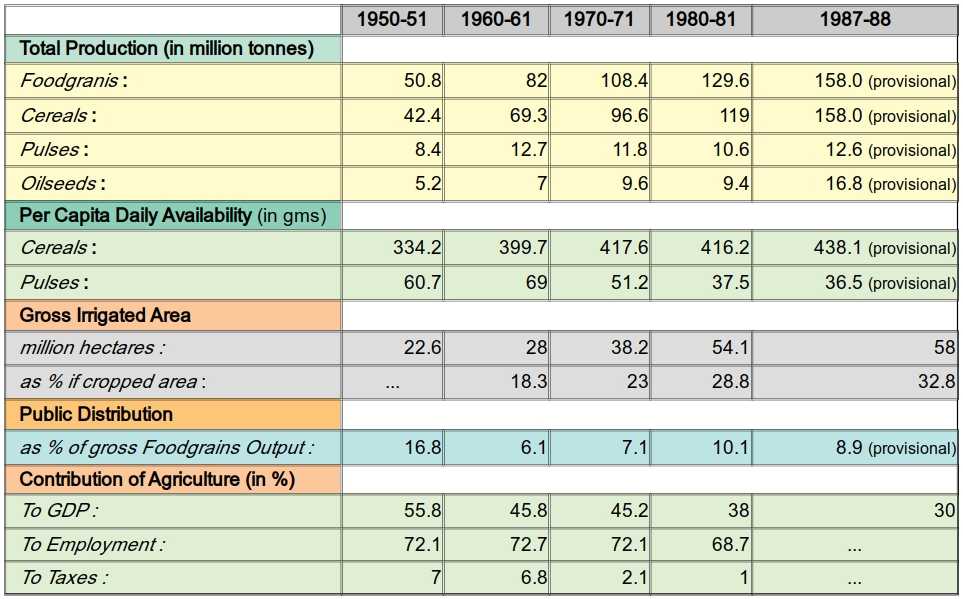
agri

CMIE publication, Statistical Outline of India (Tata Services Ltd.)


Land Scandal : Distribution of Operational Holdings
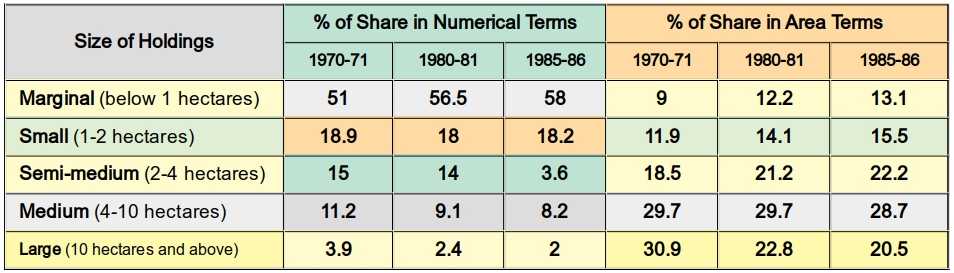
land scandal

Source : Statistical Outline of India (Tata Services), 1989-90


BLACK ECONOMY

The Dark Invader

THE case of the black economy in India is a sordid example of how the cynical dictum that it pays to be corrupt and dishonest is actively nurtured by those in authority themselves. Consider the following chain of events that has been going on endlessly in this country ever since Independence :
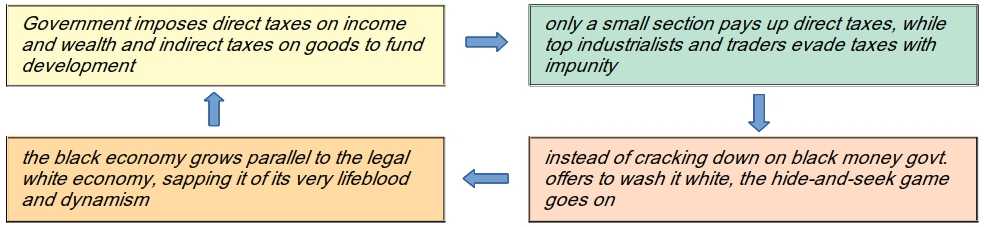
Dark 

On the external front, too, the situation is the same. Both exporters and importers have for years been bleeding the Indian economy while through various means like under-invoicing exports and over-invoicing imports stashing away precious foreign exchange abroad. Using hawala operators corrupt politicians and industrialists regularly transfer large sums of money to bank accounts abroad. Indian agents of foreign companies (a la Bofors) are paid a substantial part of their commissions abroad directly resulting in a net loss to the Indian economy, And what does the government do? Under the pretext of attracting investments and tapping these illegal sources it shamelessly pleads with these anti-national swindlers to return money stolen from the country, assuring them in the tone of a sick father searching his absconding son, 'come back, all will be forgiven'!

The third dimension of the black economy in the country is smuggling. While gold, silver and electronic items have long been favourites with the mafia dons who operate smuggling networks with the help of their patrons in government, thanks to the recent devaluation and the hike in costs of normal import, the smuggling of other products is also likely to go up in a big way.

The only solution to the black economy problem is a politically and morally strong-willed government taking stern steps to ensure the implementation of laws and initiating punitive action against the offenders. But then how is one to expect a government propped up by the very same criminals to bite the hand that feeds them

  •     Size of the black economy: 20% of GDP, i.e., over Rs. 1 lakh crore
  •     Profit from illegal imports of gold and silver in 1990: Rs. 1,560 crore.
  •     Estimated flight of capital between 1971 and 1986: $ 28.6 billion or 71% of the external debt piled up over this period
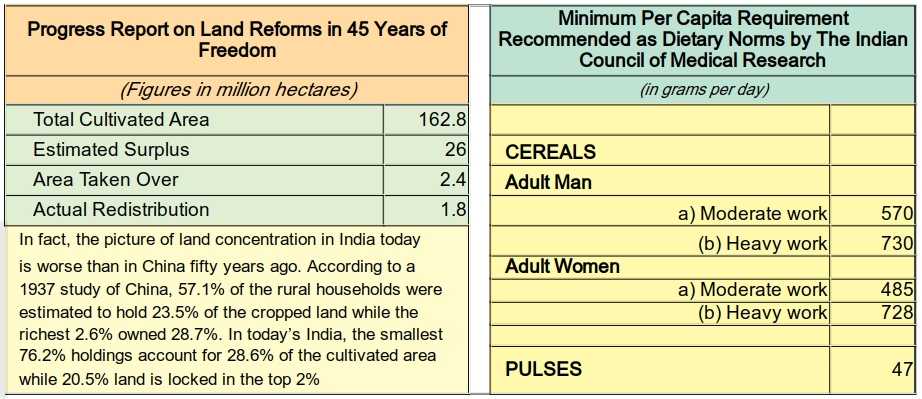
 

chart


BALANCE OF PAYMENTS: This is an account of the net economic transactions made by a country in relation to other countries. The transactions include exports and imports as well as transfer or receipt of funds and assets in various other forms like in our case remittances by Indian workers employed abroad and outflow of Indian resources on account of profit and royalty for foreign capital and technology operating in India and payment of interest and repayment of principal for our external debt burden. India's balance of payments situation has always been precarious since Independence indicating continued economic dependence on and vulnerability to external forces and factors. Since the beginning of the 'liberalisation' era the situation has become far more alarming.

BLACK ECONOMY: See box.

BUDGET: Presented to the Parliament usually at the end of February every year it is an account of the government's estimated spendings and earnings for the forthcoming financial year (April-March) and also a statement of the actual revenues and expenses of the outgoing year. The earnings come basically through taxes, revenues of government organisations like the railways and post and telegraph, and through domestic and external borrowings. The expenditures are incurred in running various government departments and financing the five year plans.

Taxes again are of two types – direct and indirect. The former is levied on wealth or income and the latter collected through excise duties and sale taxes on widely consumed products and customs duties on import. Naturally, direct taxes are collected more from the rich while indirect taxes pinch the pockets of the common man.

A shortfall in revenue against the government's expenditure is called a deficit. Most widely talked about today is the 'fiscal deficit' which is basically the difference between what the government plans to spend in a particular year including debt repayments and the total revenues it hopes to collect for this purpose from all its usual sources excluding external and internal borrowings. The bigger the gap, the more the government will have to borrow or print money or both to make ends meet.

Some of the salient features of the Indian budget in recent years have been:

  • Falling share of direct taxes in total revenue and increasing dependence on indirect taxes which means the government and its institutions like bureaucracy and army run more on the common man's hard-earned income than on the rich man's share of profit.

  • Rising non-plan expenditure which means more and more money is being spent on non-developmental areas such as defence, subsidies, maintenance of a huge bureaucracy and interest payments for growing debts
  • Rising deficits indicating the government's utter failure in collecting the right revenue from the right source as also in economising its own operations.

  • Falling share of resources transferred to the States showing increasing control of the Centre over the national economy leading to unwanted redtapism and arbitrariness in formulation and execution of developmental projects.

  • Diminishing relevance of the budget presentation itself with the growing practice of raising revenue through extra-budget hikes in prices of key items like coal, steel, petrol etc., declaring major policy measures like devaluation and new trade and industrial policies outside the budget framework and rampant manipulation of budget figures in order to present a rosy picture of the economy.
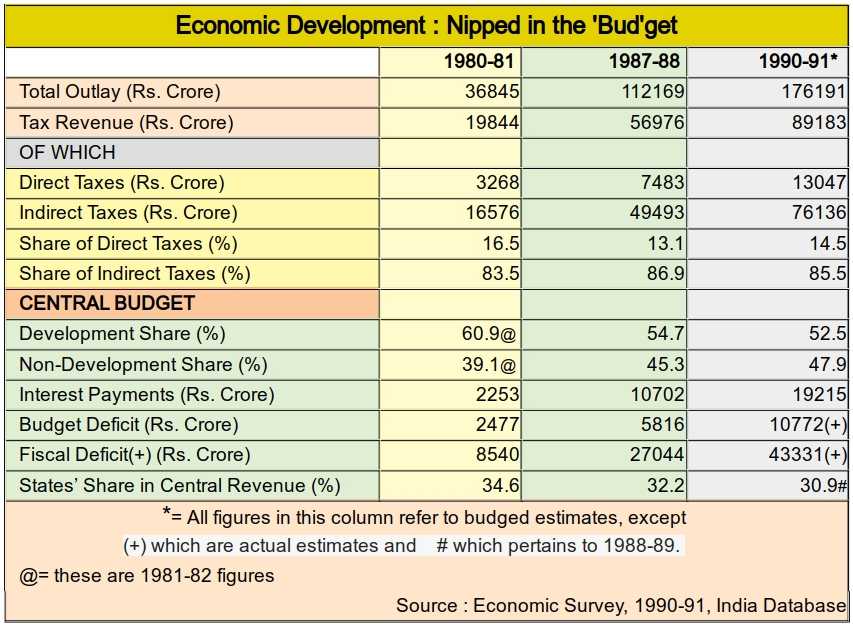
Economic chart


CREDIT RATING: This is the index of a country's ability to pay back its debts to global lending organisations. The index is evaluated by international credit-rating agencies which keep a watch on the 'investment worthiness' of nations around the world. In the beginning of the last decade India had a good credit rating which enabled the government to borrow foreign exchange at will in international markets and pay the growing import bill of the country. But in August last year one of the leading credit rating agencies, the New York-based Moody's suddenly downgraded India's credit-rating sharply setting off a chain of similar downgrading by several other agencies. According to some observers the earlier rise and recent crash in our credit-rating are all part of a devious design to draw the country into a dangerous debt-trap.

DEBT TRAP: A country can have two kinds of debt – external and internal. The former refers to the amount of loans to be repayed to lenders abroad while the latter is the money owed to lending sources within the country. Debt servicing refers to the amount paid by a debtor nation annually to its creditors on account of both the principal and accumulated interests.

After depending for years on aid in the form of grants and soft, i.e., low-interest and relatively unconditional loans, in the eighties India emerged as a major borrower of funds from commercial sources in international markets. The country is also borrowing funds by giving high interests and lot of other incentives to attract short term deposits in Indian banks from non-resident Indians. While the official figures put the debt in 1990-91 at nearly Rs. 99500 crores, taking into account the Rs. 20,000 crore in NRI deposits, the Rs. 30,000 crore in the form of other short term borrowings and various other kinds of external liability of the government, total external debt exceeds a whopping Rs. 175,000 crore or 70 billion dollars.

Rising Deficits

Behind the Fiscal Fixation

IT is commonly understood that if a person keeps on spending more than what he or she earns over a period of time there is bound to be trouble ahead in the form of first debt and than bankruptcy. So when the IMF sternly advises the Indian Government to cut down its fiscal deficit before approaching it for a loan, on the face of it the prescription seems to make sense. When establishment economists tell us that cutting down the deficit is the only way of controlling inflation the move appears even more sound. But what is the IMF's real interest in asking for narrowing the fiscal deficit?

Surely not bringing down the inflation, which in fact in the Indian contexts is more related to the growing bank credit to the private sector and increasing profitability of speculative activity in stocks, real estate and the money market. While as a lending institution IMF is obviously interested in ensuring that the Government is in a position to repay its loans the measures it recommends for bringing down the fiscal deficit reveal a more long term strategy.

The experience of other economies where the IMF has successfully pressurised governments into accepting its 'cure' shows that (a) in the name of curbing deficits the first sector of government spending that gets hit is basic amenities and social welfare like health, education, rural development and the supply of essential goods at subsidised rates, (b) to raise additional funds public sector assets in core areas are sold off to domestic big business and global giants thus gifting them with a ready handle to squeeze and pressurise the nation, (c) a recession is often triggered off in several sectors of industry dependent on government purchases for a market. In other words, by picking out the fiscal deficit as the villain behind the economy's woes, the IMF ensures a systematic erosion of public welfare and the direct role of the state in the economy and hence attainment of its political-ideological objective of greater marketisation.

An important point to note here is that this recommendation is just one part of the larger 'liberalisation' package that is thrust upon the debtor country which includes the opening up of trade and industry. Ironically these policies which result in increasing dependence on borrowings and imports to sustain the delusion of 'export-led growth' also constantly ensure that the fiscal deficits of the governments never really come down substantially. This leaves the IMF and its pet economists with a ready scapegoat to flog while the 'cure' kills the patient. “They did not liberalise enough and their governments spent too much” would be the epitaph the IMF would love to write over the tombs of each of its victims.


Similarly, spurred on by wasteful expenditure on several counts the government's internal debt has also increased by a phenomenal six and a half times since 1980 and according to official figures themselves is likely to touch Rs. 171,635 crore by the end of 1991. Including other liabilities like employees' provident fund and small savings deposited in banks or in the custody of the government the actual amount of current internal debt of the government is estimated by others to be as high as Rs. 319,779 crore.

The foreign debt crisis facing the country can be best understood if one compares the growing servicing cost of external debt to the earnings through exports every year. This year the debt servicing to export earning ratio is expected to be over 30% or nearly one-third of revenues through exports. 20% is regarded as the safety limit beyond which the country falls into the debt-trap.

DEVALUATION : This refers to a reduction in the value of national currency against foreign currencies. In India recently the value of the rupee was brought down by 22 percent vis-a-vis currencies like the US dollar, British pound, German mark and the Japanese yen This step was part of the standard IMF prescription for debt-ridden economies and is done in the name of making the domestic products cheaper for buyers abroad so as to promote exports and hence the inflow of foreign exchange with which to repay outstanding debts. But exports and imports, being dependent on a lot of other domestic and international factors, often do not respond favourably, and in the bargain the devaluing country only ends up selling cheaper and purchasing dearer while the burden of foreign debt records an automatic rise.

Dwindling Value of Indian Rupee in The Global Market
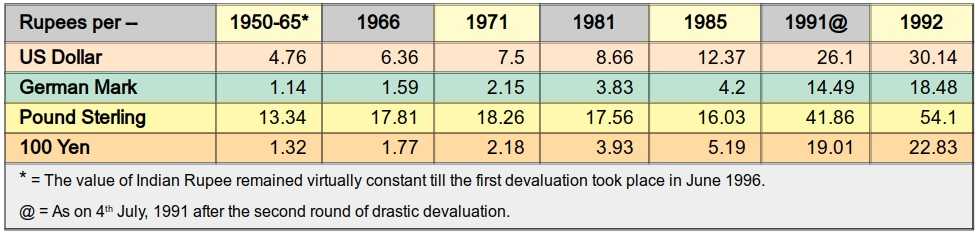
Rupee

ECONOMIC GROWTH :

See chart box “The Great Trade Robbery”.

EXPORT-LED GROWTH : This is a doctrine which says that a nation's economy can grow rapidly if only it can manage to raise its exports in a big way. The most commonly cited 'success stories' of this strategy are the four newly industrialised 'Asian tigers-South Korea, Taiwan, Singapore and Hong Kong – whose rapid growth is attributed to their allowing exporters, both domestic and multinational, a free hand along with liberal government incentives and support.

Actually this is nothing more than a sweeping and misleading generalisation of the experience of thinly populated small port states whose economies were also to a large extent propped up by the United States for geo-political reasons. A big country like India with a vast agricultural population can only grow by first concentrating on the full development of its domestic market. Yet in the vain hope of export-led growth, Indian government has already dutifully devalued the rupee and virtually handed over the entire economy to domestic big business and foreign multinationals through its new trade and industrial policies. So far the outcome has been that while exports are growing too slowly to pull up the rest of the economy, imports have assumed alarming proportions pushing the country into a debt-trap. In other words, the dream of export-led growth has turned into the nightmare of an import-bred disaster.
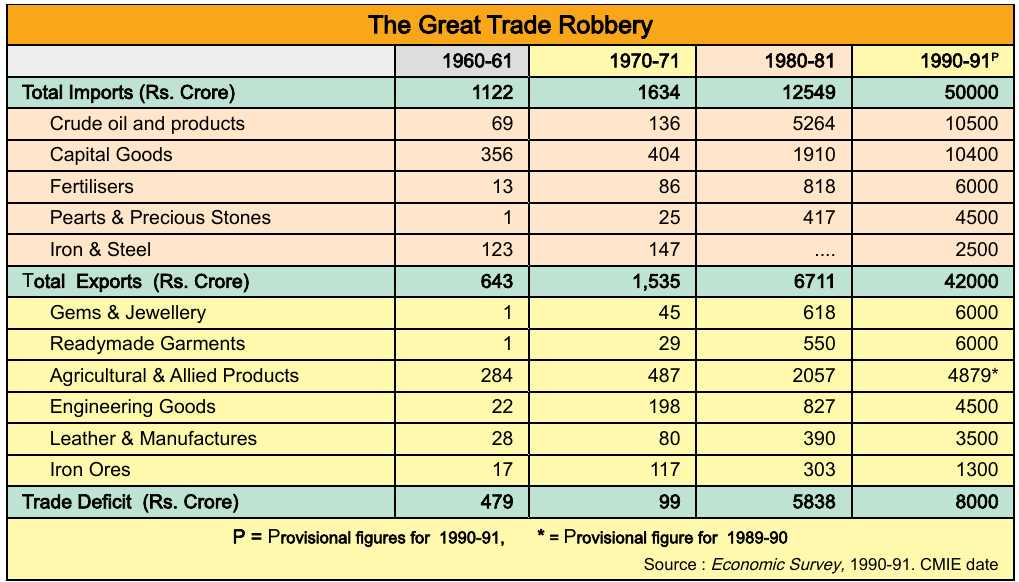
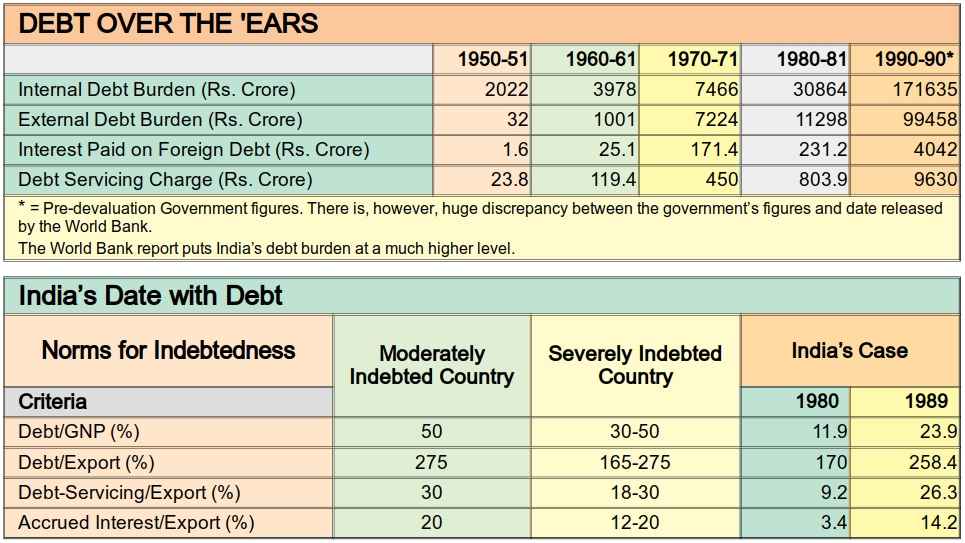
Trade Robbery


Debt


FOREIGN EXCHANGE:

Frozen, Flying and Floating!

THESE DAYS the government is always complaining of a foreign exchange crunch. We are told that we do not have adequate foreign exchange to foot our import bill for even a month or honour our immediate debt repayment obligations in the world market.

Well, let us start from the other end oi the story. We have a staggering 12.15 billion dollars of 'frozen' forex in the form of unutilised foreign aid. The other day the Rajya Sabha was informed by the Minister of State tor Finance that this huge quantity of soft loans from the World Bank and the International Development Agency, meant mostly for pending projects in the fields of irrigation, thermal power, railway electrification, dairy development and road transportation is lying unused due to delay and the government's inability to release matching rupee funds.

There is also an abundance in another variety of foreign exchange, the 'flying' forex. An estimated 5 billion dollars of foreign exchange are illegally siphoned away every year from the country to 'safer havens' abroad. There are four major routes through which this flight of capital takes place:

(a) cash transfers through the hawala market where foreign exchange is illegally bought and sold,

(b) trade misinvoicing which means both an understatement of the export earnings and overstatement of the import bill,

(c) kickbacks or commissions paid into secret bank accounts of agents of foreign companies as in the case of the Bofors deal, and

(d) transfer of funds through banks (like BCCI) from one country to another.
According to a study made by the Department of Revenue Intelligence on the basis of figures for the 1984-88 period, every year the country loses an estimated

*$ 2.150 million of forex through hawala remittances,

• $ 1,200 million through under-invoicing of exports and

•$ - 700 million through over-invoicing of imports,

•$ 400 million due to non-repatriation of export earnings,

•$ 500 million through payments by foreign tourists to unauthorised dealers and

•$ 50 million through onward smuggling of articles.

Clearly then, the government's concern for forex is not about utilising the frozen forex and stopping the wasteful interest payments on unutilised loans. Catching the flying forex is also not on the government's immediate agenda. The government simply wants a ready and adequate fund of foreign currency, which we may call the 'floating' forex, to ensure an uninterrupted spree of imports.


GATT: Acronym for the General Agreement on Tariffs and Trade, it is an international forum meant ostensibly for promotion of world trade through a reduction of trade barriers and abolition of preferential trade agreements. The two major trade barriers are tariffs like custom duties which render import economically prohibitive and quotas which place physical restrictions on the volume of specific imports from specific countries. But like most other international bodies, the GATT too has been virtually hijacked by the US, the biggest trading country in the world to armtwist other nations, especially those from the Third World, into opening up their domestic markets to American capital and commodities.

GROSS DOMESTIC PRODUCT (GDP): A measure of the total flow of goods and services produced within the economy every year. This is obtained by computing the value of the total output of goods and services at market prices. The word domestic is used to distinguish it from Gross National Product (GNP) which apart from domestic production also includes the total foreign trade of the country during the year and inflows and outflows of funds in various other ways. In 1989-90, India's GDP at current market prices stood at Rs. 3,95,143 crore (measured at 1980-81 prices, it immediately becomes half, Rs. 1,97,419 crore), while the corresponding value of GNP was Rs. 3,92,524 crore (Rs. 1,95,237 crore at 1980-81 prices). So, our GNP is Rs. 2,619 crore less than GDP showing that we are a net loser in international transactions.

Another similar term used is the Net National Product or what is also called national income which is derived from the GNP after making adjustments for the wear and tear, and fall in values of various fixed assets of the country. In 1989-90, India's national income at current prices was Rs. 3,46,994 crore (Rs. 1,74,798 crore at 1980-81 prices.)

These terms are used as broad measures of the status of a nations economy with higher GDPs and GNPs supposedly indicating greater development. But hidden behind these figures are often factors like massive inequalities in the distribution of income, imbalances among various economic sectors and geographical regions, reckless squandering and criminal neglect of precious natural and human resources, all of which tell considerably on the nature and level of economic development.
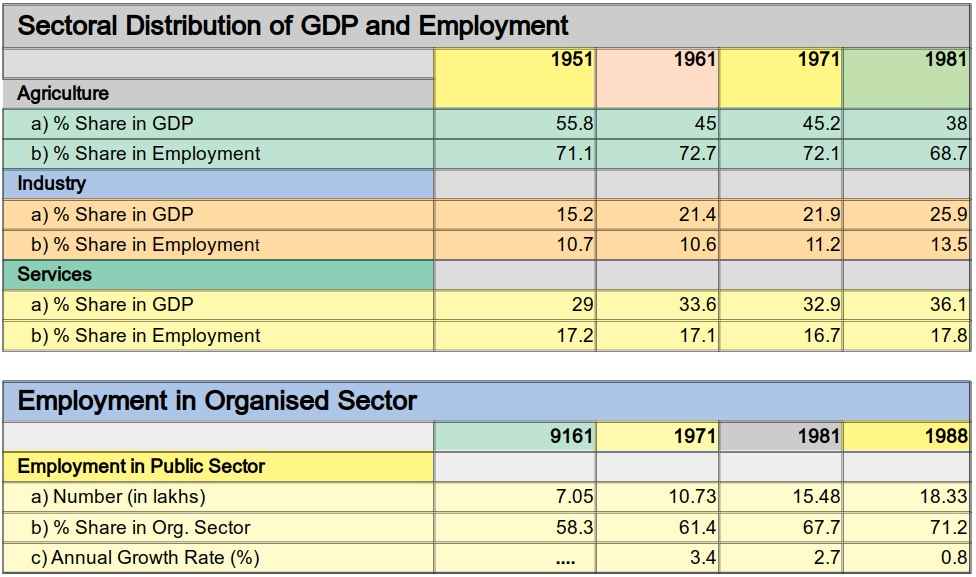
sector

I hereby promise you THE RIGHT TO get WORKed up”                   --- Biswanath Pratap Singh.

Job SEEKERS : (in million)
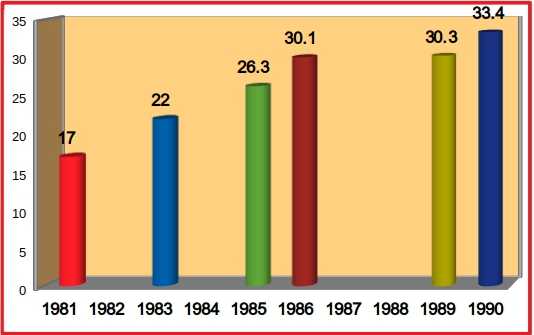
Job Seekers
Number of person on live registers of employment exchanges


HARD CURRENCY : A currency which is easily tradeable for goods and services and other currencies in any part of the world. For instance, the US dollar has universal acceptability as a hard currency. However, in recent years the Japanese yen is fast dislodging the dollar from its traditional position of global pre-eminence. The IMF, however, generally uses a combination or basket of currencies which is called a Special Drawing Right (SDR). At present, the value of 1 SDR is a little more than 1 US dollar.

HOT MONEY : Funds which flow into a country to take advantage of higher interest rates prevailing there. In India non-resident Indians have been depositing such 'hot money' because of the government offering them special rates of interest and various concessions. The major danger with such deposits is that often this money is borrowed from other banks abroad and is a front for Indian investors with illegal foreign exchange. These deposits can also be withdrawn at very short notice suddenly depleting the government's foreign exchange reserves.

INDUSTRY : Like agriculture, industry in India is also ridden with ironies. Here are some of the major ones.

  • While India boasts of being one of the largest industrialised nations in terms of volume and also variety of output, in terms of cost, quality and management, Indian industry is highly inefficient.
  • While the share of industry in GDP is now almost equal to that of agriculture, industrial employment is only a small fraction compared to the workforce engaged in the agricultural sector. In other words, our industrial structure is highly capital-intensive while the country is short of capital and surplus in labour.
  • Our industry is still largely dependent on foreign technology, foreign funds and imported inputs. This dependence has been particularly aggravated in the eighties due to the policies of liberalisation.
  • Consumer durables has been the fastest growing industrial segment in recent years which signifies a sharp shift away from the production of essential goods needed by the masses of ordinary working people to luxury and consumer products for the consumption of the Indian elite.
  • While the concentration of assets in the hands of the top industrial houses has continued relentlessly the number of industries turning sick and the number of workers thrown out of employment has also risen atrociously.
  • Far from snapping the umbilical chord between trade and industry, large sections of Indian industrialists still prefer to operate in the twilight zone between production and speculation. Given half a chance many of our industrialists would close down their factories and embark on real estate business instead.
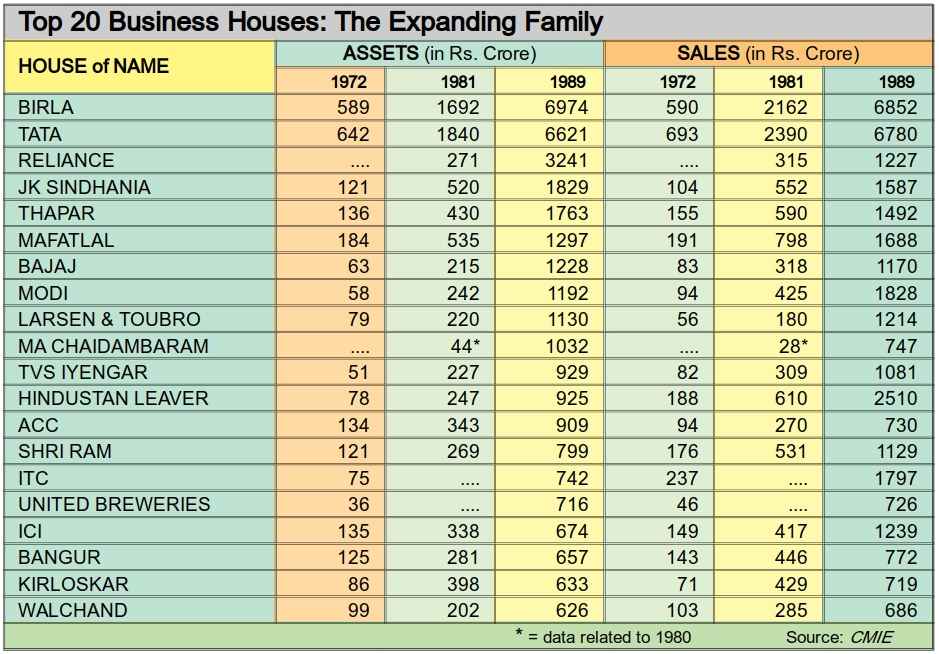
house


industry


performence


market


INFLATION : Inflation in simple terms is the rise in prices of various goods over a period of time. Basically this may be caused due to two broad reasons: (1) due to the 'cost push' given to the prices of key inputs like petrol, coal, steel etc. by the government which translates into an escalation of prices all around, and (2) due to increase in the supply of currency circulating in the economy resulting in ‘too much money chasing too few goods'. For example the money supply in the economy is increased whenever the government faced with shortage of funds to balance its expenditure resorts to the easy way out by simply printing more currency notes for its use.

But a close examination of the economy reveals a number of additional culprits: (1) the large amount of credit given to the corporate sector in the past decade which has also enormously increased the money supply in the economy, In fact in 1989-90 the private sector had borrowed Rs. 22,630 crore from banks as against a borrowing of Rs. 19686 crore by the government, (2) the indiscriminate increases in indirect taxes affecting prices of essential commodities, and (3) the entry of vast amounts of black money in the trade of various goods and increased speculation in real estate.
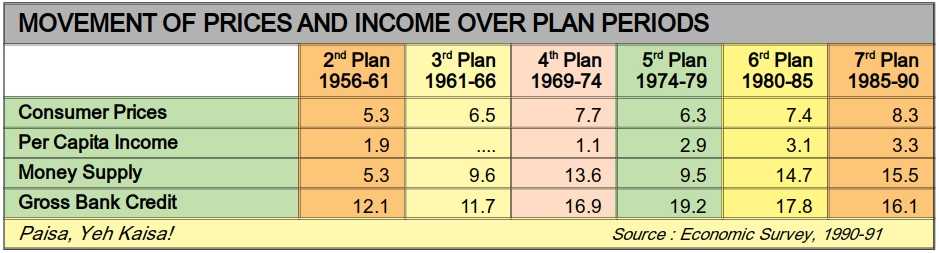
movement


Purchasing Power of Rupee (with 1960 as base)
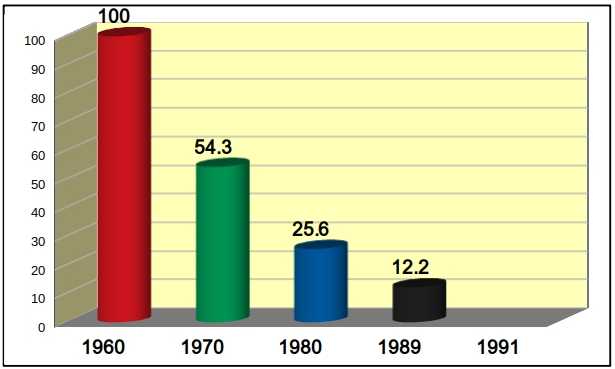
purchage

Source : Statistical Outline of India (Tata Services), 1989-90

IMF-WORLD BANK

The Deadly Duo of Debt Imperialism

IMF IS the abbreviation international Monetary Fund. And the full name of World Bank is the International Bank tor Reconstruction and Development. As implied by their names, the two organisations have a formal difference in their functions. The Fund is more in the nature of a general lending agency while the Bank arranges loans for specific projects and also monitors the development and working of such schemes. But the two are not only twins, they also work in tandem.

The inception of these twin organisations in 1945 through an international conference at a place called Bretton Woods in the United States was an integral part of the global realignment of forces after the Second World War. Though these organisations have a multilateral appearance and composition and their funds come from the contributions of various member countries, in reality like the United Nations these two organisations are also controlled by the big industrial powers, the United States in particular.

In the garb of promoting international economic cooperation, the Fund-Bank nexus has proved itself to be the most trusted custodian of the interests of the imperialist economic order. The IMF has in fact emerged as the supreme arbiter of the global loan market and attained complete mastery in the an of influencing the economic policies of the debtor country with a meager amount of debt. For instance, the share of our borrowings from the IMF in our total external debt was only 4.75% in 1980 and went up to a peak of 14.78% in 1983 before declining to sheer 2% by 1990.

The combine has several ways of playing this game. Apart from crude methods like direct intervention and imposition of conditionalities, it also uses subtler but often more effective means like educating and training Third World economists and administrators who then 'independently' steer their own economies along the Fund-Bank path. What is particularly galling about the Fund-Bank sermons to the developing countries is that the combine maintains a totally different standard for the industrial powers. For example, since the mid-80s the US has emerged as the world's largest debtor nation running up an external debt of over $ 650 billion by 1990. Further, its internal debt is currently an astronomical $ 3,336 billion whiie since1984 its trade deficit has averaged over $100 billion annually. And yet, as the Cuban leader Fidel Castro put it a few years ago, the IMF never sends its experts to the White House to correct its most in incredible deficits despite its location just a few blocks away from the IMF headquarters in Washington".


INTELLECTUAL PROPERTY RIGHTS : This refers to the view that inventions, research and development constitute 'intellectual property' and any use of such work should entail payment of royalties or fees like in the case of actual material properly. The advanced nations led by the United States have been insisting that all developing countries sign the treaty concluded at the Paris Convention which lays down the norms for protecting patents for expertise and technology developed in different parts of the world. India along with several other third world nations was put on the Super 301 and Special 301 lists by the United States whereby exports from these countries were threatened with severe restrictions for allegedly not protecting the rights of 'intellectual property' of the United States.

Signing the Paris Convention would mean that Indian farmers will have to pay royalty to the Americans for using high yielding variety seeds and Indian drug companies would have to shell out huge sums of money as patent fees for manufacturing even the simplest of medicines. While the US makes a lot of noise about protecting its own 'intellectual property' it keeps silent on the billions of dollars that third world nations lose annually due to the westward migration of their professionals. Maybe it is time the Third World started demanding 'royalties' from the West for the phenomenal siphoning of resources and valuable knowledge during the entire colonial era and now the on-going brain drain in the age of neo-colonialism.

Brain drain costs India $51 billion

LONDAN, April 14, India transferred over $51 billion in brain power to the United States and other Western nations between 1967 to 1985, according to a study by two leading British scientists.

The study said that when skilled people like engineers and scientists move to other countries they take with them all the capital invested by state resulting in a brain drain. The capital referred to here is the money spent on education and training.

Experts estimate that by adding the money that it takes to educate a scientist or engineer and their average productivity. India transferred $51 billion in human capital to the United States between 1967 to 1985.

Professor Alan Smithers and Professor John Pratt of the University of Survey, in their study said that industralised nations, most notably the United States, encourage the influx of scientists to meet their growing demand.

The study also found that between 1974 and 1988 the number of immigrant scientists and engineers in the United States doubled to 10.5 per cent of the total from 5.8 per cent and the five leading sources of this talent were India, Britain, Taiwan, Poland and China.

The UN Conference on Trade and Development (UNCTAD) found that some developing countries lose 20 per cent to 70 per cent of their annual output of doctors. Over the last two decades, the number of American earning advanced degrees has declined, leaving empty seats that have been fulled by foreigners.

Doctoral degrees earned by non-citizens in 1972 was 15 per cent and in 1989 it was 26 per cent. In new Jersey Institute of Technology, 734 out of 887 full time students are from Asia. In the University of Texas 205 of 355 civil engineering students are non-Americans. At some universities foreign application out-number domestic ones.

Also, Americans cannot make the grade because on lack of motivation and training from kindergarten to collage level. The drop has been steepest in technology and hard sciences. – ANI


LIBERALISATION: This is the term used to describe the process of removing curbs and control son domestic and foreign industry in the economy. Initiated by Mrs Indira Gandhi in the early eighties after the first IMF loan this policy was pursued vigorously by Rajiv Gandhi from 1985.. While the removal of red tape and bureaucratic controls over the economy is always welcome, in India this has meant basically unrestricted freedom for domestic big business houses and foreign multinationals to reap super-profits and for the social elite to buy all the consumer goodies they want with borrowed foreign exchange while at the same time shackling the common people in the prisons of unemployment and poverty.
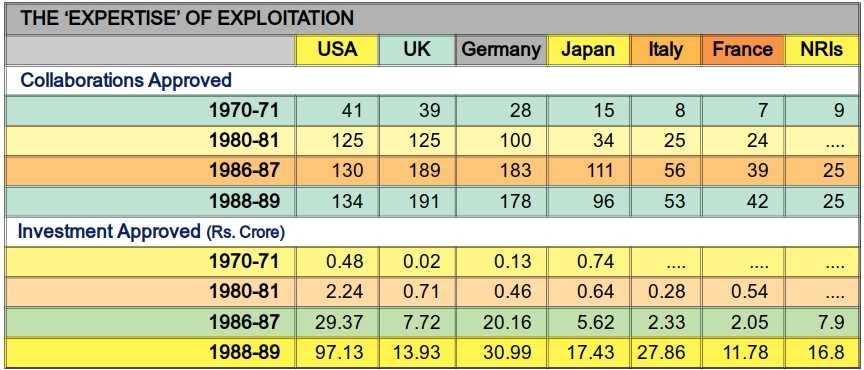
Expertise

Source : CMIE

THE ACQUISITIVE CLASS

% of 18-30 year olds living in households* owning the following consumer durables

*= families with a month income above Rs. 2,500 in the four metropolitan cities
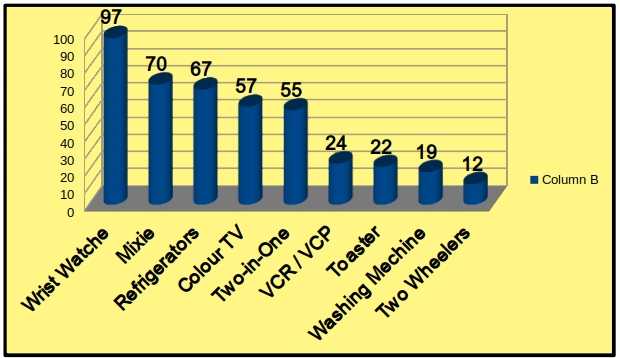
acquisitive

Source : PATHFINDER Survey

MULTINATIONALS: These are giant size companies with assets and production bases spread over several nations outside their parent country. Many of the multinational corporations, or MNCs as they are commonly called, today have turnovers larger than the gross national products of many third world nations. For example ITT, one of the largest US multinationals has 700 subsidiaries in 67 countries on 6 continents and alone accounts tor one third of USA's balance of payments.
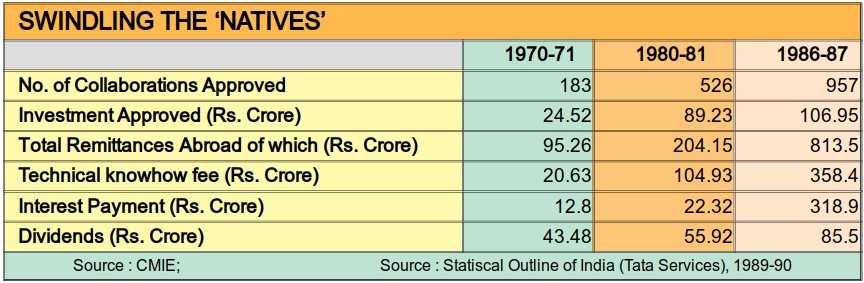
 

natives

Multinationals

The Fatal Attraction!

THE $ 70 billion debt burden is not the only indication of our declining national strength. Perhaps a more frightening pointer is the sordid clamour for attracting foreign investments in the country. The official propaganda machine wants the nation to forget the 'absurd dream' of self-reliant industrialisation and development and take to worshipping everything foreign or 'global', as the new rhetoric goes. We are being told that foreign investment is a much more lucrative proposition than foreign debt, for our headache to pay interest will be replaced by their headache to earn profit. And they cannot earn profit without giving us a share in the shape of greater production, employment, wages, exports, technological knowhow and what not! Moreover, total foreign investment in our country is still only $425 million, less than a third of what even China has, $1400 million.

All this is excellent suicidal logic, China has a GDP double of ours and what is more crucial, their manufacturing output is four times larger and exports more than threefold. And thanks to her superior national, economic and political strength, socialist China has far greater manoeuvrability and bargaining power against foreign capital than India. Moreover, our experience with foreign capital shows that (a) in most cases foreign investment does not mean opening of new factories or fresh addition to productive capacity, it just means transfer of shares in existing companies from India to foreign hands with the obvious implications of a shift in managerial control and outflow of national resources, (b) instead of earning foreign exchange for us through exports, foreign investment shows much greater interest in capturing the market of low-priority, high-profit consumer goods and thus eating into the domestic industrial base, Pepsi being a scandalous current example, (c) foreign investment is generally accompanied by a technology which is internationally outdated and nationally inappropriate, wasteful and labour-displacing, and last but not the least, (d) foreign capital is often found to operate in a most shady and arbitrary manner, defying every modicum of accountability and flouting every law of the land, even committing genocide with impunity.

Bhopal was no aberration, if only exposed in a brutally objective manner what a reckless and arrogant multinational can mean to a people. Especially when it is abetted and shielded by a corrupt, anti-people and spineless government. And while our collective conscience continues to rage against the disgrace of Bhopal, recent history of Asia, Africa and Latin America is replete with examples of subversions of a different order – multinational-sponsored military coups, large-scale espionage and fascist insurgency operations and propping up of any number of corrupt and authoritarian regimes.

The attraction of the multinational could well be fatal.


NON-RESIDENT INDIANS: They are people of Indian origin living abroad and engaged as employees, professionals or businessmen. The government in recent years has identified NRIs as a potential source of investment in the country and offered a number of incentives including as in the present budget a scheme whereby they can deposit any amount of funds in Indian banks without any questions being asked about the origin of the money. While genuine and patriotic-minded NRIs should no doubt be encouraged to contribute to national development, in actual practice many NRIs are nothing but fronts for Indians with black money or for smooth operators abroad looking for concessional NRI avenues to enter the lucrative Indian market.

POVERTY LINE: Poverty in India has been defined as that situation in which an individual fails to earn income sufficient for bare means of subsistence. Poverty line is a cut-off point used to quantify the extent of poverty. One indicator used is the calories of nutritional intake of a person with the cut-off point calculated as 2250 calories per person per day. Using such narrow criteria the Indian government has been claiming that the percentage of poor in the total population has been steadily declining. The absurdity of considering nutritional intake alone as a criteria to determine poverty is evident from the fact that other vital inputs such as shelter and clothing have not been taken into account.

Ironically, while on the one hand the Indian ruling elite is trying to model its own standard of living along the consumption patterns of the affluent West, it refuses to redefine the concept of poverty line in India which is really nothing more than sheer starvation line. In monetary terms, a family of four in the US is regarded poor if its earnings are below $11,000 a year or $ 900 (i.e., more than Rs. 20,000) a month. In India, in sharp contrast, for a household of five the Planning Commission put the poverty line at an annual income level of Rs. 9120 in urban areas and Rs. 7,980 in rural areas for the year 1987-88.

DUNKELSPEAK!

URUGUAY ROUND : Eighth round of multilateral Trade Negotiations being held under the auspices of GATT. Since the round was launched in Punta del Este in Uruguay (in September 1986), it bears the name Uruguay Round even if meetings of this round are held in Geneva or elsewhere. The round, launched primarily at the initiative of the US and Japan, saw the GATT purview being extended to trade in services and various aspects of domestic policies including patent laws, treatment meted out to foreign investment and subsidies given to various groups of producers.
TRIPs: Trade-Related Intellectual Property Rights
TRIMs: Trade-Related Investment Measures
CATS: General Agreement on Trade in Services
PARIS CONVENTION : Multilateral economic treaty for the protection of industrial property, dealing with patents, trademarks and designs. Founded in 1683 by 13 members, mainly the imperial powers and their satellites.
SPECIAL 301 : A clause in the United States Omnibus Trade and Competitiveness Act 1988, under which India has been put on "priority watch" list since June 1989. The threat was carried out on April 30, 1992, when Indian exports of drugs and pharmaceuticals were struck off the duty-free list for India's alleged violation of US intellectual property rights.


GATT TALKS

Don't Say Uncle to Dunkel

UNLIKE in the past when GATT negotiations were confined to inter-country trade issues, the Dunkel proposals bring within their fold subjects of domestic policy lke patent laws, subsidies provided to farmers and exporters and investment and banking practices, thereby undermining the freedom of individual countries to choose internal policies of their liking,

The implications of succcumbing to the pressure to conform are grave for India.

a) The country's existing patent laws will have to be changed to grant product patents instead of just process patents as at present. This will prevent Indian manufacturers from producing domestically any product patented abroad, making imports inevitable and pushing up prices especially in the vital area of medicines.

b) The government wilt lose all control over the working of patents. This means that the production of items of national and social importance will be left to the whims of the patent holders, and that too foreign ones.

c) India will have to cut down subsidies to farmers or face penalties. This will increase the cost of agricultural inputs and push medium and poor farmers out of work with dangerous implications for the nation's food security.

d) The patenting of seeds and plants will force Indian farmers to pay royalties every time they sow a new crop and make the county's agriculture totally dependent on multinationals.

e) The proposals do not give India any advantage in its two areas of strength vis-a-vis other nations i.e., textiles and services in terms of increased access to Western markets, while India will have to give MNCs a free hand in entering the domestic market without imposing any obligations on them.


PROTECTIONISM: The practice of imposition of barriers by a government through tariffs or quotas to restrict inflow of imports into the domestic economy. While the developed countries are pressurising developing nations through forums like GATT and IMF into opening up their markets they themselves are zealously guarding their own domestic markets behind increasingly protectionist barriers.

SERVICES: These include a whole array of governmental and private activities in the fields of administration, law and order, defence, construction, banking, insurance, education, culture, advertising, media, tourism and the like. The original role of the service sector was that of a lubricant for the economic machine moving on the wheels of agriculture and industry. However in India there has been a totally disproportionate swelling of the service sector with little relation to the actual requirements of the economy and society. And again within the service sector basic needs like housing, healthcare, education and social welfare get the least attention while administration, defence and internal security comer the lion's share of funds.
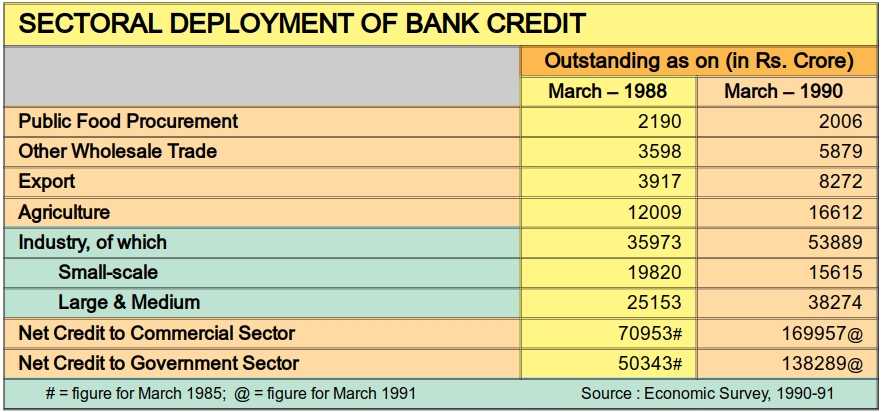
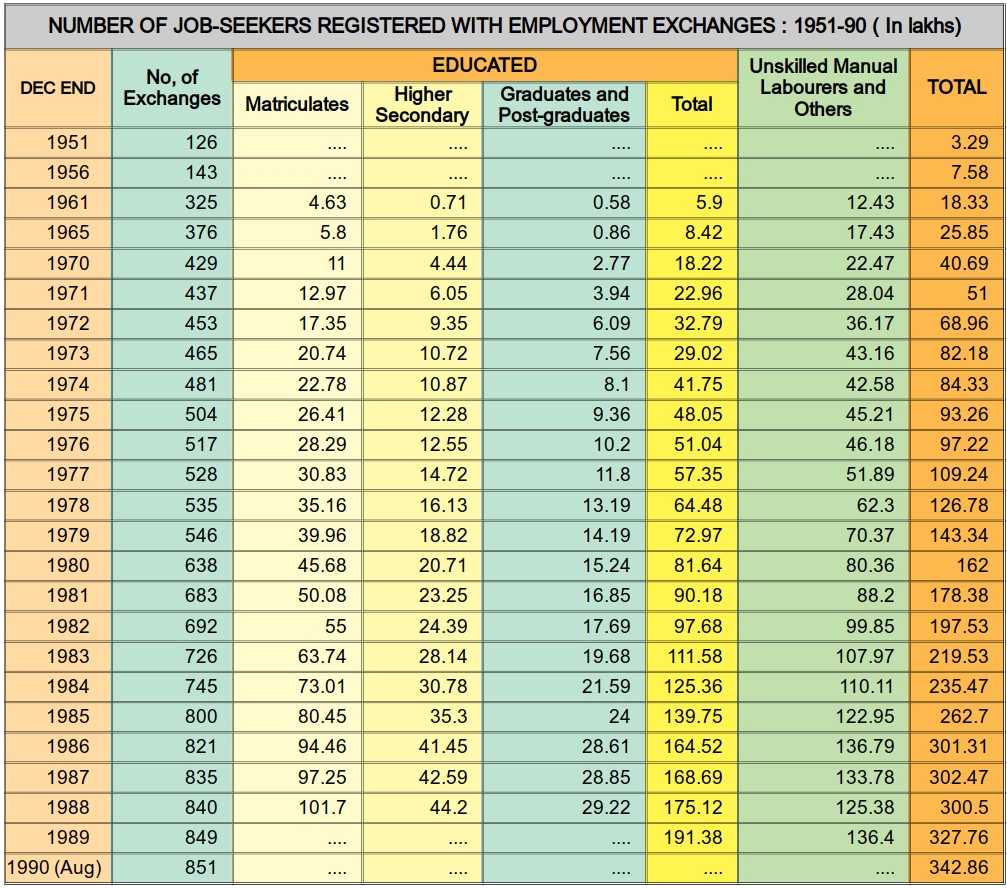
 

sectoral


job seeker


STOCK EXCHANCE : A market where shares and securities of various companies are bought and sold. This institution which has become a key symbol of capitalist economies is basically a mechanism through which companies raise funds ostensibly for use in setting up new industries and improving existing ones. It is also supposed to be a forum for the general public to invest its savings and earn interest and dividends according to the performance of the company whose shares they have bought. In actual practice it is found that brokers and industrialists who can manipulate the stock market make more money out of indulging in speculative selling and buying than by using the money for generating profits through production.

SUBSIDIES : Subsidies are compensatory payments made by government agencies to producers and traders of goods and services with a view to holding the concerned prices below a specified level. For example the fertiliser subsidy paid to fertiliser manufacturers is supposed to enable them to sell the product at below production costs to farmers. Scrapping of subsidies has always been a standard prescription of the IMF. But the real problem is that the bulk of subsidies in India are not properly targeted. For example, not even half of the total subsidy on health services and one-third of the subsidy on water supply, sanitation and housing flow to the rural sector which houses 75% of the overall population and also the majority of the population below the poverty line.

According to a study commissioned by the Planning Commission on the subject in 1987-88, the actual volume of subsidies was a phenomenally high Rs. 43,324 crore which is almost 15 per cent of the country’s GDP. The same year however the government showed a total subsidy bill of only Rs. 5,892 crore in its budget. The question that the IMF and its pet economists cunningly evade is who gets these huge ‘hidden subsidies’ and why is nothing being done to stop the criminal drain and misuse of this public money.

Economic Growth

Opium of the Economists

AFTER the magic term 'liberalisation' the one other mantra chanted most by establishment economists has been 'growth'. At the end of the Seventh Five Year Plan, we are told, the country achieved a growth rate in GDP of 5 per cent and in the next Plan this is slated to go up to 5.5 per cent. But impressed by the rhetoric, when we look around us, we first see only decline all over. Decline in our real incomes, decline in government services, decline in employment, decline in the quality of life. Ah yes, how stupid of us not to see the 'growth' – in prices, the assets of the top business houses, the luxurious consumption of the middle and upper middle classes, in the country's external debts and trade deficits, not to speak of the 'growth' in the per capita availability of colour television sets and Maruti cars.

The word 'growth' while having every positive ring about it paints, like most other terms in economics and statistics, a very distorted picture of what is really happening to the Indian economy. On close scrutiny one finds that even the much touted 5 percent rate of growth has been conjured up only by tagging the booming service sector to the relatively slow-growing agriculture and industry which really constitute the backbone of our national economy.
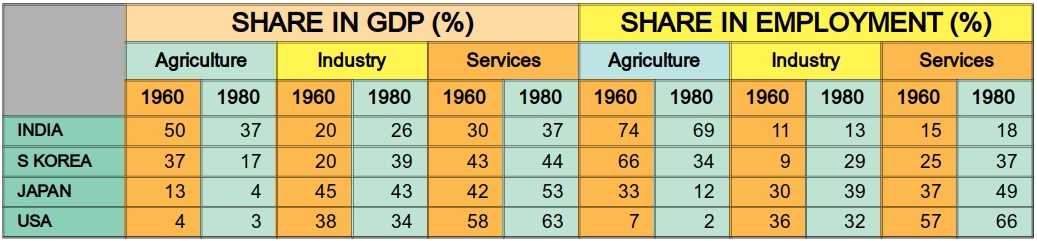
share in GDP


But isn’t the expansion of the service sector the hallmark of a developed economy? Yes it is, but the problem that in our case this growth resembles more an under nourished body with as shollen head. The rapidly increasing share of services in GDP is only a sign of lopsided development, whereby the country acquires the glamour and gloss ot an advanced economy while remaining basically poor and without a proper foundation in industry. Also disturbingly unlike in the advanced nations, where the growing service sector absorbs a proportional section of the national workforce, in India it accounts for barely one fifth of the labour force while cornering more than 40% of the national income.

A conspicuous consequence of such abnormal growth has been the swelling of a segment of the society, which while not producing anything tangible and contributing little to the economy, fuels inflation with its high spending power and promotes an import-hungry consumer durables market. The cost of this ‘growth’ is borne of course by the urban and rural poor for whom the only thing that grows is their long list of miseries.
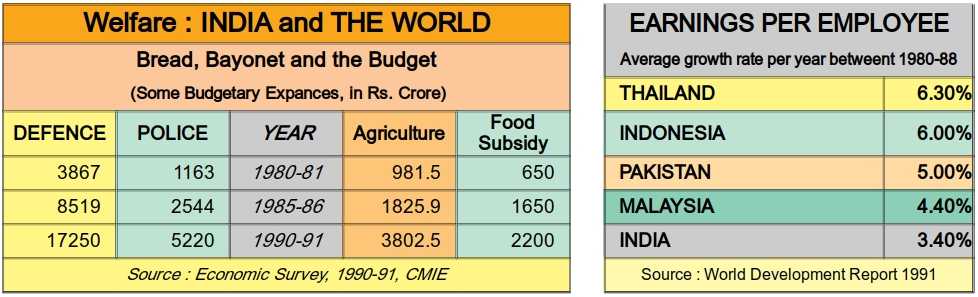
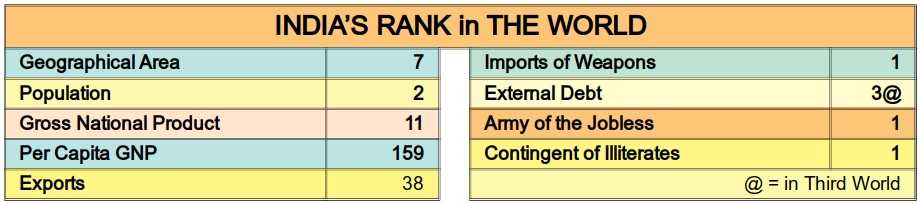
 

Welfare


rank
India And The IMF Loan :: Sold For A Few Dollars More!

Publisher

IIMS Publication

Language

english

Year

1992

Published Date

11-06-2025

Get Updates

Join our official channels for latest updates.

WhatsApp Telegram Mobile App (Coming Soon)

Subscribe To Our Newsletters

Stay updated! Subscribe to get the latest updates right to your inbox.

Connect With Us!

Follow us on Social Media for the latest updates

Party Organs

  • Liberation
  • MLUpdate
  • समकालीन लोकयुद्ध
  • আজকের দেশব্রতী
  • தீப்பொற
  • ಕನ್ನಡ ಲಿಬರೇಶನ್

Useful Links

  • Documents
  • Organisation
  • Statements
  • GJSC
  • Gallery
  • Books

Important Links

  • About
  • Privacy Policy
  • Disclaimer
  • Help
  • Contribute

CPIML Liberation

Charu Bhawan, U-90, Shakarpur, Delhi 110092
Phone : +91-7042877713
Email : info@cpiml.org

Communist Party of India (Marxist-Leinist) Liberation | 2026 © Creative Commons Attribution-ShareAlike 4.0 (CC BY-SA) license