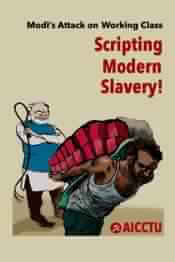
AICCTU Publication
U-90 Shakarpur, Delhi - 110092
Phone: 91-11-22521067 e-mail: aicctu@gmail.com
website: www.aicctu.org facebook: www.facebook.com/AICCTU.HQ
twitter: @AICCTUhq
Published by Rajiv Dimri on behalf of AICCTU
Contact: 9205642035

IN Marx’s memorable words,
"If money, according to Augier, [14]
“comes into the world with a congenital blood-stain on one cheek,”
capital comes dripping from head to foot, from every pore, with blood and dirt.”
INFORMALISATION, outsourcing, casualisation and contractualisation are the strategies of capital to circumvent hard-earned labour rights and to maximize profits. Fixed Term Employment and Apprenticeship are the new strategies for ‘Hire and Fire’. The existing labour law protections are being done away with in order to expedite the process of restructuring of the labour market according to the demands of capital. With the dismantling of public sector from commanding heights, rampant privatisation, liberalisation of economy, end of planning machinery and with imperialist globalisation, the private capital has taken over the reins of power.
In such a backdrop, the advocates of Indian capital are worried about the mismatch between the process of liberalization and labour legislations of the period of state capitalism. In their opinion, labour market conditions were more distorted owing to ‘protective' legislations for the organized sector workers who are only 7 percent of the total work force. On the other hand, 93 percent of the unorganized sector workforce that was not covered by any meaningful legislation was a potential detonator waiting to explode any time like the growing unemployed workforce. Even though it is a fact that these laws are more often than not illusory with poor implementation, yet by their mere existence - legitimising workers’ organising for implementation of the laws - is seen as too much of a hurdle to the capitalists. The proposed legislations are expected to demolish trade union rights and to postpone the possibility of an explosion of the disgruntled unorganized sector workers. It is an attempt to match labour market conditions with the process of liberalization.
While the unprotected and cheaper unorganised sector workers are expected to compete with the global labour, the organized workforce in the country is expected to compete with the domestic unorganized labour. Labour reforms to restructure the labour market corresponding to the pace of globalisation and liberalization process is something ‘inevitable' in order to resolve the so-called ‘mismatch'. The present phase of dismantling of the labour law protection regime that was earned by the militant struggles of the working class was preceded by the disinvestment and privatisation policies of the State since 1991.
Legislation on Special Economic Zones that would exempt the zones from the applicability of labour laws, amendments to Industrial Disputes Act that would make retrenchments and closures – hire and fire – much easier, allowing night work for women, amendments to the PF act that would make the fund meant for the protection of workers' future vulnerable to financial market fluctuations and handing them over to private parties through Pension Fund Regulatory and Development Authority (PFRDA), the newly found ‘principle' of allowing markets to decide the wages of government employees that would guide the Central Pay Commissions, and the proposed executive orders and rules, etc. are perfectly complementary to each other. Its purported objective of an ease of doing business is a direct attack on the most basic of rights of workers. In fact, the Modi-led BJP government attempts to create a conducive atmosphere through executive orders and circulars first and subsequently amending apparently 'minor' changes in necessary acts that does not fall under Parliamentary scrutiny or that can escape any scrutiny as was done in the case of Standing Orders Amendment Act.
WE are a nation where almost 60% of workforce is still dependent on agriculture as their source of livelihood, yet whose contribution to national income is steadily declining. The industrial capital has, till date, failed to absorb the surplus labour from agriculture and from rural areas. It is only the ‘push' factor, triggered by the agrarian crisis, and not the ‘pull' factor that normally accompanies industrial growth – that is mainly responsible for large-scale migration of rural work force to urban areas in search of employment. Almost three decade-long implementation of globalisation and liberalization policies has resulted in the growth of gross inequality. The neoliberal economic policies have added few more billionaires in the country, but this has been at the expense of millions of poor becoming further poorer and starving.
A vast unorganized sector that contributes 65 percent of the GDP, employing more than 40 percent of the total population and comprising 93 percent of total workforce in the country is one major distinguishing feature of Indian capitalism. Though several legislations are fully or partially applicable to the workers in the unorganized sector, none of these is being properly implemented. They do not have any job protection or social welfare benefits.
IN the era of liberalization and globalization, workers are fragmented into different sections; there are some permanent workers on high wage islands working in MNCs, big corporate houses and in public sector, while at the same time there are poorly paid, totally unprotected contract and casual workers. This section of permanent workers is progressively declining while workers with not even minimum wages are increasing manifold. Some MNCs have learnt the lesson and found a route to bye-pass even the constricted and convoluted existing labour laws by employing workers in the name of trainees only for 6-8 months period. Every establishment now simultaneously employs permanent workers, contract workers, trainees and apprentices, daily wagers and casual workers with only the permanent workers having any semblance of wage, job and social security. Even this is not guaranteed to these permanent workers especially in sectors without any trade union presence such as the garment sector for instance. Workers are denied job security, wage security and with new laws in place, the barest minimum social security of ESI, PF too. According to new laws, ESI and PF have become optional and the companies are legally free to obtain some namesake insurance and get away with it. The government is coming up with the concept of ‘regular’ employment in place of ‘permanent’ employment which can be taken care of by legalizing ‘Fixed term Employment’.
The Modi-led BJP government is now toying with the idea of getting rid of the mandatory obligations of minimum wage and introduce a concept of ‘Floor Wages’ which is almost equivalent to Rs. 4500 – 5000. Thus, the concept of ‘minimum wages’, which is any way nothing but starvation wages in real sense, is also being replaced by so-called uniform ‘national wages’. or Floor wages. Please note that it is not Rs. 18,000/- as hyped by rumour mongering fake news media. 8 hour work day is denied and the 12 hour work day has already come to stay in most of the private sector companies.
New amendments suggest that contract workers cannot claim ‘Same pay for Same Work’ and rather, they can only claim minimum wages in the state. Hire and Fire is the norm. Contract labour system is being relegated to a second position with a system of apprenticeship and trainees, where payment of minimum wages is not mandatory, is being pushed to overwhelm the employment pattern. To raise number of apprentices from the level of 3 lakhs to 30 lakhs in next three years is the perceived action plan of the government.
Almost 75 percent of the companies are going out of the purview of labour laws with an amendment of the condition to seek government permission for retrenchment and closure from 100 to 300. If you raise any hue and cry against removing the condition of taking permission for retrenchment for companies employing more than 300, then the nomenclature of companies established within 5 years and having operating capital less than Rs. 25 crores, is stated as ‘Start ups’ to keep them out of the ambit of any labour laws.
The procedure for forming trade unions is being made cumbersome and registrations of general workers’ unions are already being denied. Workers’ fundamental ‘Right to Strike’ is also being snatched away in various forms. All these existing laws were enacted only after huge sacrifices and militant strikes by the working class. In such a context, the working class movement today is compelled to take up centuries old demand of 8 hour work day and trade union rights. Building a resistance movement against anti-worker, pro-corporate amendments have become our major task today and we should prepare ourselves to make the working class fight back. The working class has to prepare itself not for its own freedom but also the freedom of all people and for the right to dissent and resist. It is possible only through militant struggles against corporate, communal, manuvadi fascism.
Changes in land acquisition laws to facilitate corporate land grab, and pro-employer reform of labour laws are the foremost agenda of Modi government today. Even well before consolidation of 44 central laws into 4 codes, namely on Wages, Industrial relations, Social Security and on Safety and Service conditions, the codes are becoming redundant with the proposal of 3-Year (2017-18 to 2019-2020) Action Agenda by NITI Aayog. The Action Plan has not minced words in saying that codification of laws into 4 is not sufficient unless they are backed by rapid reforms in labour laws. In effect, now, the major issue is informalisation of the formal and disorganization of the organized. The idea is to make the formal working class sector much more informal so that existing formal labour can be forced to compete with the informal. In the name of rectifying the situation of ‘low productivity and low wage employments’, the government is pushing high wage workers also to low wages.
It is not SEZs (Special Economic Zones) of hundreds of acres that are exempted from labour laws any more. Instead, declare the entire eastern and western coasts of thousands and thousands of acres as CEZs (Coastal Employment Zones), declare industrial and freight corridors and make labour laws redundant for lakhs of workers. This is the proposed strategy of the present Modi-led BJP government.
Liberalisation of Labour market to make it consistent with liberalization of economic policies has been a long pending agenda, yet previous governments were hesitant to touch this. With increasing pressures from IMF and other transnational institutions, imperialist dictates and with the assumption of central power by corporate communal manuvadi fascists, the agenda of market-driven labour conditions and anti-worker reforms has come to the fore. Even MNREGA is being dismantled to allow abundant supply of labour force in cities so that prices of labour power can be depressed to the lowest. Affordable housing and other such schemes are only to provide a cushioning effect to the impending crisis. Abundant supply of labour to depress price of labour, in turn to reap super profits, is the strategy being perceived by the government now.
IT is an established fact that rapid growth rate of GDP alone cannot address the requirement of massive additional job creation. But, the capitalists and the governments have adopted the theory that rapid growth rate alone can achieve it. The result is there for all to see.
India's count of the unemployed is likely to increase from 18.3 to 18.9 million between 2017 and 2019 and the share as well as the absolute numbers of those in vulnerable employment is also likely to increase. The share of informal jobs, for all sectors and non- agricultural sectors, are put at approximately 90 percent and 80 percent, respectively. A recent World Bank Report titled “Jobless Growth?” paints quite a bleak picture: “The demographic transition is swelling the ranks of the working-age population across most of South Asia. In this context, keeping employment rates constant would require massive job creation. But there is a widespread perception that increases in the working-age population have been offset by declining employment rates, and that women accounted for the most of the decline (page 29).” Based on its estimate of the number of people aged 15 and above, the Report projects that to even maintain constant employment rates up to 2025, India will need to create at least 8 million jobs per year. We may also note that India's own official estimates of the net new entrants in the job market at the current juncture have been put between 10 to 12 million every year. BJP manifesto promised to create 10 – 20 million jobs per year but only created 4 lakhs jobs in 2016-17.
As per the official estimates, there is a need to create 10-12 million jobs every year to absorb the potential entrants to the labour force. The latest estimates, available from the Labour Bureau, paint an extremely depressing picture with respect to the pace of job creation. Apart from being nowhere near what would be required to facilitate near full employment, there has been a staggering decline by about 90 percent in creation of new jobs; the figure for new jobs has come down from about 11 lakhs in 2010 to 1.5 lakhs in 2016.
Even the latest Economic Survey of the Government of India acknowledged serious negative fallouts of these measures for the different dimensions of the economy, including the employment generation. Likewise, according to the CMIE – CPHS data about 1.5 million jobs were lost, during the first four months of 2017, which was attributed to Demonetization. Several industry and manufacturing associations and field studies from individual researchers reported very significant job losses due to the shocks of Demonetization and GST during 2017 and 2018. There were reports of large scale retrenchment of workers, substantial instances of reverse migration (from urban to rural areas) and increase in the employment demand under MGNREGA, etc. If we take all these in conjunction with the trend reported by the Labour Bureau annual surveys between 2011–12 and 2015-16, it is very obvious that the Modi-led BJP government is clearly pro-corporate and against the labour and employment generation.
It appears that those already employed have now been registered due to the recent government policies. For example, prior to 2016 only enterprises with more than 20 employees on the rolls required mandatory registration under the EPFO, which was brought down to 10 in 2016; thus, because of the definitional shift there is an illusion of increased formal jobs, when in reality it is not any net increase in jobs. But, Modi government is trying to interpret it as massive employment generation.
A major worrisome trend is the relentless informalisation of work in the formal sector. Thus, as per the NSSO estimates of 2011-12 (which is the latest available estimate), count of informal labour was a whopping 447.2 million out of a total labour force of 484.7 million. Most of these workers can be classified as 'vulnerable' who work in insecure jobs with negligible social protection. As already noted, informality and vulnerability has been on the rise, despite, relatively high economic growth rates of GDP; withdrawal of the Indian state from several key areas in the social sector has only aggravated the vulnerability of the working class.
While the total employment in the organized sector has grown from 38.89 million in 1999-2000 to 81.6 million in 2011-12, the informal jobs within the organized sector increased from 15.95 million to 47.20 million during the same period. In fact, the share of ‘informal’ workers in the ‘formal’ sector increased from about 30 per cent towards the end of 1990s to about 58 per cent as per the most recent estimates of the NSSO. This indicates that an overwhelming majority of the new jobs generated in the organized sector in the last decade are informal in nature so that at present informal jobs constitute 58% of the organized sector employment. In sum, an overwhelming majority of workers are in casual wage employment or in self- employment, and most of them are trapped in extremely insecure work and living conditions, characterizing informal employment. It is also important to emphasize that the prospects of upward mobility for most of them are severely limited.
Although there has been some increase in employment of women in regular work in recent years, studies have shown that this growth is primarily taking place in community and personal services of which domestic work forms a considerable segment. The latest data of the Labour Bureau shows that while the participation rate for males in the most productive age group (18-29 years) in 2014 is 70.1, it is at an abysmally low figure of 29.4 for females.
The poverty head count for the workers of most oppressed castes like Dalits, is among the highest in the informal sector, and this is a function of the type of employment and discrimination across different axes that they are subjected to. The overwhelming majority of socially marginalized groups cannot get beyond manual, ‘menial’ and shop floor work.
The Arjun Sengupta Committee report said that more than 80 per cent of the country’s workers fall under the category of the ‘poor and vulnerable’ which meant that their daily per capita total consumption, at 2004-05 prices, was 20 rupees or less than that. There is no evidence of any significant improvement in the well-being of workers during the era of so-called economic reforms.
The growing trend of informalisation is reinforcing the duality and disparity between organized and unorganized sectors and between formal and informal employment. The process of structural transformation in the economy (moving people from low-productive to high-productive employment) is hindered by this growing disparity and inequality. Any labour reforms must aim to contribute to the reduction of this disparity by reversing the process of informalisation and by encouraging formalization of informal employment. Deregulation (reducing government intervention) or unleashing market forces will only lead to phenomenal increase of vast army of unprotected employees and may, in fact, aggravate it further.
Hence, the key and real issue is to enact legislations to protect informal work force in formal and informal sectors. Only a miniscule minority of around 7 percent of entire working class in the country is protected by a plethora of legislations which is also being scrapped now. Even multinational companies are only employing contract labour or trainees. Some companies employ trainees only for a day less than 6 months and send them out. There are many MNCs and corporate companies which employ only 5 percent of workers as their regular employees which is only the band of managerial staff and very few regular workers. In such a context, making hire and fire easier for the industries is only beating around the bush.
Hire and Fire may automatically become easier when there are abundant or alternative avenues of job. But, in Indian scenario, where unemployment rate is very high and employment generation is in the negative, making hire and fire easier can only help to create vast army of unemployed that is already becoming a social and political issue.
Underemployment, self-employment or vulnerable employment is a major problem in the country. The government is only talking about increasing it more with ‘pakodawalah’ model of self-employment and reducing formal, suitable and skilled employment. The human capital, which is an asset of the country, is being squandered.
POST-INDEPENDENCE, towards achieving rapid economic progress, massive investments were made in the establishment of the public sector undertakings. The Industrial Policy Resolutions of 1948 and 1956 demarcated the areas of operations of public sector and private sector. There was a radical change in government`s policy towards the public sector in 1991, with the adoption of a new industrial policy where the role of public sector was drastically reduced. In the earlier industrial policies, seventeen industries were reserved exclusively for the public sector, while twelve other industries were to be progressively made private owned. However, in the industrial policy of 1991 only eight industries including defense production, atomic energy, coal and lignite, mineral oils, iron ore, manganese, gold and diamond, atomic minerals and railways been reserved for the public sector. It also provided that if need arises private sector units may also be permitted to enter these industries. The most important feature of the 1991 policy on public sector was the introduction of disinvestment and privatisation of public sector undertakings in the name of Corporate Restructuring.
The Ministry of Disinvestment was also established in 2001 during the Vajpayee regime which was converted into a Department under the Ministry of Finance by UPA-I in 2004. Importantly, the disinvestment process, which began in 1991-92 with the sale of minority stakes in some public sector undertakings, shifted focus to strategic sales during 1999-2000 to 2003-04. Hindustan Zinc, BALCO, Maruti were taken up post 2001. The challenge to the disinvestment of BALCO in the Supreme Court was disallowed with the Supreme Court holding that it was a prerogative of the Government to disinvest in the public sector undertakings and the workers had no say in the matter. The illusion that the Courts would protect the interests of the workers which would be most affected by disinvestment was effectively shattered. In 2004, UPA – I updated the disinvestment policy but due to the intervention of the Left allies and struggles of the working class there was a lull in disinvestment activities. But UPA-2 without Left parties, resumed disinvestment process. The adoption of the policy of liberalization, privatization and globalization as a part of economic stabilization and structural adjustment programme in 1991, on the dictates of the World Bank and IMF, saw disinvestment being initiated in public sector as a route of privatization resulting in the work force being thrown out on a large scale. This, in fact, is not just a jobless growth but job snatching growth. Modi has accelerated it beyond belief by effectively introducing the outright sale and closure of public sector undertakings including NHPC, Coal India, ONGC, etc. Strategic sectors like Railways and Defence have been opened up for 100% FDI.
The idea of the government is to generate revenues through selling out profit making public sector in the name of disinvestment and fund the budget, instead of taxing the corporate houses and the filthy rich. Thatcherite buzzword of government has no business to be in business is the Mantra of Modi government. NITI Aayog has suggested strategic sale, an euphemism for ruthless privatisation, of 20 PSUs and disinvestment in another 20 PSUs. The sale of Air India looks imminent. Privatisation of railways is another major step. Even though handing over trains and tracks may not be that immediate, definitely handing over stations, hospitals and workshops to private corporate houses, foreign companies and PPP (Public Private Partnership) mode appears to be quite imminent. Partial privatisation of manufacturing units of Defence follows suit.
Disinvestment of PSUs is the strategy of 90s but the latest, after 25 years of disinvestment, is the end game of handing over of government and public sector assets to private companies. The government has set a record disinvestment target of Rs. 72,500 crores this financial year. Out of which 15,000 crores is to come from strategic sales of handing over to private players, land is to be part of the deal and management control will remain with the private companies.
The companies in which the government proposes to sell stake and hand over management control include Dredging Corporation of India, Central Electronics, Scooters India, Hindustan Prefab and Pawan Hans. Others include Hindustan Latex, Goa Shipyard, Triveni Structurals and HEC. Also, the government has drawn a list of 11 fields of ONGC and four of Oil India, in which 60% participating interest would be auctioned to private players. Commercial coal mining will now be opened to private. The Centre is expected to open 10 coal blocks for private commercial mining bids in 2018—four blocks each in Odisha and Chhattisgarh and one each in Madhya Pradesh and Jharkhand. Next step is to encourage private players into infrastructure development.
There are also talks about privatisation of power distribution, which might come through with the amendment in the Electricity Act 2003. Privatisation of public sector banks appears to have been put on hold, at least, for now, with capital infusion so as to make it more attractive for sales and to save future buyers from the hardship of any immediate investment to make it viable. Often privatisation leads to a situation that PSUs further bleed to death. The telecom sector is a case in point. The leading four telecom operators in the country are private players, which have pushed government-run BSNL and MTNL to a corner.
But, only saving grace is the parliamentary elections in 2019. Whether Modi government will take the risk of antagonising crores of workers through privatisation in the run up to elections is the question mark. But, the blue print for wholesale privatisation is ready and the route is being cleared through large scale disinvestment and whichever be the new government, irrespective of its colours, is just to follow the same.
INCREASINGLY, government programmes for provision of basic facilities are being dismantled, in many instances, with the onus shifting to private/ voluntary organizations or private companies. Mid-Day Meal through Self Help Groups appear to be the exclusive form adopted in West Bengal. In Jharkhand, it was observed that in the name of 'Jal Sahiya', workers are being exploited to the hilt. They are responsible for building toilets in every household, for testing water quality in each household, etc., but no regular payment but for promises of some incentive of Rs. 75 per toilet and Rs. 15 per test which was never received. These revised schemes denied basic rights to those engaged in working at the grassroots by designating them volunteers and not regular workers and paying an honorarium instead of salaries. There are today almost 20 million such workers who are denied the status of being workers. Under the Modi government, the agenda has become even more open and explicit, as all policies and schemes are now to be pursued with the help of international finance capital under the garb of ‘national development’.
The private sector is being lured by providing huge incentives to capture these social sectors for commercial purposes. On the contrary, budget allocations for schemes like MGNREGA, ICDS, NRHM, Mid-day meal, national literacy mission, tribal sub-plan, scheduled caste sub-plan, drinking water and sanitation, to list a few, are greatly reduced only to maintain some skeleton service.
FROM around 70% in early 1980s, the share of employment in agriculture declined to 60% in 1999-2000 and further to 49% in 2011-12 (Reports state that 58% are presently dependent on agriculture). Most striking is that for the first time since the recording of data on employment, the absolute number employed in agriculture has fallen; between 2004 and 2011-12, nearly 35 million persons moved away from the sector. Lakhs of farmers have committed suicide in view of agrarian crisis leading to increasing non-profitability of agriculture especially for those owning small parcels of land. Commercialisation and corporatisation of agriculture has driven small and marginal farmers to the brink and are forced to move towards urban areas in search of employment.
MGNREGA is a scheme designed to tackle the massive problem of rural unemployment. But, the purpose of the scheme is being defeated by delinking the MGNREGA wage rates from the Minimum Wages Act, 1948 and making it unattractive and unresponsive. This is further complicated when the central government has slashed budget allocation for the scheme. Choosing not to increase wages to any decent level, in real terms, has dealt a major blow to the functioning of the scheme and consequently to large segments of the most vulnerable sections of India's work force. Moreover, when urban areas are not able to pull workers from rural areas, massive push factor to urban areas in search of employment creates imbalance and thus results in huge crisis of unemployment.
ARJUN Sengupta Committee report suggested that when all the informal workers are covered under social security schemes (as per its projected model and package), the Union government contribution will be Rs 20,583 crore (including pension to below the poverty line workers and administrative expenses), and the contribution of state governments will be Rs 4,819 crores, by the end of financial year 2010-11. Overall, as per the projection of eight per cent GDP growth, this worked out to 0.48 per cent of GDP for the year 2010-11. Other estimates show that it is possible to raise these resources by improving the overall architecture of taxation in the country. The simple point is: meeting the needs of a basic level of universal social security is hardly expensive and does not in any way hurt the country’s global competitive potential. But, the Modi led BJP government is advocating insurance schemes to be funded by individual worker and to cater to the super profit dreams of corporate insurance mafia, including some MNCs.
ALTHOUGH firms employing less than 100 workers increased their employment more than larger firms, possibly indicating a threshold effect of Chapter V-B of the IDA (Industrial Dispute Act), allowing smaller firms to freely retrench, the difference was insignificant for manual workers. On the other hand, as compared to these smaller firms, a larger proportion of the bigger firms reported a decrease in employment, which increased with the size of firm. The inference was that these firms were not being deterred from hiring and firing, despite the IDA provisions remaining undiluted’. In his 2007 survey of labour issues in India, R. Nagaraj notes how the organized sector ‘shed 1.8 million (6.3%) jobs, mostly in manufacturing (1.2 million jobs or 18%)’ between 1997 and 2004. Numbers like these are hardly evidence of the lack of labour flexibility.
MOST significant labour laws – Industrial Disputes Act, Trade Union Act, Industrial Employment (Standing Orders) Act, Workmen’s Compensation Act, Payment of Wages Act, etc. – were enacted in the colonial period between 1926 and 1947 under the impact of Russian revolution and various other national liberation struggles in which the militant workforce was at the forefront.
The regulation of Indian industry began with the enactment of factory laws beginning in 1881 under pressure from the Lancashire industry which saw the Indian cotton mills’ unrestrained use of women and child labour and long hours of work up to 16 hours a day as ‘unfair competition’. Regulation remained weak and piecemeal till the completion of First World War, but interestingly we find in these ‘factory laws’ the beginnings of the practice of definitional thresholds so that a large part of the ‘traditional’ and small industries were deliberately kept out of the purview of regulation.
A major shift is noticeable post the First World War period in the 1920s. Goaded by the newly instituted International Labour Organization (ILO) and widespread industrial unrest following the war, the colonial state took the first measures to institute what we can call the modern labour law regime. The penal contract system was abolished and trade unions were given immunity against criminal prosecution for legitimate industrial dispute (1926). A series of welfare legislations such as the Workmen’s Compensation Act 1923, Maternity Benefit Act and Payment of Wages Act 1936 were enacted, alongside the revamped Factory Law of 1922. Common to all these laws, however, was the limited scope and definitional ‘threshold’ that excluded the vast majority of workers in establishments below a certain size or of a certain status.
The keystone of the emergent labour law regime, however, was the enactment of the Industrial Disputes Act of 1947. A spurt of industrial action in the late 1920s, chief among which was the famous seven month long general strike in the Bombay Cotton Mills in 1928 and 1929 led by the communist trade union, Girni Kamgar Union, led to the passage of the Trade Disputes Act of 1929 which formalized state intervention in industrial disputes, with provisions prohibiting strikes and lockouts in public utilities and specifying the process of adjudication by the establishment of a board of conciliation or a court of enquiry for arbitration and adjudication under state authority. That this act was passed when the communist trade union leaders were incarcerated for long periods under charges of conspiracy and sedition needs to be emphasized, as also the fact that in the Imperial Legislative Council moderate trade unionists like N.M. Joshi opposed the provisions of the act, tooth and nail. A significant incident associated with this legislation is that Bhagat Singh and B.K. Dutta threw a bomb and courted arrest, while it was being fiercely debated in the Imperial Legislative Assembly. The aim of the then proposed legislation was to tie down and channelize the rising working class movement
into legally approved channels away from militant strike action. It was only partially successful.
MODI has declared a veritable war on the working class. The minimal protection in the form of labour laws that have been snatched from the ruling classes over a century of bloody struggles in which thousands of workers have sacrificed their lives are now being cast into the bin. Bowing to the dictates of imperialists and their agents like the Adanis and the Ambanis, Modi is determined to reduce the working class to slaves under the ominous sounding slogan of “making business easy”. Modi does not shy away from being the agent of the Ambanis and the Adanis of the country. Wherever Modi goes, Adani and Ambani go; from US, to Brazil to Japan to France to Australia! Modi secured a mining contract for Adani, when they visited Australia together and, in fact, Modi arm-twisted SBI to give Adanis a loan of more than 6000 crore rupees for the project. Anil Ambani went to France with Modi and was rewarded with the Rafale project! Such is his dedication to their cause. So it was expected that Modi would bow down to the industrialists’ long-standing demand of removing labour protection to the workers.
EVEN before bringing in any amendments to the labour laws, the Modi government has rendered the existing labour laws infructuous by revising the system of inspections by labour inspectors for violations of labour laws.
Most labour laws empower the labour inspectors to conduct surprise inspections of establishments to check for labour law violations. Of course, there were only some 3000 odd labour inspectors throughout the country who were authorized to check violation of labour law provisions, such as the Minimum Wages Act of 1948, in nearly 78 lakh establishments, or about 2500 establishments per inspector. In Maharashtra, the most industrialized state in the country in 2010, each labour inspector had to inspect some 5800 establishments. It was, therefore, quite understandable that while in the 1980s nearly 80% of the establishments were inspected annually, the figure had come down to 17% by 2010. In Uttar Pradesh for many years now no inspection can take place without the District Magistrate’s permission. What this abysmal level of inspection and consequent evasion of law has resulted in is a spike in industrial accidents and blatant violation of labour laws over the last decade. This is the case with the old inspection system. Yet, irrespective of these limitations, this was a major worry for the industrialists’ lobby.
Now, the Ministry of Labour and Employment introduced a revised inspection scheme with the objective of “simplifying business regulations and for bringing in transparency and accountability in labour inspections”. As per the new scheme, all inspections were based on a web portal assignment system, and the employers would be given prior information before any inspection. The system completely limited the powers of inspectors and made surprise inspections an impossibility and the entire process of inspections useless.
In fact, the present system does not conform to the Labour Inspection Convention, 1947 of the International Labour Organization to which India is a signatory, and which recognizes that the functions of the system of labour inspection shall be to secure the enforcement of the legal provisions relating to conditions of work and the protection of workers while engaged in their work, such as provisions relating to hours, wages, safety, health and welfare, the employment of children and young persons, which inter alia mandates that Labour inspectors should be empowered to enter freely and without previous notice at any hour of the day or night any workplace liable to inspection. Modi government is clearly violating the ILO convention.
THE existing labour law regime, howsoever limited, is one of the prime targets in Modi’s war on the working class at the instance of the industrialists’ lobby. Various laws have already been amended and various Codes have been in the pipeline for the past three years or so.
Much to the glee of the managements, Modi has unilaterally amended the Industrial Employment (Standing Orders) Central Rules and introduced fixed term employment as a means of employment in all sectors, despite the opposition of the Unions. Legally, now, workers employed in fixed term employments are not entitled for any notice or pay in lieu of termination of his service as a result of non-renewal of contract or employment or on the expiry of such contract period without it being renewed. Workmen engaged in "fixed term" are also disentitled from the protection against retrenchment under the ID Act. Very consciously the amendment has blurred the line between permanent employees and fixed term employees, paving the way for replacing permanent employment with fixed term employment for all practical purposes.
In effect, this amendment permits managements to practice the unfair labour practices of employing a worker with the oblique motive to deprive the worker of her/his statutory right of permanent worker status.
The door is now open for managements to henceforth employ workmen under fixed term contracts, pay them whatever wages it feels, exploit them in every manner possible and throw them out at its pleasure and these workers have no right whatsoever against it. This is accomplished without any major change in accompanied law.
There are 33 million child labourers in India, of whom more than 80 per cent of them are Dalit while the remaining are from the Backward Classes. With increasing poverty, agrarian crisis, migration and other related crisis, child labour is on the increase in the country. Child labour affects the children both mentally and physically and destroys their future. Hence the Child Labour Act, 1996 was enacted.
The Modi government though has enacted the Child Labour (Prohibition and Regulation) Amendment Act, 2016 that effectively sanctions continuance of child labour instead of stopping the same. The Amendment provides that adolescents from the age of 14 to 18 years can be employed in any processes except mining, explosives, and occupations mentioned in the Factory Act. Thus, the existing list of 83 hazardous occupations are done away with legally permitting employment of child labour in chemical mixing units, domestic work cotton farms, battery recycling units, and brick kilns amongst other hazardous industries, which were hitherto prohibited. Secondly, the amendment allows child labour in “family or family enterprises”. A large number of children work in what is claimed to be family enterprises but in highly exploitative intergenerational debt instances, and the Modi Government has effectively granted legal sanction to such exploitative employments.
IN the name of simplification of laws, Modi is effectively removing all laws that guarantee minimum wages, minimum norms of conditions of service, etc. This is being done by throwing out existing 44 labour laws and replacing it with 4 Codes. These are “Labour Code on Wages”, “Labour Code on Industrial Relations”, “Labour Code on Social Security and Welfare” and “Labour Code on Occupational Safety, Health and Working Conditions”.
A cursory look at these Codes reveals that rights and protection guaranteed under the existing 44 laws would all be removed, and capital-friendly Codes would be enacted. Modi has repeatedly lied that these Codes are necessary since there are too many overlapping laws and that the Codes are worker-friendly. However, the real intent in proposing the said Codes is to do away with the hard won rights of the workers and reduce the entire enforcement agency into subserving the interest of the employers, of corporates and MNCs. This is the true face of “ease of doing business” while making hard the livelihood of poor workers.
THE proposed Labour Code on Wages Bill, 2015 is being brought in to replace four laws – the Payment of Wages Act, 1936, Minimum Wages Act, 1948, the Payment of Bonus Act, 1965 and the Equal Remuneration Act, 1976.
The Code on Wages takes away several existing rights:
1. Apprentice has been excluded from the definition of employee, whereas they are included under existing law. Evidently therefore they will not be entitled to any protection of the law on wages.
2. Criteria for fixing wages: This Code is purportedly being introduced with the intention of providing a national minimum wage to all workers. However the fundamental principles of fixing the minimum wage as brought about in the Indian Labour Conference and the Supreme Court directions are being completely ignored. The Supreme Court in Workmen Represented by Secretary v. Management of Raptakos Brett, laid down the following six criteria for minimum wage determination: (1) 3 consumption units for one earner; (2) Minimum food requirements of 2700 calories per average Indian adult; (3) Clothing requirements of 72 yards per annum per family; (4) Rent corresponding to the minimum area provided for under the Government Industrial Housing Scheme; (5) Fuel, lighting and other miscellaneous items of expenditure to constitute 20 percent of the total Minimum Wages; (6) Children, education, medical requirements, minimum recreation including festivals/ceremonies and provision for old age, marriage, etc. to constitute 25 percent of the total minimum wage). The Code has done away with all of this. Based on this formula even the Seventh Pay Commission recommendation of Rs. 18,000 as minimum wage, which the government accepted for central government employees, is not sufficient. However, when the same demand was made for all workers, the government, in fact, explicitly denied that it had any intention to fix a Rs 18,000 monthly national minimum wage. We should demand only Rs. 26,000 as minimum wage at the level of prices as on date.
3. Revision of wages: The Code sets five years as the standard time for wages to be revised, while currently five years is the maximum period for the revision of wages. However, several States have previously reduced this period to less than 5 years, for instance, in Tamil Nadu the law as it stands today, requires revision of minimum wages at least once in 3 years. Thus the proposed Code will defeat the benefits to workers especially in these States.
4. Removal of inspectors and bringing in of “facilitators”: One of the major changes by the proposed law is to remove the posts of inspectors and bring in “facilitators”. It allows a policy of self- certification which is heavily flawed. Further, the proposed Code makes it mandatory for the Facilitator to give an opportunity, to the employer to comply with the provisions of this Code by way of a written direction. If the employer complies with the direction within such period, the Facilitator shall not initiate such prosecution proceedings. This is nothing but a self-certification for loot and plunder of workers' sweat and blood.
5. Lighter Penalties: The Minimum Wages Act, 1948, the Payment of Bonus Act, 1965 and the Equal Remuneration Act, 1976 provide for fine and/or imprisonment as penalty. However, under the proposed Code, no penalty of imprisonment is provided. Further, the proposed Code does not propose any minimum penalty. Maximum penalty is only a fine of Rs. 50,000/- and the existing punishment of imprisonment is removed from the proposal. The proposed Code only provides for imprisonment on the second commission of offence. Further, a new section is introduced making the compounding of offence mandatory. This is a dangerous section that makes it mandatory to allow offending employers to go scot-free solely on the payment of a certain amount to the government, without even looking into compliance.
6. Watering down of the Equal Remuneration Act: The Equal Remuneration Act has been completely diluted by restricting it to gender discrimination only in respect of payment of wages, and excluding discrimination related to recruitment, conditions of service such as promotion, vocational training, transfer etc., which are provided under the existing Act. Further the Code does not provide for an advisory committee as provided for under the Equal Remuneration Act, 1976.
7. Working Hours and Overtime: Under Section 13 of the proposed Code, the government can fix the number of hours of work, which shall constitute a normal working day. But, several categories of workers are excluded from fixing normal working day. In the name of urgent work, preparatory work, intermittent work, timely work, etc., employees can be forced to work any number of hours. Effectively speaking 8-hour work day has become a matter of the past.
This means that the existing definition of overtime of work beyond 8 hours per day and 48 hours per week is being sought to be done away with. By removing a clear definition of overtime and allowing complimentary and intermittent work to exceed normal hours, the proposed bill opens the door to compulsory overtime without extra payment.
8. Dilution of the Payment of Bonus Act: The provision of exemption of new establishments in the Payment of Bonus Act, 1965, from paying bonus has been further expanded in the proposed Code by introducing many ambiguous terms. The definition now includes “trial running of any factory” and “prospecting stage of any mine.” Hence, not only are new establishments exempt from providing bonuses, but existing establishments can also escape liability by being on “trials runs” or at “prospective stages” in order to gain exemption from paying bonuses to their employees. There is no time limit for these “trial runs” or “prospective stages.” The codes also stipulate that the “audited accounts of companies shall not normally be questioned”, thereby removing the right of workers or their unions to question the accuracy of the balance sheet of a company or even demand clarifications in order to ascertain “surplus” while seeking bonus above the minimum level as mentioned in the Bonus Act.
THE Draft Labour Code on Social Security seeks to repeal 17 laws. The first question that this raises is as to why full-fledged and functional systems that are in place including the Employees Provident Fund Organization (EPFO), the Employees State Insurance Corporation (ESIC) and the various welfare boards are being dismantled completely in this manner without any reason whatsoever. In fact, the Building and other Construction Workers Welfare Board which has been made functional with the intervention of the Supreme Court and has only now started working, is also being dismantled.
Secondly, the Code allows the Government to fix a threshold limit in respect of the establishment to which the Code would apply, the income limit and the wage ceiling, and also allows them to exempt any establishment from its scope, clearly bursting the purported objective of the Code being universal.
Further, the Code allows the Central Government to exempt any employer or class of employers from the levy of cess, bringing into serious questions the manner in which it would function.
The method of enforcement and the functioning of the enforcement agency is also unclear. Further the inspection scheme being pushed forth by the Government which drastically reduces the power of inspectors raises further doubt in respect of enforcement.
Code on Social Security is, essentially, aimed at relieving capitalists' accountability and answerability towards its workforce. The code is a fundamental departure from the concept of social security that is supposed to take care of health benefits, retirement benefits and other benefits for workers to lead a decent life at the fag end of their life span. It was basically the responsibility of the employers and also the state. Now, the responsibility is being thrown on to the shoulders of workers while industrialists who earn profit out of labour power of their workers are not responsible for their well-being but for paying wages.
The para 353 of "The World Development Report 2019" that talks about changing nature of work and future of work says, "Enhanced social assistance and insurance reduce the burden on labor regulation of having to deal with risk management. As people become better protected through enhanced social assistance and insurance systems, labor regulation could, where appropriate, be made more flexible to facilitate movement between jobs. For example, if seeking to provide a livable income, countries could choose to use more social assistance to supplement earnings and relax pressure on minimum wages that are set at levels that exceed labor productivity. Similarly, income support for the unemployed could be provided by unemployment benefits rather than by severance pay."
Hence, the World Bank prescription is to relieve the owners of capital from the responsibility of its own labour and the responsibility is now shifted to the society and the individual workers. Social security measures suggested by the World Bank, is to follow the western model where even unemployed are protected to the full till they find a job. More than right to work, it was right to income that governed the policy of social security. But, the present code does not provide any guaranteed minimum income, to be precise, may not even ensure minimum wages but for floor wages for those work. For others, it is only a barest minimum health insurance - some may be financed by the government while others who are part of labour force are forced to fund their own insurance. The World Bank report is perceiving a situation where enlarged social security coverage but with much reduced benefits can offer a cushioning effort to the denial of minimum wages and also social security benefits by the employers.
THE Draft Labour Code on Social Security seeks to repeal 17 laws: (1) The Employees State Insurance Act. 1948; (2) The Employees’ Provident Fund and Miscellaneous Provisions Act, 1952; (3) The Employees Compensation Act, 1923; (4) The Personal Injuries (Emergency Provisions) Act, 1962; (5) The Personal Injuries (Compensation Insurance) Act, 1963; (6) The Maternity Benefit Act, 1961; (7) The Payment of Gratuity Act, 1972; (8) The Unorganised Workers Social Security Act, 2008; (9) The Mica Mines Labour Welfare Fund Act, 1946; (10) The Limes tones and Dolomite Mines Labour Welfare Fund Act, 1972; (11) The Iron Ore Mines, Manganese Ore Mines and Chrome Ore Mines Labour Welfare Fund Act, 1976; (12) The Beedi Workers Welfare Fund Act, 1976; (13) The Cine Workers Welfare Fund Act, 1981; (14) The Iron Ore Mines, Manganese Ore Mines and Chrome Ore Mines Labour Welfare (Cess) Act, 1976; (15) The Cine Workers Welfare (Cess) Act, 1981; (16) The Beedi Workers Welfare Cess) Act, 1976; and (17) The Building and Other Workers’ Welfare Cess Act, 1996.
On the other hand, the code is offering reduced percentage of contributions from employers while even the informal workers in organised sector will have to contribute around 17.5 percent of their wages and the self-employed 20 percent. The social security envisaged is of three layers - bare minimum social assistance for the aged, social insurance for the workforce and a fund created through savings and cess.
On the other hand, the lakhs of crores of funds lying with PF, welfare boards and all will be divided and handed over to state boards and based on schemes which are not stated in white and black in the code but will be decided subsequently by the governments now and then. Central government will only act as a fund manager for the state boards and will engage in pumping a portion of funds to the speculative market. In such a situation, existing crores of PF members only have promises and their returns are not categorically assured by the code. The transition from existing schemes of PF, ESI, welfare board funds, etc., are full of only promises and not backed by concurrent schemes.
Industrialists employing more than 100 workers are free to choose their own alternative social security mechanism and given a clean chit for a major fraud on workers and their earnings. Samajik Surakhsa Mitras who are basically honorarium based workers are vested with greater powers including conciliation and recommendations while labour conciliation machinery and inspection systems are almost dismantled but for maintaining some semblance of it.
So, the government is following the dictates of World Bank in a much convoluted form that is un-favourable to workers and favourable to industrialists. This is not a social security legislation but a legislation that provides security to the capitalists.
THE Labour Code on Industrial Relations Bill, 2015, seeks to codify the statutes dealing with industrial relations, that is, the Trade Unions Act, 1926, Industrial Disputes Act, 1947, and Industrial Employment (Standing Orders)
Act, 1946.
THE draft Small Factories (Regulation of Employment and Conditions of Services) Bill, 2014 exempts all factories employing less than 40 workers from 14 central labour laws, namely (1) The Factories Act, 1947; (2) The Industrial Disputes Act, 1947; (3) The Industrial Employment (Standing orders) Act 1946; (4) The Minimum Wages Act,1948; (5) The Payment of Wages Act, 1936; (6) The Payment of Bonus Act, 1965; (7) The Employees State Insurance Act, 1948; (8) The Employees Provident Funds and Miscellaneous Provisions Act, 1952; (9) The Maternity Benefit Act 1961; (10) The Employees compensation Act,1923; (11) The Inter-state Migrant Workmen (Regulation of Employment and Conditions of Service) Act, 1979; (12) (State) Shops and Establishments Act; (13) The Equal Remuneration Act, 1976; (14) The Child Labour (Prohibition and Regulation) Act, 1986. It has been apprehended that such a change would take out more than 70 per cent of the factory establishments in the Country out of the coverage.
CODE on Occupational Safety, Health and Working Conditions (COSHWC) is not a legislation with clear cut directions to be enforced but full of ambiguities, deception and rhetoric. It looks like a novel rather than any piece of legislation. For example, the code that replaces 13 legislations offers 'suitable' arrangements only for wash room and all existing provisions of working conditions are done away with by a stroke of the pen. For women workers with children of tender age, it does not offer a creche but for a suitable room for children. Likewise, the list is endless.
The proposed law completely removes the system of inspectors and puts in its place “facilitators”, substantially reducing their powers and making them redundant.
Industry has been defined to exclude any activity of the Government relatable to the sovereign functions of the Government including all the activities carried on by the departments of the Central Government dealing with defence research, atomic energy and space; and any domestic service. This allows for the exemption of a large number of establishments outside the ambit, include those that would require steps for occupational health and safety.
The aim of the act is to institutionalise the system of hire and fire and giving all leverage to industrialists.
The Bill attempts to exclude several categories of workmen from the purview of the Bill and makes an attempt to insulate the principal employer.
This is a highly retrograde step especially in the context of various countries across the world, in fact, reducing the number of maximum hours of work. It enhances the limit of overtime hours from the present limit of 50 hours per quarter to 100-124 hours per quarter.
The Draft Labour Code on Occupational Safety, Health and Working Conditions, 2018 intends to repeal the following laws (1) The Factories Act, 1948 (2) The Mines Act, 1952 (3) The Dock Workers (Safety, Health and Welfare) Act, 1986 (4) The Building and Other Construction Workers (Regulation of Employment and Conditions of Service) Act, 1996 (5) The Plantations Labour Act, 1951 (6) The Contract Labour (Regulation and Abolition) Act, 1970 (7) The Inter-State Migrant workmen (Regulation of Employment and Conditions of Service) Act, 1979 (8) The Working Journalist and other News Paper Employees (Conditions of Service and Misc. Provision) Act, 1955 (9) The Working Journalist (Fixation of rates of wages) Act, 1958 (10) The Motor Transport Workers Act, 1961 (11) Sales Promotion Employees (Condition of Service) Act, 1976 (12) The Beedi and Cigar Workers (Conditions of Employment) Act, 1966 (13) The Cine Workers and Cinema Theatre Workers Act, 1981.
WHILE the Bill purports to be introduced to address the demand of the Unions for recognition, the contents are completely contrary to the same. The demands of Unions has been seeking for a law that makes it mandatory for employers/establishments to recognize unions so as to encourage collective bargaining, the Bill speaks about recognition by the Central Government/State Government as a Central/State Trade Union and ensures no responsibility on the employer whatsoever. It gives wide unrestricted power to the government in the matter of according recognition to Central Trade Unions.
Ironically, the Supreme Court in National Textile Workers’ Union and Ors. vs. P. R. Ramakrishnan and Ors. [AIR 1983 SC 75], had raised a pertinent question “There is another equally, if not more, important factor of production and that is labour... Then how can it be said that capital, which is only one of the factors of production, should be regarded as owner having an exclusive dominion over the concern, as if the concern belongs to it?”
This shift in the Court, has in fact, noted by the Supreme Court itself in Harjinder Singh vs Punjab State Warehousing Corporation [(2010)3SCC192], which found that “Of late, there has been a visible shift in the courts approach in dealing with the cases involving the interpretation of social welfare legislations. The attractive mantras of globalization and liberalisation are fast becoming the raison d'etre of the judicial process and an impression has been created that the constitutional courts are no longer sympathetic towards the plight of industrial and unorganized workers.”, and further held that “any attempt to dilute the constitutional imperatives in order to promote the so called trends of "Globalisation", may result in precarious consequences”. However, the Courts continue to betray the constitutional guarantees to the workers even as recently as last year when the increase in minimum wages to lakhs of workmen across the State of Karnataka was struck down on a technical ground. The Delhi High Court has followed suit and struck down the minimum wage notification of Delhi government recently.
RAJASTHAN is the laboratory for the saffron government at the centre to implement anti-labour, pro-corporate reforms. Laws are amended first in BJP ruled states and then by the central government. The Rajasthan Government has already enacted several amendments to labour laws adversely affecting both the individual and collective rights of workers:
THE Gujarat BJP Government has also enacted the Labour Laws (Gujarat Amendment) Act, 2015 amending the Employees Compensation Act, Industrial Disputes Act, Minimum Wages Act, Factories Act, Motor Transport Workers Act, Payment of Bonus Act, Beedi and Cigar Workers Act, Contract Labour Act, Payment of Gratuity Act, Equal Remuneration Act, Building and Other Construction Workers Act and Unorganised Workers Social Security Act.
IN 2018, Jharkhand state government has made anti-labour, pro-corporate amendments to Contract Labour Regulation Act by raising the minimum number of workers to 50 for applicability of any labour law. Labour Minister also clarified in the floors of the assembly that even existing mandatory facilities of ESI, PF and Gratuity are optional and it is left to the concerned employer to decide whether to extend the same to workers are not. Thus, lakhs and lakhs of contract employees are pushed to the brink without any labour law coverage. Further, the same government has also reduced the period of 3 years to 3 months for a retrenched worker to approach the court of law. Beyond 3 months from the date of retrenchment, the worker will not be legally entitled to approach the court.
THE Maharashtra BJP Government has enacted the Contract Labour (Regulation and Abolition) (Maharashtra Amendment) Act, 2016 which limits the application of the Contract Labour Act to only those establishments that employ more than 50 workers. Thus large number of small and medium-scale establishments will now be out of the purview of the Act, and larger establishments will also employ four to five sets of 40 contract workers to avoid coming under this law. This means employers can refuse to provide hitherto statutory benefits, including ESI, provident fund, minimum wage, leave and other benefits to contract workers in smaller units. The Central Government has been bringing about various amendments to the existing laws that are chipping away at the basic rights of the workers.
IT is natural that workers get organized only in the process of seeking higher wages, higher benefits and better working conditions. In the recent past, whatever militant struggles worth the name is the garment workers' struggle in Bangalore, Auto component workers' struggle in Pricol, the automobile workers' struggle in Maruti and some more industries around Delhi and the women plantation workers struggle in Munnar, Kerala. Please note that garment workers struggle was completely a spontaneous one that occurred as a lightning and no organized trade union movement was able to provide any leadership to it. It achieved the limited purpose of withdrawal of PF circular by the central government; perhaps the only struggle that forced Modi-led BJP government to roll back its anti-workers measure. We should take it as a lesson and should prepare ourselves to take over such spontaneous outbursts of workers which are expected to be increasing manifold in the given context of rapid liberalization under Modi government. Whereas the historic struggle of Pricol workers in Coimbatore is being led by AICCTU. Workers are continuing the path of struggle against heavy odds that include life term for 2 workers and in spite of severe repression not only by the management but also by the state administration and the judiciary.
Pricol, Maruti, Munnar and Garments workers of Bangalore indicate new forms of struggles and new possibilities and direction of working class movement that can grow in the coming days. Workers of manufacturing, construction, logistics, apparel industries, and increasingly workers of many service sectors like e-commerce workers, scheme workers, etc., are emerging as new forces potential enough to act as a motive force of the working class movement in the country in addition to the existing movements of auto and auto components industries.
THE working class is being subjected to a determined onslaught with the sole intention to take them back to the social and economic conditions of the times of the Industrial Revolution. Internationally, this is a juncture marked by continuing global economic crisis, massive inequality and relentless assault on the living conditions and basic rights of the working people. Accompanying this economic crisis is a renewed rise of fascist tendencies and forces riding on war and racist violence, rampant Islamophobia and state surveillance. The victory of the BJP-led NDA in the 2014 Lok Sabha elections followed by the rise of BJP-led governments in a record number of Indian states has emboldened the RSS, the core organisation which leads the BJP and a vast network of allied and affiliated outfits, to unleash its fascist agenda with unprecedented aggression and speed. The BJP today is spearheading a neo-liberal policy offensive in every sphere, while simultaneously thoroughly polarising the society on communal lines and subverting and capturing the entire range of state and non-state institutions in furtherance of the RSS agenda.
History has time and again shown that fascism attacks the organisation of the working class and deprives it of its political and economic rights won through struggle.
The fascist forces are primarily directed against the working class as it slashes wages, destroys unions, attacks the right to strike and re-establishes the absolute rule of employers. Whether the current fascist onslaught serves as a temporary instrument or not, it is the responsibility of the proletariat to fight it head on. The power of the organised revolutionary class struggle of the proletariat is the only weapon that can defeat the onslaught of fascism. This is all the more necessary since fascism is able to attract the masses including from the proletariat since it makes a demagogic appeal to their most urgent needs and demands much like Modi has come to power on the “Acche Din” and “Sabka Saath, Sabka Vikas” bogeys.
A new world order was established from the 18th century onwards marked by industrialism and imperialism. The industrial revolution brought prosperity for the bourgeoisie and intense exploitation for workers with the introduction of wage slavery replacing previous systems of social slavery. But before long, the working class started revolting against their new masters, the bourgeoisie. Waves of workers’ struggles were witnessed all over the world. Revolutions in Russia in 1917, in China in 1949 and also scores of workers struggle in third world countries were outcome of the turbulence in society created by the new capitalist system. In India too, the struggles were more militant and against capitalists. The working class was at the forefront of the struggle against the British colonialists. Remember the words of the revolutionary Bhagat Singh who said that the workers are the most important element of society; yet, they are robbed by the exploiters of labour and deprived of their elementary rights; the peasant who grows corn for all, starves with his family; the weavers who supplies the world market with textile fabrics, has not enough to cover his own and his children’s bodies; masons, smiths and carpenters who raise magnificent palaces, live like pariahs in the slums, while the capitalists and exploiters, the parasites of society, squander millions on their whims.
Workers' movement succeeded in securing their right to form trade unions, job security, wage security and social security through their protracted, militant struggles and by throwing out imperialist colonial powers. An Independent India saw the emergence of a state-centred labour regime that sought to contain and control this source of political energy by enforcing industrial peace, fostering responsible trade unions and developing a social policy focused on workers in the organised sector. However, the unorganised sector continued to languish without any protection whatsoever.
The advent of liberalization in India witnessed the phase of theft of worker’s rights by myriad practices like contractualisation of the work force, ‘Hire and Fire’, starvation wages, lack of job security, no annual increments, no social security benefits, etc. Even the right to form union is also being attacked. This situation has worsened over the past 3 decades. Misleading slogans like India’s “Development” and “progress” are coined by the ruling classes, when in reality, workers are looted and poverty and disparity are increased. The Modi government, the darling of crony capitalists and imperialist forces, has extended an open invitation in the name of “Make in India” to come and loot and plunder the country including the “labour power” of the proletariat. Modi has boasted of providing 'ease of doing business' for global and local corporations: eroding and destroying labour and environmental protection laws in the process. To camouflage the pro-corporate image of the regime, Modi and his ministers have of late begun to talk about 'ease of living' alongside the much touted 'ease of doing business'. But this deceptive discourse stands shattered by shocking reports of starvation deaths and farmer suicides. Modi's 'Skill India' scheme stands exposed as a sham when instead of providing any fresh training and avenues for salaried jobs, the unemployed are left to eke out survival somehow by informal self- employment like street-vending and the government seeks to claim credit for avenues of self-employment such as selling pakodas in the name of providing jobs. Indeed, street vendors have poignantly pointed out that their own 'ease of living' and 'ease of doing business' are both under attack when they are evicted from urban streets. The World Development Indicators (March 2017) shows that wage and salaried jobs as percentage of total employment stood at 21.2 in India – shamefully behind the South Asia average (26), Bangladesh (44.5), Pakistan (39.6), and even behind the average for Heavily Indebted Poor Countries (28.9) and Least Developed Countries (33.3). A recent draft Systematic Country Diagnostic report by the World Bank has emphasised that India needs to create regular, salaried jobs with growing earnings rather than pushing the majority of the people in precarious and low-income survival activities.
Amidst declining growth and falling real income for vast majority of Indians, inequality has been growing sharply. The process has been steadily gathering momentum for the last three decades, and especially in the Modi era of unmitigated corporate aggression amidst growing economic disaster for the common people. Since 2014, the wealth share of the top 1% has begun to grow by leaps and bounds, from 49% in 2014 to 73% in 2017. Latest studies show that top 5% has income equal to rest of 95%. At the same time, India continues to remain one of the hungriest countries in the world, ranking 100 among 119 countries in terms of the Global Hunger Index in 2017.
The judiciary in India is only aiding the process of neo-liberalism. The courts are delivering most reactionary judgments consistent with the policies of liberalization. The hard earned rights of the working class movement like job security, wage security, social security and collective bargaining rights are being brutally snatched away. In the SAIL case, the Supreme Court ordered in 2001 that the abolition of contract labour does not entail automatic absorption of contract workers. In Uma Devi case of casual and temporary workers, the Supreme Court in 2006 ordered that workers employed without due selection process have no right to be regularized. In the era of neo-liberalisation, Courts and Government of India are the two sides of the same coin. Judiciary at all levels, including local courts, and also the labour departments are siding with industrialists. The workers are now convinced that the judiciary is compromised.
Unionisation and strikes are anathema to corporates. Modi’s amendments are reversing all labour laws to take the country to a situation of no laws of the 18th century. Corporate and multinationals are being given free hands for hire and fire. Workers are being treated like slaves. Hard won rights of the working class are being snatched away in the name of ‘development’. Even the barest minimum legal protections hitherto extended to workers are being removed to pave the way for unhindered ‘development’ of capitalism. The first and foremost target of Modi and Sangh Parivar is the workers right to protest, right to form unions and the right to bargain. Maruti, Yenam, NOIDA, killing of Jute mill and Tea garden owners of Bengal, etc., are the recent incidents of outbursts of workers. These incidents were not guided by any union but were the indication of the outcome of the helplessness and despair of workers when there is no avenues of legal, organized channels of remedy are possible. The BJP government is a ‘Corporate, Communal, Manuvadi, Fascist government. The situation in the present era is becoming more and more similar to that of the plight of workers of 18th century.
In this political context of unfolding fascism in India, working class struggles cannot just be confined to four walls of factories anymore and just cannot be limited to economic struggles alone. The struggles should assume the dimension of working class struggles for fighting fascism and asserting the dignity and for establishing social and class justice in the society. This encompasses the struggle against fascist tendencies, all forms of caste and patriarchal prejudices and obscurantism within the working class itself. Indeed when Ambedkar tells us that caste is not about division of labour but division of labourers, he actually calls for unity and assertion of labourers as a class on an anti-caste basis. It is the workers who have been, and still are, the only class capable of elevating the toiling people to masterhood of their destiny. The sole hope lies in the revolutionary potential of struggles by the working class.
Today in India, we are faced with not just a routine kind of class rule of capital, what we are confronting is nothing short of a fascist regime that combines the most unabashed kind of crony capitalism and subservience to imperialism with aggressive majoritarianism and the worst forms of caste and gender violence and oppression. While the Constitution of India is being daily subverted and shelved, the rule of lynch mobs, often openly protected and patronised by the state and the ruling party, has become the order of the day. This has emerged as the order in place of the rule of law that is supposed to be the basic foundation of every bourgeois republic. The most regressive ideas and trends in Indian history, that remained largely marginalised during the anti-colonial struggle, seem to have staged a parliamentary coup, using electoral victories as a licence to reshape the state and regiment the society on most regressive lines.
The spring thunder of India was the watershed in Indian revolutionary politics emerging at a time of the first major economic and political crisis of the independent nation, demonstrating the inescapable link between class struggle with the dream of Indian Revolution. A revolutionary communist line was forged on the battlegrounds of peasant struggles guides the path our thinking, line, method and style of work to this day. A time has come crying out for the revolutionary potential of the working class to be released in protection of the struggling masses and for the establishment of a just social order.