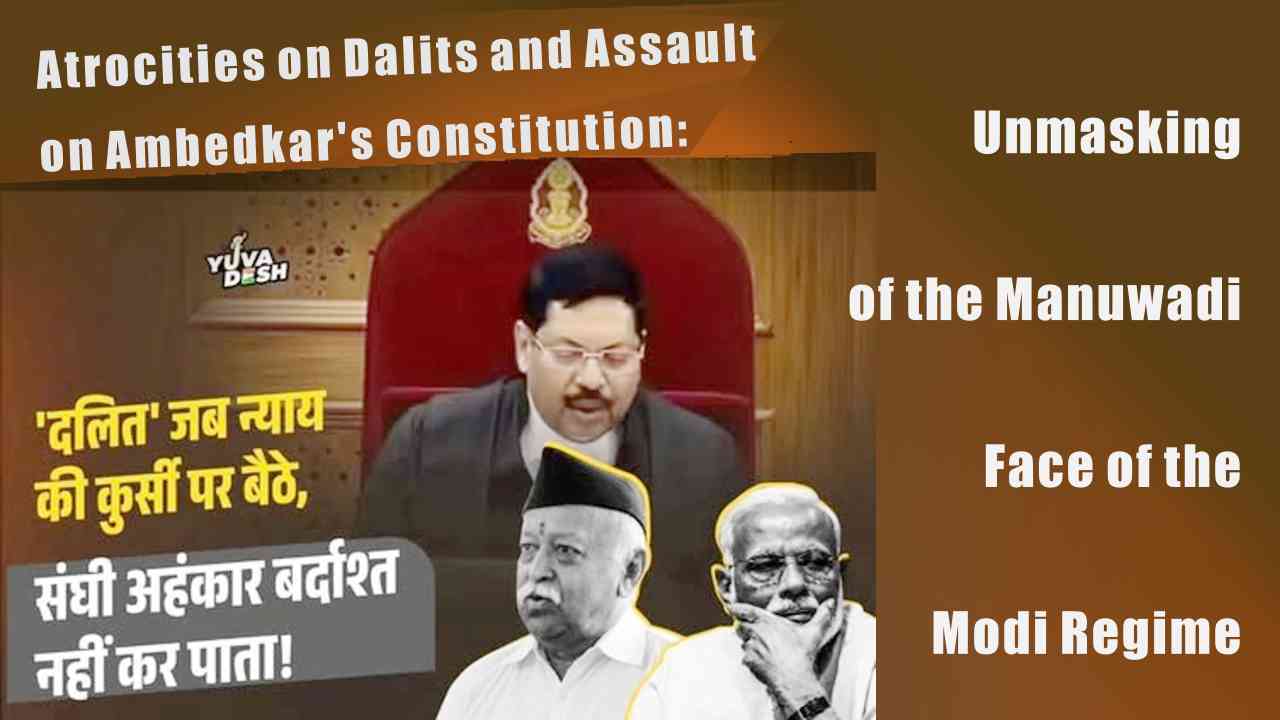
The attempted hurling of a shoe at the Chief Justice of India right inside the Supreme Court is an alarm bell for India's beleaguered republic that India cannot afford to ignore. The shoe thrower was no crazy intruder or outsider, but a senior advocate and a member of the Bar Association. The act too was not a sudden impulsive one, but the result of an orchestrated campaign against the alleged anti-Hindu bias of the judiciary in general and the CJI in particular. And even though CJI Gavai preferred to ignore the act and not get distracted, the offender expressed no regret whatsoever for his act, rather sought to justify it as a divinely ordained move.
The shoe hurling by septuagenarian lawyer Rakesh Kishore happened on October 6. The immediate trigger behind this act is suspected to be a comment made by CJI Gavai on September 16 when he had dismissed a public interest litigation asking for restoration of a mutilated Vishnu idol in a Khajuraho temple. The CJI had dismissed the petition as a publicity interest litigation and directed the petitioner to contact the Archaeological Survey of India, the custodian of the temple complex. Reportedly the CJI had also asked the petitioner to invoke his devotion and pray to the deity. Such light-hearted comments made by judges are fairly routine in the culture of jurisprudence worldwide, but in this particular case the Hindutva hardliners made it into an example of alleged insult to Hinduism or Sanatan, to use the term currently preferred in Sanghi parlance.
As a result of the Hindu right’s celebration of the shoe-hurling advocate and his appearances on various media channels, it however became clear that his grudge against CJI Gavai was not just because of this one comment but also because of his remarks against bulldozer raj and his well known Ambedkarite Buddhist beliefs. His mother's refusal to accept an invite to grace an RSS centenary event with her presence may also have intensified the urge to teach CJI Gavai 'a lesson'. The AI-generated video that was shared as a digital accompaniment to the physical assault gave away the unmistakable casteist character of the whole episode. The video showed the CJI with a blue face and an earthen pot hanging around his neck, depicting a cruel casteist practice that portrays a Dalit's spit touching the ground as a crime.
The Chief Justice who was the victim in this assault may have preferred to move on, in order to deny those responsible the oxygen of publicity craved by frivolous petitioners or perpetrators of casteist mischief, but that in no way diminishes the gravity of this hate crime or the sign it holds for the future of our judiciary. The Sangh brigade is now out to openly intimidate and silence the judiciary to rule out any possibility of judicial restraint on the actions of a tyrannical executive. And when the CJI happens to be from a Dalit background and the Buddhist community, in only the second instance of a Dalit Chief Justice in the history of independent India, the Sangh brigade feels all the more emboldened and empowered, fuelled by the Manuvadi hatred so central to its ideology.
Around the same time that the Chief Justice was attacked inside the Supreme Court, Dalit IPS officer Y Puran Kumar of Haryana became a victim of institutional murder, leaving an eight-page suicide note, which should actually be seen as a charge sheet against "blatant caste-based discrimination, targeted mental harassment, public humiliation and atrocities" perpetrated by senior officers in the police hierarchy of Haryana. Just a few days earlier on October 2, when the world remembered Mahatma Gandhi on his 156th birth anniversary and the Sangh brigade backed by the full power of the Modi regime was busy celebrating the centenary of the foundation of the RSS, a Dalit man Hariom Valmiki was lynched to death in Raebareli district of Uttar Pradesh.
Atrocities on Dalits are evidently increasing in diverse forms across India, especially in BJP-ruled states. A staggering 57,789 cases of atrocities on Dalits were registered in 2023 according to the latest figures released by the National Crime Records Bureau. The top four states are Uttar Pradesh (with 15,130 cases), Rajasthan (8,449), Madhya Pradesh (8,232) and Bihar (7,064), accounting for nearly 70% of the registered cases of atrocities in the whole country. Ironically, the voice of the biggest Dalit party of yesteryear, the Bahujan Samaj Party led by Mayawati, remains utterly mute in the face of the growing atrocities on Dalits or the intensifying assault on the Constitutional foundation of the rule of law. Addressing a rally in Lucknow on the 19th death anniversary of Kanshi Ram, the founder of the BSP, Mayawati thanked the Yogi Adityanath government for the upkeep of the parks and memorials dedicated to social justice icons while remaining completely silent about the increased atrocities on Dalits in Yogi's Uttar Pradesh or Modi's India.
Fighters for social justice and constitutional rights cannot brook such capitulation and collusion. As the Manuwadi character of the Modi regime becomes increasingly manifest, the forces of social justice must resist the regime with greater unity, determination and vigour. Today, the upcoming Bihar Assembly Elections provide the most urgent platform for the fighting forces of democracy and justice to demonstrate their unity and defeat the Manuwadi fascist regime.