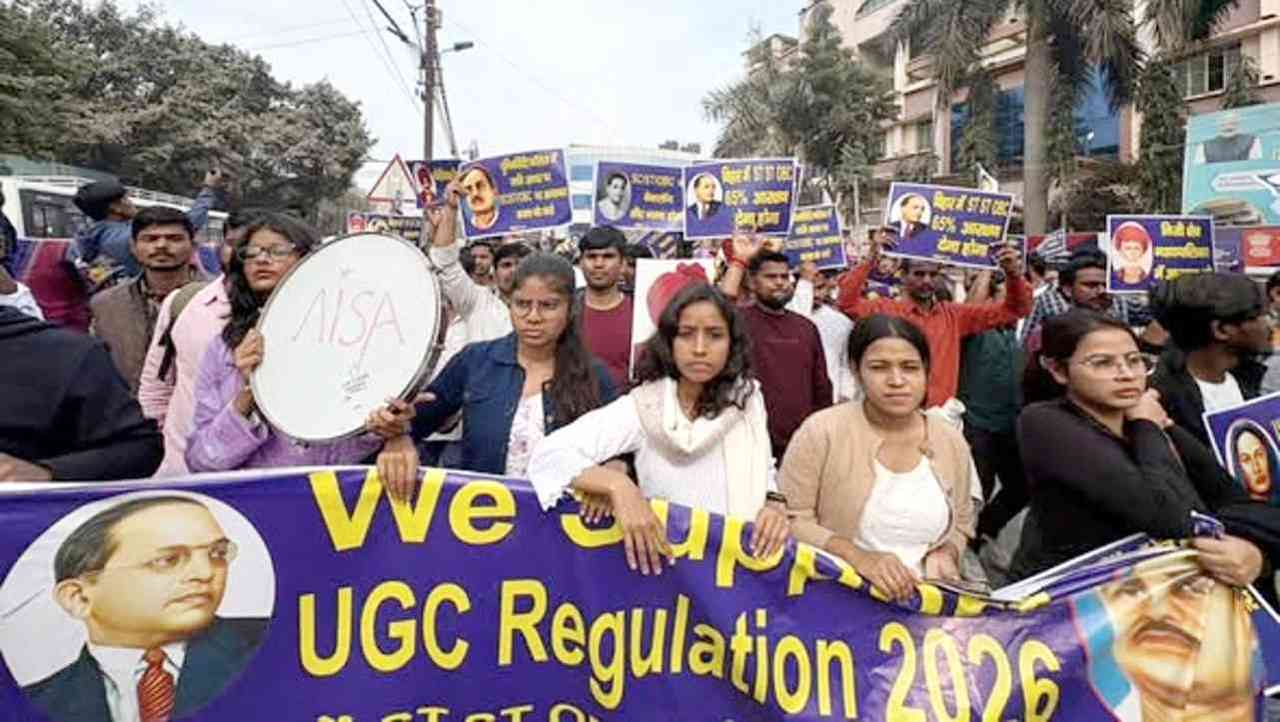
It has been ten years since the shocking institutional murder of Rohith Vemula which had awakened India to the brutal reality of caste discrimination in India's institutions of higher education and research. Ten years later, Rohith Vemula has been murdered all over again with the Supreme Court and the Modi government betraying the quest for equity and justice in India's higher education institutions. Every attempt to end social discrimination, injustice and oppression has historically always been met in India with virulent social reaction from the powerful and the privileged, but this time round the government and the judiciary both shamefully sided with this social reaction using the manufactured outrage as an excuse and escape route to betray the very cause of social justice.
The first serious attempt to address the issue of caste and gender discrimination and injustice in campuses led to the adoption of the 2012 UGC regulations. But the institutional murder of Rohith Vemula in January 2016 exposed the inadequacy of those regulations. Students and progressive citizens across India have since been demanding effective legislation in the name of Rohith Vemula to end caste discrimination in campuses. But the Modi government refused to pay any heed to that demand. On the contrary, students of JNU, HCU and other universities that took the lead in demanding justice for Rohith were subjected to a witch-hunt and demonisation by the Sangh brigade.
In May 2019, Maharashtra witnessed yet another institutional murder when a young Adivasi post-graduate medical student Dr. Payal Tadvi lost her life to caste discrimination.
The cry for a Rohith Act resonated with renewed urgency following Payal Tadvi’s institutional murder. The mothers of Rohith and Payal, Radhika Vemula and Abeda Tadvi, went to the Supreme Court demanding justice and discrimination-free campuses where no student, researcher or teacher from a marginalised social background has to die like Rohith or Payal. It was as a result of this legal battle and the continuing call for stricter anti-discrimination measures that the UGC eventually issued the equity regulations days before the tenth death anniversary of Rohith Vemula. Compared to the 2012 regulations, the new 2026 equity rules provided for a more specific and time-bound redressal process and structure and also took note of the discrimination suffered by the OBCs along with complaints made by individuals from SC/ST communities.
It took just a few days of upper caste outrage against the UGC's new equity rules for the Supreme Court to step in and stay the regulations. The same Supreme Court which had urged the UGC to draft stricter anti-discrimination regulations as recently as September 2025 now described the UGC focus on caste discrimination suffered by the SC-ST-OBC Bahujan communities as a regressive roadblock in India's journey towards a casteless social order! What was equally galling was the complete silence of the UGC and the government and their refusal to defend the regulations they had notified just a few days earlier, while congratulating themselves for taking this historic step! Meanwhile, the manufactured upper caste outrage on India's streets screamed about reverse discrimination and upper caste victimhood, even burnt Modi-Shah effigies to dramatise the backlash, and spewed all kinds of familiar casteist venom.
The regulations had their share of flaws including vagueness in defining discrimination and weakness of the proposed structure and system of grievance redressal. But the claims of upper caste exclusion and vilification are clearly misplaced and the alleged threat of misuse of the new rules is deliberately exaggerated. The remedy is to improve the regulations to make them more effective and certainly not to accept discrimination and oppression as the natural order and protect the well-entrenched privileges of the dominant castes as their right. The very fact that, even more than seventy five years after the proclamation of the constitutional commitment to ending all kinds of discrimination and establishing social equality and ensuring social justice, the state still does not have the political will to enforce the spirit of the Constitution, shows us how the caste order continues to pull India back at every step.
The system of affirmative action in the form of reservation for historically oppressed and marginalised groups has periodically faced acute opposition in India. Attempts to ensure rights of women have also evoked patriarchal backlash since the colonial period when Rammohan Roy fought for the banning of widow immolation or Jyotiba and Savitribai Phule pioneered education for women and Dalits. The reaction has continued even after the attainment of independence and adoption of the Constitution. From the enactment of the Hindu Code Bill in the 1950s to the subsequent passage of anti-dowry or anti-rape legislations or the women's reservation bill, every progressive measure has run into stubborn Manuwadi opposition from well-entrenched caste hierarchy and patriarchy. The memory of the frenzied upper caste opposition to the Mandal Commission recommendations in 1990 and the BJP's withdrawal of support to VP Singh is still quite fresh.
The current juncture can clearly be seen as a continuation of this battle. In the Modi era, the BJP has managed to camouflage its essential Manuwadi identity by creating a pro-OBC image and perfecting the art of social engineering by sub-dividing castes, both SCs and OBCs, pitting one group against another and cobbling a larger social coalition around its core upper caste support base. The bracketing of OBCs with SCs and STs in the UGC regulations can potentially unsettle this social engineering blueprint. The Supreme Court stay on the UGC regulations has therefore come as a huge relief for the Sangh-BJP establishment. While the BJP sees this as an opportunity to wriggle out of the crisis, the upper caste lobby has smelled victory, and having stalled the UGC regulations it would now like to stop every quest for social equality and equitable representation in diverse spheres and push for reversal of the entire trajectory of affirmative action.
The movement for land rights offers an instructive analogy. Following the defeat of the Vajpayee government and its "India Shining" narrative, we had seen a renewed surge for land protection and land rights legislation in India. This was the phase when the Forest Rights and Rural Employment Guarantee Acts were passed, the Land Reform Commission set up by Nitish Kumar government submitted its report and the Land Acquisition Act was passed making consent and adequate compensation mandatory for any acquisition of land. The Bihar land reform report was however dumped by the government to appease the feudal lobby, and ever since its ascent to power the Modi government has been relentlessly trying to subvert and reverse these legislations. Even though its attempt to scrap the Land Acquisition Act did not succeed and the pro-corporate farm laws too had to be repealed, the government has now unleashed an all-out bulldozer raj to grab as much land as possible.
While the Supreme Court stays the UGC regulations, the VBSA Bill 2025 proposes to replace the UGC itself, along with the All India Council for Technical Education and National Council for Teacher Education with a single centralised regulatory body. The entire domain of higher education is being subjected to unprecedented centralisation, privatisation and Hindutva ideological regimentation. And in a repeat of the assault on JNU, HCU and other progressive student movement campuses in the wake of the institutional murder of Rohith Vemula, once again JNU has come under attack at this juncture of churning among students for social justice, academic freedom, quality education and dignified employment. In a shocking crackdown on campus democracy, JNU administration has rusticated all four central office bearers of JNUSU - President Aditi, Vice President Gopika, General Secretary Sunil, and Joint Secretary Danish, along with former President Nitish, for protesting against the installation of a surveillance system in Dr. BR Ambedkar Central Library.
For seekers of substantive social justice, equitable representation and functional democracy, the stakes are clearly much higher than just UGC regulations. A powerful student upsurge at this juncture holds the key to the future of India's democracy and the road to the annihilation of caste, within the campuses of higher education and beyond.