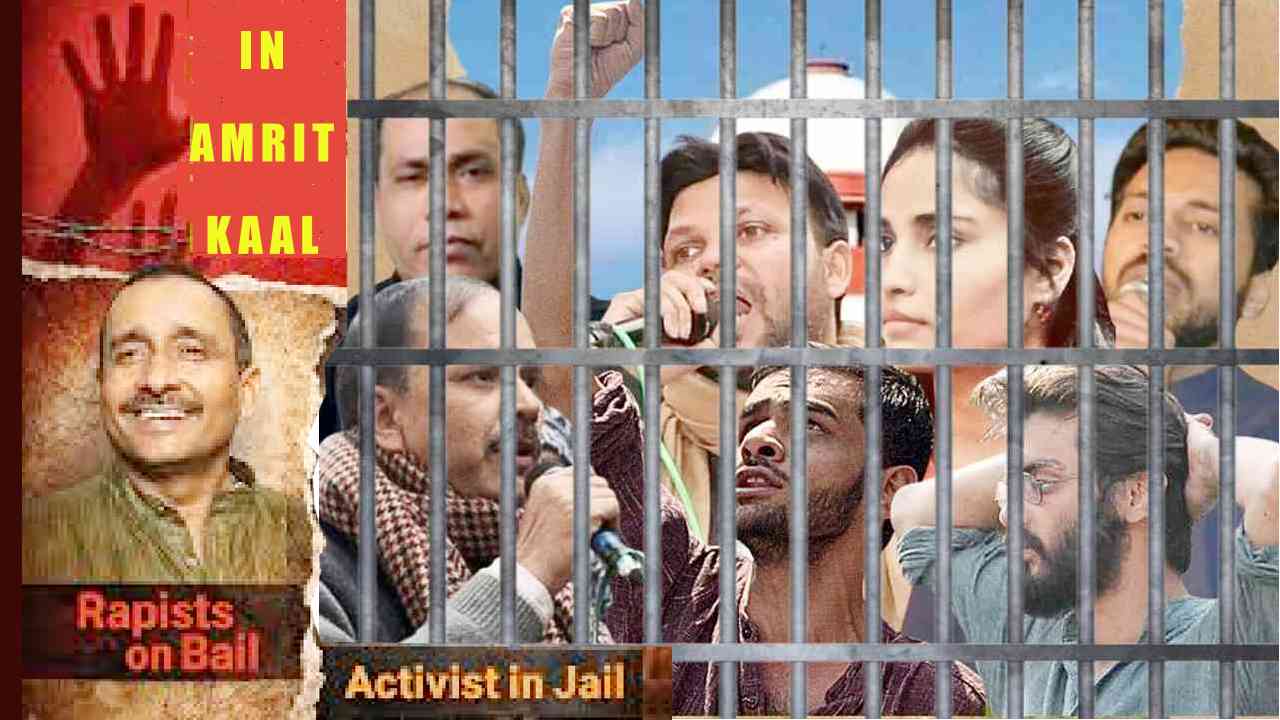
When the Supreme Court of India finally heard the bail petition of Umar Khalid, Sharjeel Imam, Gulfisha Fatima, Meeran Haider, Shifa-ur-Rehman, Mohd. Saleem Khan and Shadab Ahmed after more than five years of detention without trial, the overwhelming expectation was that the accused would now be set free on bail. After all the Supreme Court has repeatedly invoked the principle that bail should be the norm and jail only an exception. Even under the draconian UAPA, a three-judge bench of the Supreme Court comprising Justice Surya Kant (currently CJI), Justice Aniruddha Bose and Justice N. V. Ramana, had famously upheld the supremacy of Article 21 which guarantees a citizen's right to life and liberty while granting bail in 2021 to petitioner K.A. Najeeb who had been detained without trial under UAPA since 2016. A belated bail for all petitioners therefore seemed the natural outcome to expect.
But the judgment by Justice Arvind Kumar and Justice N. V. Anjaria in the Delhi Riots bail petition case has now been delivered contrary to the Supreme Court's own earlier position. Five of the seven petitioners have been granted bail while Umar Khalid and Sharjeel Imam - neither of whom were in Delhi at the time of the riots with Sharjeel already being in jail - have been stopped from filing another bail petition within a year. The distinction has been made by identifying Umar and Sharjeel as ideological masterminds and the rest as local level facilitators. Instead of upholding the constitutional rights of the petitioners, the judges have endorsed the conspiracy narrative put forward by the Delhi Police. Instead of being an exception, jail has thus been defined as life for the activists. Yahi aab zindagi hai (this is now my life), as Umar said after the denial of bail.
Like the infamous conspiracy cases of the British colonial era against India's freedom fighters, the Delhi Riots Case and its predecessor, the notorious Bhima Koregaon Case, are conspiracy cases hatched under the Modi-Shah-Doval doctrine against India's dissenting activists and intellectuals. Instead of focusing on the actual incidents and their well known triggers - like the open incitement of violence by BJP leaders like Anurag Thakur, Parvesh Verma and Kapil Mishra against the Shaheen Bagh protesters - the cases are based on absolutely concocted allegations like threat to the life of the Prime Minister or to the unity and integrity of the country. Consequently, the victims of violence in both Bhima Koregaon and Delhi riots have not got any justice, the perpetrators and instigators continue to roam free, while activists framed in the conspiracy cases rot in jail without trial for years on end.
If the Delhi riots were orchestrated to crush and defame the peaceful constitutional protests against the divisive and discriminatory Citizenship Amendment Act, the Delhi Riots Case is being weaponised to run a witch-hunt against anti-CAA campaigners. And as pointed out by actress Swara Bhaskar, a prominent equal citizenship campaigner herself, the witch-hunt is being specially directed against Muslim scholars and activists like Umar and Sharjeel. For the five accused who have been given bail, the conditions attached are so stringent that they cannot exercise several fundamental constitutional rights like the freedom of expression or freedom of assembly. For Umar Khalid and Sharjeel Imam, the future of course looks way too uncertain with even their right to make a renewed appeal for bail deferred by yet another year.
The most sinister implication of the verdict is the precedence it now provides to the government's fascist design to conflate peaceful constitutional protests and democratic movements with terrorism and treason. Ironically, just before the denial of bail to Umar and Sharjeel, rape and murder convict Ram Rahim was again granted parole for 40 days, for the 15th time since his conviction in 2017. And just the next day, the same Supreme Court granted bail to businessman Arvind Dham in a money-laundering case related to ₹27,000 crore bank fraud. India's apex court seems to be endorsing a doctrine that singles out activists and dissenters to rot in jail while allowing rapists, murderers and economic offenders to roam free and enjoy their liberties. The Constitution which promised "justice, social, economic and political" and "liberty of thought, expression and belief" is being put to a severe test by its supreme custodian, the apex court of the country.