The fourteen students of Jawaharlal Nehru University (JNU) who were arrested by Delhi Police and sent to Tihar Jail were finally released on bail on March 1.
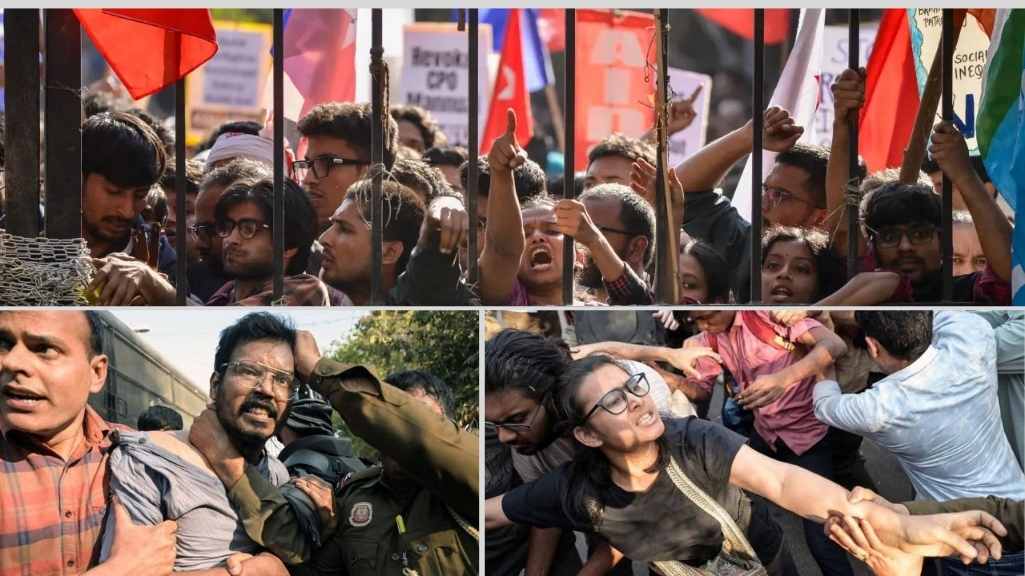
The fourteen students, including office bearers of the JNU Students’ Union (JNUSU), a former JNUSU President and the President of the All India Students’ Association (AISA), had been arrested on February 26 following a brutal police crackdown on the JNU march to the Ministry of Education.
The march demanded the immediate implementation of the University Grants Commission (UGC) Equity Rules on the lines of the Rohith Act, increased public funding for higher education, the resignation of the casteist and racist JNU Vice-Chancellor, revocation of the rustication of JNUSU office bearers, and an end to the systematic attack on campus democracy.
During the February 26 protest, the police locked the university’s North Gate with chains and erected barricades to trap protesting students. In a deeply condemnable act of ideological violence, police personnel were witnessed breaking a portrait of Babasaheb Dr B. R. Ambedkar. This act exposed the casteist character of the repression and the complicity of an administration that targets Dalit-Bahujan students for demanding the Rohith Act and justice against caste discrimination in campuses.
Despite being a peaceful march, the police unleashed brutal violence, detaining more than fifty students and injuring many. After keeping the students overnight in the police station, fourteen students were formally arrested and produced before the court, where bail was granted to all of them. However, due to stringent verification conditions in the bail order, the students were forced to spend more than forty eight hours in Tihar Jail even after bail had been granted. They were released only after a petition was filed in court highlighting the violation of their liberty despite the bail order.
The fourteen students who were arrested are Nitish (former JNUSU President and AISA leader), Aditi (JNUSU President and AISA leader), Gopika (JNUSU Vice President and SFI leader), Danish (JNUSU Joint Secretary and AISA leader), Neha (AISA President), Ranvijay (AISA leader), Rahul (AISA), Ansh, Shyam, Gowri, Manikant, Varkey, Abhishek and Vishnu Tiwari.
Following the arrests, protests erupted across the country as part of the All India Protest Day call given by AISA, with students and democratic organisations condemning the repression and demanding the immediate release of the JNU students.
Across the country, students have been raising their voices demanding the implementation of the UGC Equity Rules on the lines of the Rohith Act to combat rising casteist violence and caste-based discrimination in universities. Right wing groups such as ABVP have repeatedly unleashed violence against this movement as part of a feudal Manuvadi conspiracy to sustain centuries old caste oppression.
From attacks on student protests in Delhi University, to violence against encampments demanding implementation of UGC Equity Rules and reinstatement of arbitrarily rusticated JNUSU office bearers in JNU, to repression against the movement in Banaras Hindu University and other campuses, feudal Manuvadi forces backed by the BJP regime are attempting to maintain the cycle of caste oppression and discrimination.
After their release, the JNU 14 vowed to intensify the struggle for social justice and accessible education for all and to resist the conspiracies of Manuvadi forces seeking to crush democratic student movements.
CPIML GS Visits JNU in Solidarity
CPI(ML) Liberation General Secretary Dipankar Bhattacharya visited JNU on March 2 and met the JNU 14, expressing solidarity with their struggle for social justice and education. He also addressed a public meeting organised by the JNU Teachers’ Association titled “Withering Justice: Social, Economic and Political – Jail for those who demand justice, VC office for those who mock it. Ministry of Education, Jawab Do.”
Condemning the violence unleashed by Manuvadi forces along with the BJP regime, he said that the implementation of UGC Equity Rules on the lines of the Rohith Act is the urgent need of the hour and that the student movement demanding social justice in campuses will continue to strengthen despite repression.
Addressing the gathering, Com. Dipankar noted that during the 2016 attack on JNU, the university had become a site of active solidarity for progressive forces across India. Today JNU is facing another such juncture when the university, the student union and the progressive campus of JNU are under renewed attack. This is a juncture not just for JNU but for the progressive student movement across India given the ominous implications of the stalling of UGC equity regulations coupled with the assault of the VBSA Bill.
Saluting the student activists who have just come out of Tihar jail and the inspiring voices of the vibrant campus at this critical juncture of our republic, he added that JNU still remains a powerful bastion of progressive ideas and determined activism.