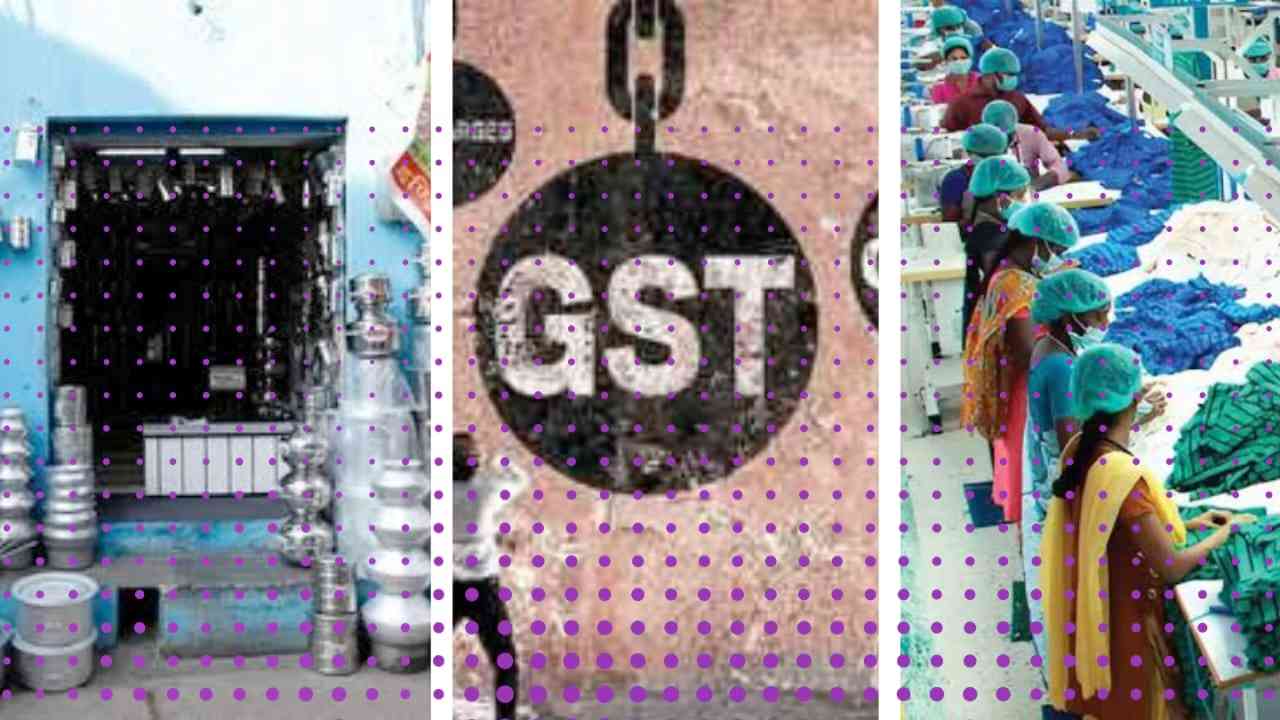
As indicated in Narendra Modi's 103-minute-long August 15 address, the Modi government has now come up with what it calls GST 2.0 or Next-Generation GST Reforms. Spokespersons and apologists of the government are of course trying to delink the GST reforms from Trump's tariff onslaught, presenting it as a reform package that emerged from the government's own policy planning. But the adverse implications of Trump's tariff war for India's foreign trade have clearly forced the government to look inwards at the domestic economy. Hence the renewed invocation of the long-forgotten 'swadeshi' rhetoric by both BJP and RSS leaders and the accompanying buzz around India's domestic market with this supposed booster dose of GST reforms.
Ever since its ill-prepared launch in 2017, close on the heels of the disastrous demonetisation adventure, GST has been a lethal blow to India's marginal and small enterprises, the livelihood and consumption expenditure of the common people and the balance of fiscal federalism. The inherently regressive nature of an indirect tax which disproportionately affects the poor was compounded by multiple slabs and excessive tax rates that spared almost no item of essential consumption and public service. The demands for lowering of tax rates for items of essential consumption, rationalisation of the multi-slab system, simplification of the complex compliance procedure and restoration of the federal balance by giving states a better share and more autonomy are being raised from day one, but the government has never paid any heed.
Under GST 2.0 the government has finally eliminated the 12% and 28% slabs, making the system now essentially two-tiered with two levels of taxation - 5% and 18%. There is of course a prohibitive 40% slab for a few luxury items or items like cigarettes and tobacco whose consumption is considered injurious to health. The new version thus makes GST somewhat simpler compared to its previous version, and there is also a certain effective lowering of the tax rate for quite a few items. This is a belated partial vindication of a widely felt popular demand and hence certainly welcome. The question however remains as to how far the benefits of tax reduction will be passed on to the consumer. Any simultaneous increase in the prices of the items which will now attract lower tax rates will nullify the tax advantage to the consumer.
The government has assessed the GST reforms to result in a revenue loss of about Rs 48,000 crore. Even if this entire amount returns to the market as enhanced domestic consumption, it will be no match for the decline in India's exports as a result of the aggressive Trump tariffs, which is estimated at Rs 4.4 lakh crore. In fact the tariffs will not just affect exports, there will be a cascading effect on India's domestic economy by way of job losses in the labour-intensive export sector and depressed income and consumption of the affected workers. A real boost to the domestic economy can only come from enhanced job-generating productive investment, enhanced public spending, especially in the social sectors, and increased purchasing power of the poor and middle classes.
This demands a fundamental reorientation of India's revenue collection strategy away from taxing the poor and middle classes to taxing the rich. Why does the government continue to shy away from any kind of wealth tax in an economy where the top 1% controls 40% of the country's wealth and the bottom half accounts for only 3%? Why does the government continue to lower corporate tax over and above the huge tax exemptions and loan write-offs granted to the corporate sector? In 2014, personal income tax accounted for 38% of India's direct tax revenue while corporate taxes contributed 62%. In a decade of the Modi era, the ratio has reversed with personal income tax now contributing 53% and the share of corporate tax down to 47%.
Trump's tariff war has also forced the Modi government to make some drastic foreign policy readjustment. Under American pressure, the Modi government had earlier begun to downgrade India's involvement in groupings like BRICS and SCO. But in the wake of the unprecedented imposition of 50% tariffs on Indian exports by the Trump administration, Narendra Modi made it a point to attend the SCO summit in Tianjin, his first visit to China in seven years, and also use the opportunity for a renewed bilateral engagement with China for the first time since the China-India military stand-off of 2020. However, just after Modi signed the Tianjin Declaration condemning the continuing genocide of Palestinians in Gaza and the US-Israel military strikes on Iran, India hosted the far-right Israeli finance minister Bezalel Smotrich who has been banned by countries including the UK, Australia, Canada, New Zealand and Norway for his open calls for ethnic cleansing.
India cannot have a flip-flop foreign policy revolving essentially around a surrender to the US-Israel axis while making ad-hoc adjustments with Russia and China to attempt to balance the American pressure. What India needs is a truly independent foreign policy with a clear anti-imperialist thrust and consistent emphasis on cooperation with countries of the Global South. The current juncture has forced the Modi government to make partial adjustments in its economic and foreign policies. Progressive democratic forces of India must seize this moment to intensify the struggle for rejection of the pro-imperialist pro-corporate policy trajectory and reorientation of India's policies in favour of the needs and rights of the Indian people.