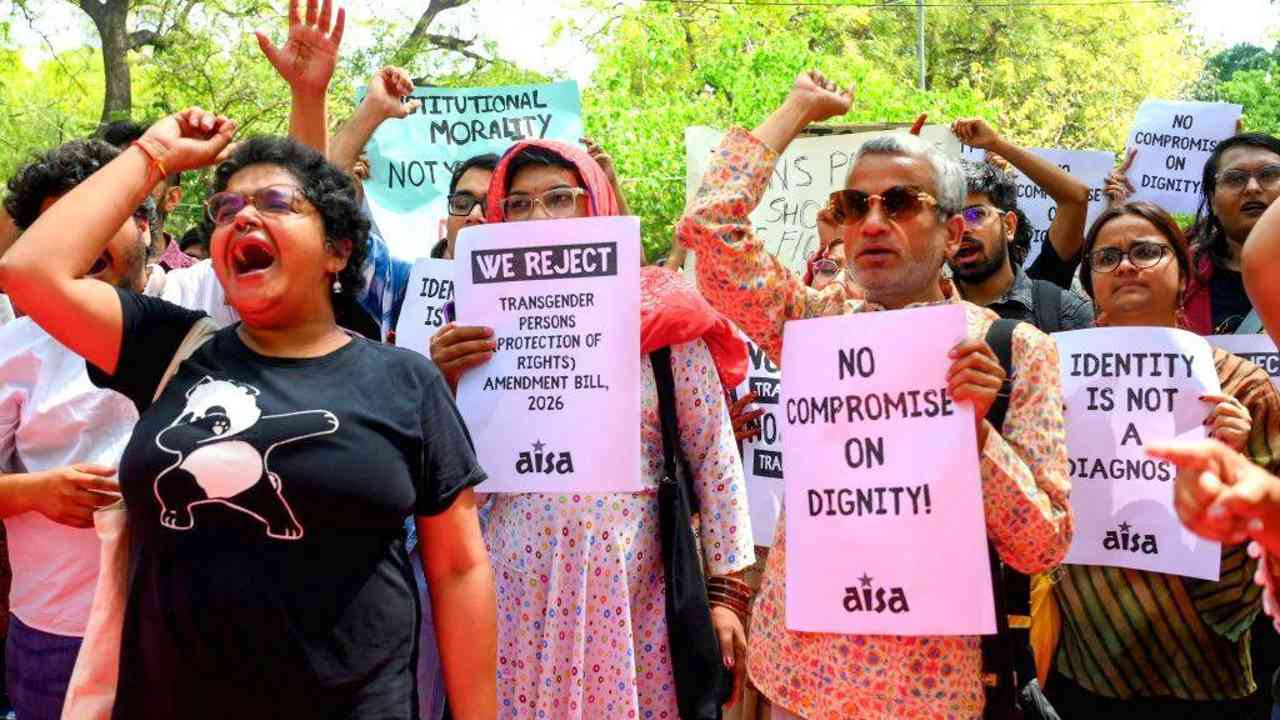
The abrupt introduction of the Amendment Bill to the Transgender Persons (Protection of Rights) Act, 2019 in March 2026 has triggered widespread protests by thousands of transgender people across the country. In a manner now characteristic of the Modi government’s legislative approach, the Bill represented a roll-back of hard-won rights, and was brought forward without prior consultation, notice, or meaningful engagement with those affected. It was then pushed through Parliament with undue haste, disregarding serious objections raised by the Opposition as well as by representatives of the transgender community, who questioned not only the process but the very rationale and necessity of the proposed amendments.
Transgender people have been part of the South Asian societal fabric for centuries with references in ancient mythology and folklore, continuing to the Mughal period where they played a significant role in governance and state power while holding influential positions serving as advisors and military leaders. British colonial rule brought with it systematic discrimination and criminalisation of the very existence of Transgender persons culminating in the Criminal Tribes Act, 1871 which designated Transgender persons as a “criminal tribe” subjecting them to surveillance, restrictions on movement and livelihood, and social exclusion, with lasting effects of marginalisation. Transgender people were denied the right to wear female clothing and jewellery or even perform in public, and were subjected to severe police intimidation and coercion. The Criminal Tribes Act was finally repealed after Independence in 1952, yet the cultural stigma, institutional discrimination and societal ostracisation that it aided in shaping and building, continued unabated, which the transgender community courageously battled through their militant struggles across the country.
The major breakthrough achieved by these struggles was through the landmark Supreme Court judgment in NALSA vs Union of India (15th April 2014 and commonly called the NALSA judgment), declaring transgender persons a 'third gender', and recognising and directing equal access and opportunity for them in society. The NALSA judgment, crucially, recognised the right to self-identification of gender by transgender persons and set in place the legal recognition of the rights of the transgender community. Without a doubt, spurred by the NALSA judgement, further sustained struggle and advocacy strengthened the collective demands of the community and compelled the Union Government to enact the Transgender Persons (Protection of Rights) Act, 2019, marking a journey from the criminalisation of transgender people by the colonial powers in 1852 to the recognition of their rights through legislative fiat!
The 2019 Act was a major breakthrough for the recognition of the transgender community and the recognition of their rights, which included the right to self-identification; the right to an affirming identity documentation; education, social security and health of transgender persons; protection against discrimination etc. While it was criticised in its failure to provide a complete code for the protection of transgender people, the law was a starting point of recognition and rights-conferment on transgender persons.
However, this victory has turned out to be short-lived, with the Modi government introducing the controversial 2026 amendments to the 2019 Act, taking it perilously close to the colonial-era institutional discrimination and leading to widespread protests across the country and a spate of resignations from the National Council for Transgender Persons, despite which the same has been passed in Parliament and is now awaiting the formality of Presidential assent.
The NALSA judgment had affirmed, in no uncertain terms, that the right to self-identify one’s gender flows directly from the guarantees of equality, dignity, and personal liberty, and was explicit that this right is not contingent on medical intervention, bureaucratic certification, or the approval of the State. The 2019 law, despite many shortcomings, at least attempted to give statutory shape to this constitutional promise. The proposed Amendment Bill, however, marks a troubling and regressive departure.
Firstly, the amendment brings a fundamental change by introducing a restricted definition of a transgender person to cover only socio-cultural identities like Kinnars, Jogtis, Hijras, Aravanis, etc., intersex variations, eunuchs and those forced into transgender identity via mutilation or procedures. It explicitly excludes transmen, transwomen, genderqueer and non-binary persons, who, hitherto, enjoyed the protection of this very law.
Secondly, the specific purpose of the amendment to de-recognise self-perceived identities, outrightly denies the legislative history and legislative intent of the 2019 Act. The Statement of Objects and Reasons to the amendment Bill states that the law is intended to only protect those who “face severe social exclusion due to biological reasons for no fault of their own and no choice of their own”, and not to “protect each and every class of persons with various gender identities, self-perceived sex/gender identities or gender fluidities.” This militates against the binding NALSA judgment, which recognised the right of transgender persons to determine their own gender identity as integral to leading a life with dignity. This falsely-premised and regressive amendment discriminates against a large category of transgender persons by denying them the right to be legally recognised by their gender identity.
This form of retrospective derecognition of “transgender persons” by twin exclusion by definitional restrictions, is a characteristic feature of law-making in the Modi era. Through the new Labour Codes, which too are fundamentally exclusionary, crores of workers who hitherto enjoyed labour law protections, have been pushed outside the purview of the law by definitional restrictions in the new Labour Codes. And similarly we are witnessing the retrospective derecognition of people’s citizenship and voting rights through the Special Intensive Revision.
Thirdly, the amendment mandates medical scrutiny that invades privacy and bodily autonomy. The relatively straightforward process for recognition as transgender persons under the 2019 Act, is replaced by a gatekeeping procedure where a medical board’s recommendation is mandatory, before the Deputy Commissioner scrutinises any application for the certificate of identity. This, represents the second major contravention of the NALSA judgment which expressly rejected the requirement of medical evaluation and recognised the fundamental right to self-identify.
Fourthly, this gatekeeping procedure is, by design, exclusionary and meant to create sufficient bureaucratic red tape to deny protection to those it purportedly aims to protect. It is common knowledge that the transgender people facing “severe social exclusion”, whom the restricted definition aims to protect, are largely from economically, culturally and socially marginalized communities. Replacing a legal framework that allowed for self-identification with a complex framework fraught with extensive administrative and medical scrutiny, is bound to place protection of this law beyond their reach. This is another aspect symptomatic of the Modi regime – deregulation of the economy facilitating corporate loot and natural resource handover, on the one hand, and draconian policing of constitutional and legislative entitlements to the vulnerable communities, on the other.
Lastly, the amendment to Section 18 introduces new offences, which criminalise force/compulsion of persons to “to assume, adopt, or outwardly present a transgender identity”. This stigmatizes and pathologises transgender identity as being a result of coercion, instead of a representation of personal autonomy. Further, it may render communities like hijra jamaats, kinnar akhadas, etc., as well as community support groups vulnerable to criminalisation, while acts of community support and solidarity will be misconstrued as inducement. This erodes social support which has, historically been central to the survival and welfare of transgender people. The provisions are reminiscent of the colonial Criminal Tribes Act, 1871 which criminalised transgender persons for appearing dressed or ornamented as women. The provisions are capable of misuse against the support systems of the transgender person, outside of their natal families, and can put the transgender person to further risk.
Alongside the amendment to the Transgender Act, 2019 following this broader anti-diversity and anti-rights agenda of the Sangh Parivar, the manner in which the amendment was forced through is in line with the BJP’s concerted effort to reduce law-making and parliamentary process to a mockery. Immediately after the amendment Bill was introduced, two members of the National Council for Transgender Persons (NCTP) resigned since the decision to move the amendment Bill forward was taken without any formal consultation with the NCTP, which undermines the very purpose for which this Council was established. Jst. Asha Menon (retd.) Chairperson of the Advisory Committee appointed by the Hon’ble Supreme Court of India, to look into the strengthening of the systems in place under the Transgender Persons (Protection Of Rights), Act 2019, including to assess any shortcomings in the statute, has gone public stating that the Advisory Committee was not consulted and that the Amendments “have therefore come as a great shock and would be a tremendous set back to the efforts to mainstream the community”.
This attack by the Union Government on the transgender community and the reimposition of colonial stigmatisation and criminalisation of transgender people, must be strongly condemned and resisted as part of a determined movement of the people against the BJP and its parent body, the RSS and their project to undermine democracy and the Constitution.