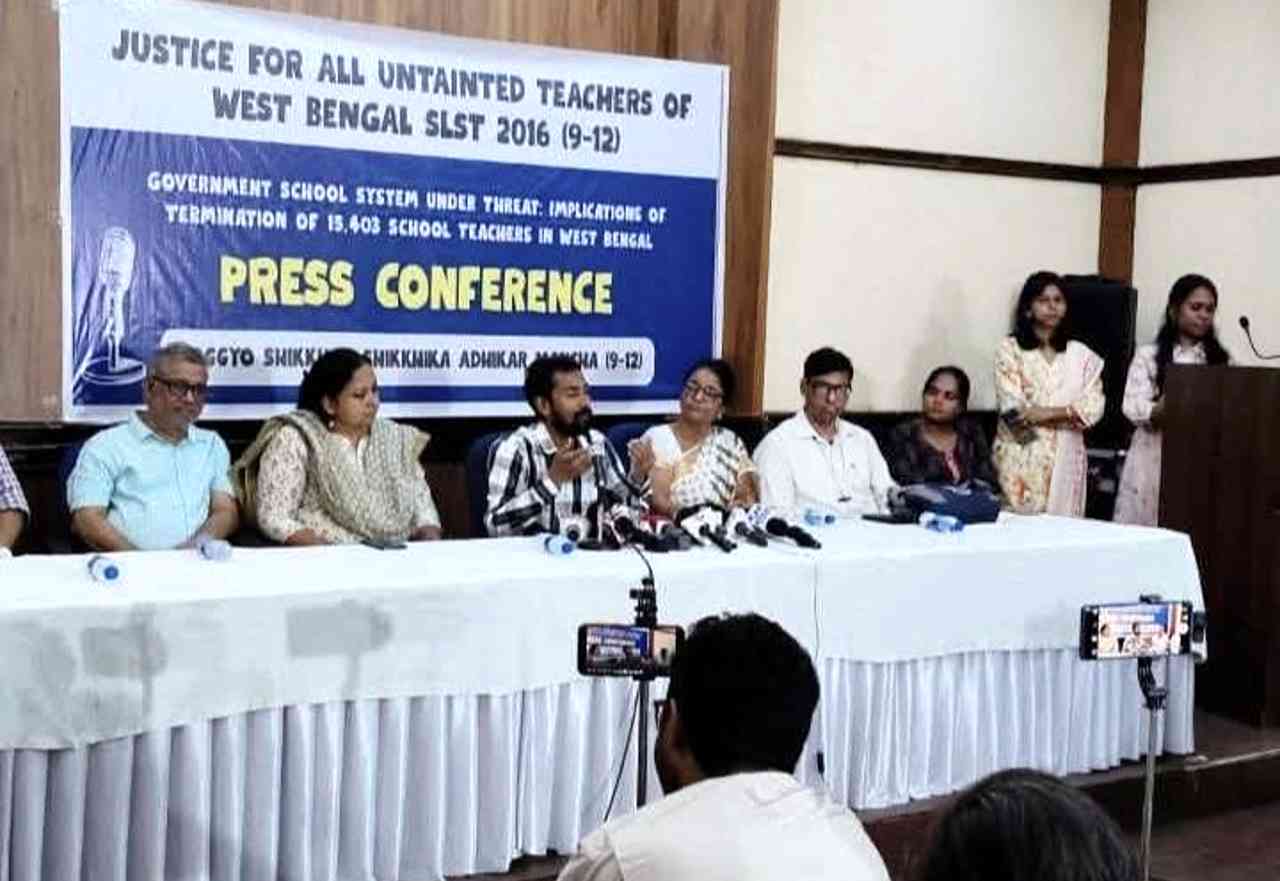
A press conference held in the New Delhi on 24 July by the Joggo Shikshak Shikshika Mancha witnessed testimonies from thousands of retrenched school teachers from West Bengal. The presser highlighted the deepening crisis in public education as a result of policies shaped by the National Education Policy and a judiciary that appears increasingly indifferent to the lives of working-class educators.
The retrenchment of over 16,000 teachers in West Bengal, despite their unblemished service records, has sent shockwaves through the academic and political landscape. The teachers, whose appointments were invalidated following a disputed verdict of the Calcutta High Court dated 22 April 2024, decried the decision as a massive injustice that targets the innocent while shielding systemic corruption.
“Where will students in rural areas, in small towns, from poor and lower-middle-class backgrounds go?” asked one of the affected teachers. “How can the retrenchment of 16,000 innocent teachers be called justice? We ask the Supreme Court.”
Mahboob Mandal, a teacher at Dosa Chandaneswar High School in South 24 Parganas, said, “Many among us are first-generation teachers who are teaching first-generation learners. Many have taken loans to build a house in the hope of bettering our lives. Are we not entitled to jobs that we earned through massive hard work? Why are we being made scapegoats in the power tussle between the Central and the State Government?”
The judgment, which cancelled the entire 2016 School Service Commission recruitment panel, has been widely criticised as unprecedented in its sweeping attack on working people’s livelihoods. Observers point to the irony of punishing those who toiled to educate the marginalised, while those responsible for the corruption remain largely untouched. Many view the verdict as yet another attack on the constitutional right to livelihood guaranteed under Article 21.
Academics and members of the civil society present at the press conference condemned the ruling and the broader policies that have enabled such a situation. Debaditya Bhattacharya, faculty at Jamia Millia Islamia and author of The Indian University: A Critical History, said, “School teachers are being punished for corruption done by those sitting in power. No one in the system cares because this goes well with the National Education Policy that prescribes closing down government schools and colleges. Thousands of schools have been closed in UP, Haryana and Jharkhand.”
Gopal Pradhan, Vice President of the AUD Faculty Association, added, “This is a direct outcome of a policy regime that has targeted the destruction of publicly funded education in the country. It is the same attitude we see even in our universities, where publicly funded institutions are facing concrete funding cuts in times of increasing inflation.”
Renowned economist and JNU faculty Atul Sood remarked, “This is an assault on working people. We know that government-funded schools are accessible to the children of working-class families, in both rural and urban areas. The attack on government schools is part of the same policy that also imposes the rules of business owners on working people, like the labour codes. These are anti-worker, anti-people policies.”
Uma Gupta, faculty at Delhi University and a leader of the DTI, said, “It is the same place where we spoke about the arrest of Ali Khan Mahmudabad because of a Facebook post written with deep academic knowledge about the current polity. The attack on education is real. The present regime is anti-education.”
Even as the press conference proceeded, several teachers were barred by Delhi Police from reaching the venue. Several retrenched teachers have been sitting on a dharna at Delhi’s Ramleela Maidan since 23 July, demanding the reversal of the High Court verdict. The teachers have also appealed to the Supreme Court to review the judgment and uphold the right to livelihood and public education.