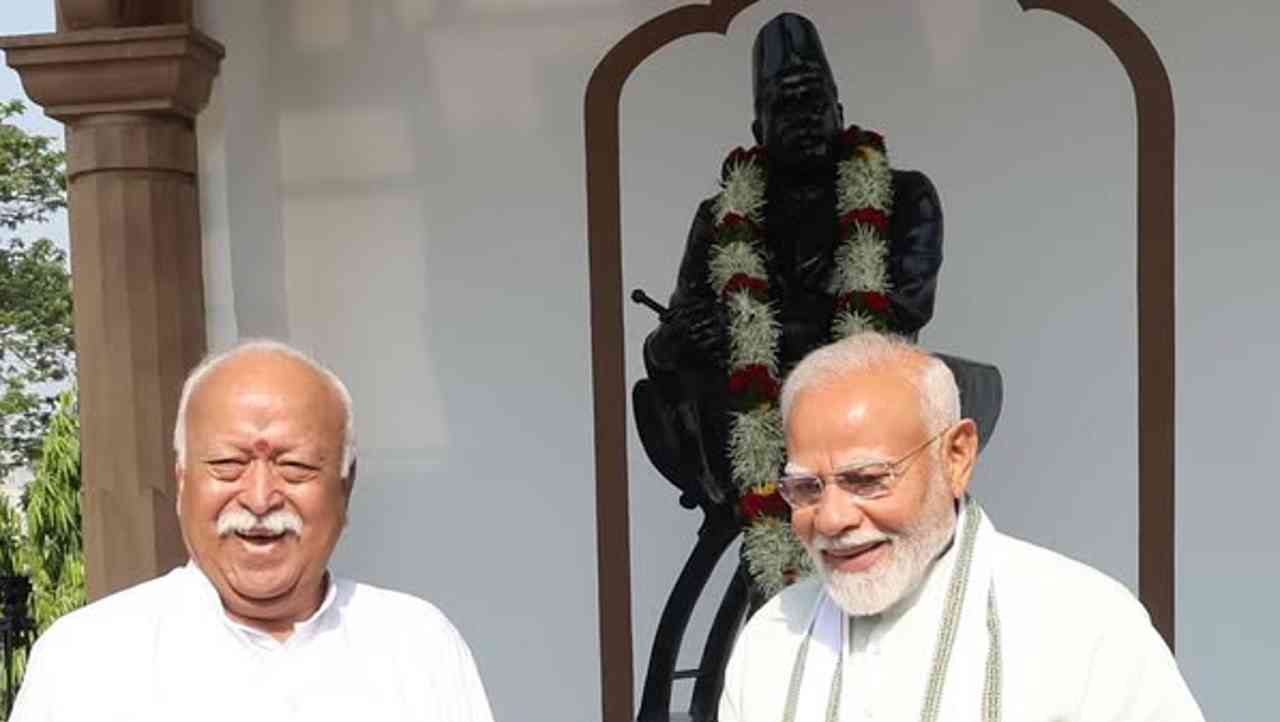
The RSS is currently celebrating its centenary. On September 11, RSS chief Mohan Bhagwat turned 75. A week later on September 17, it was the turn of Narendra Modi to reach that landmark. In RSS parlance, both leaders are now in their 'Amrit Kaal'. In the Modi era, veteran BJP leaders over 75 are generally relegated to a panel of retired advisors, and earlier this year Bhagwat too had invoked the 'principle' of retiring at the age of 75. But before long Bhagwat laid the wishful speculation about this to rest, and made it clear that both these septuagenarians will remain at the helm of the Sangh brigade's respective complementary wings of 'shakha experts' and 'state managers'. In his Independence Day address this year, Narendra Modi had already lauded the RSS as the world's biggest NGO, and now on Bhagwat's birthday he heaped rich praises that almost read like an obituary. All that now remains to be seen is who gets to replace J. P. Nadda as BJP president and when.
The idea that the RSS discomfort with the Modi cult and the Modi-Adani bonhomie has now become so deep that the RSS will force a course correction on the Modi regime is a liberal illusion. The RSS today needs the Modi government as much as the latter needs the service of the former. Just as the BJP in opposition had the full backing of the RSS, especially since the beginning of the Ram Janmabhoomi campaign, the BJP in power also enjoys the fullest blessings of the RSS. Any occasional note of criticism or concern expressed by any RSS ideologue or functionary does not change this fundamental equation or the internal cohesion of the Sangh Parivar.
In the RSS scheme of things, a Murli Manohar Joshi can surely be allowed to express concern about India's growing economic inequality in an RSS meeting and go as far as quoting Amartya Sen even as the Modi government showers unlimited largesse on the Adani group and the BJP IT cell spews venom against Amartya Sen calling him an 'anti-national' economist. The bottom line is that the RSS will do everything to absorb as much oppositional pressure as it can, but it will do nothing that risks undermining the Modi government. Indeed, even as Murli Manohar Joshi was cautioning about the alarming rise of inequality, in poll-bound Bihar the BJP-led government was busy terminating the jobs of close to 8,000 land survey employees while handing over 1,050 acres of land with one million trees to Gautam Adani on a token annual lease of one rupee.
As expected, there have been birthday wishes and gifts galore for Narendra Modi's 75th birth anniversary. Mukesh Ambani expressed the hope that Modi will be around, not sure if as PM, till 2047 to witness the 'viksit Bharat' (developed India) taking shape under his stewardship. There were messages from Israeli PM Netanyahu and Italian PM Giorgia Meloni, Russian President Putin and even a phone call from Donald Trump. But the real gift from Trump came in the form of the imposition of a punitive $100,000 fee on the H1B visa for skilled foreign employees in the US that covers large numbers of tech graduates from India hired by American IT companies. With this near-embargo on hiring of Indian tech employees in the US, coupled with the forcible deportation of undocumented Indians in the US and prohibitive tariffs on Indian exports to the US, Trump's targeting of India continues relentlessly and gets harsher by the day.
Modi's foreign policy woes are not limited to Trump's anti-India measures or India's growing isolation in the international arena, they are compounded by the steady rise in the strategic profile of Pakistan despite Modi government's relentless attempts to garner international support against Pakistan. The most emphatic pro-Pakistan statement came from Saudi Arabia with the signing of the strategic mutual defence agreement between two countries that promises to treat any aggression against either country as an aggression against both. At a time when after the Pahalgam terror attack Modi has announced a virtually 'permanent war doctrine' vis-a-vis Pakistan, threatening to treat every act of terror as an act of war, this defence agreement between Riyadh and Islamabad comes as a strategic checkmate.
Cornered on the twin fronts of external trade and foreign policy, the Modi government has been forced to brush up its rusted rhetoric of swadeshi and self-reliance. Modi would like us to believe that India has finally got the opportunity to look inward and overcome the debilitating syndrome of habitual dependence on external help. The new GST regime is being portrayed as the masterkey to unleash a new surge in domestic demand. But in the absence of any redistribution of wealth and income, any real focus on public spending in social sectors, or any emphasis on job-creating productive investment, there can be no effective increase in the purchasing power of the common people. The limited tax reduction projected to be actually transferred to the customers will be offset by the job losses being triggered by the tariff-induced decline of Indian exports. Modi calls the new GST rates a festive bonanza of savings. Is it his way of admitting that the people were being hitherto subjected to an ordeal of loot?