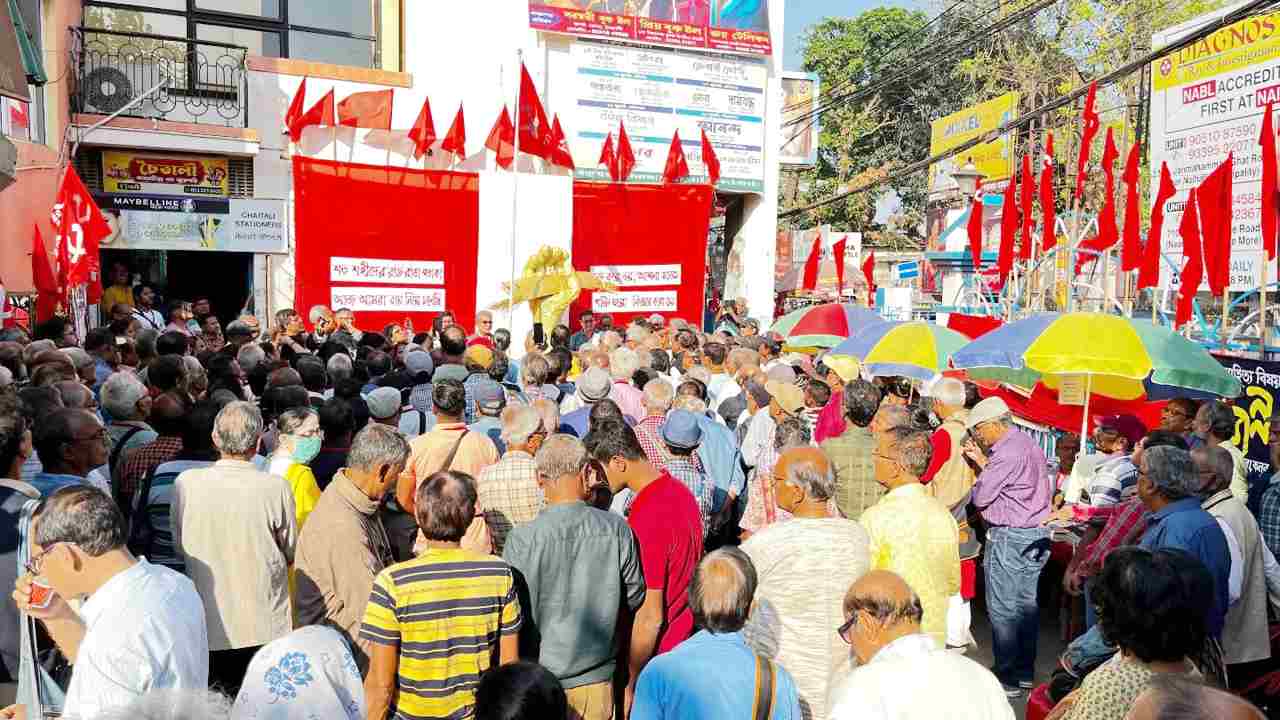
The CPIML’s 13th West Bengal State Conference was held from 18–20 November 2025 at Oikotan Bhavan in Naihati, North 24 Parganas, with a strong pledge to revive left resurgence and democracy in Bengal. On the birth centenary of legendary Tebhaga movement leader Ila Mitra, Naihati town was renamed Ila Mitra Nagar. The conference opened with the hoisting of the red flag by Comrade Meena Pal, followed by floral tributes at the martyrs’ memorial by General Secretary Dipankar Bhattacharya, Central Observer Manoj Bhakt, State Secretary Abhijit Majumdar and other state leaders. A public discussion titled “Bengal Needs a Left Resurgence” was held with prominent leaders of Left parties, after which a short cultural program by the Paschim Banga Ganasanskriti Parishad was presented. Songs by Tagore and Salil Chowdhury resonated with slogans calling for unity to defend democracy and resist fascist attacks in Bengal.
The delegate sessions began with the presentation of the draft report by outgoing State Secretary Abhijit Majumdar. On 19 November, representatives engaged in extensive debate on the draft report. A significant presence of young activists—students, youth, workers, Adivasi activists, project workers, women, minorities and cultural workers—along with veteran organizers. Many delegates shared inspiring accounts of struggles: An Adivasi delegate from Bankura described battles for forest land rights and the continued exclusion of Adivasis from basic benefits. Murshidabad delegates spoke of successful struggles of fisherfolk to regain rights to the Dwarka river. Research scholars from Kolkata highlighted campaigns against the communalization of education. Adivasi women, microfinance loan protesters, tea garden workers, disabled activists, environmental campaigners, and others narrated their struggles—from anti-eviction movements to resistance to corporate takeover of public sectors. In total, 83 out of 371 delegates and observers participated in the discussion.
Responding to the debates, the outgoing State Secretary assured incorporation of positive suggestions. The report was adopted unanimously, and a 67 members State Committee was elected. Comrade Abhijit Majumdar was re-elected as State Secretary. 18 new comrades from various background -- students, women activists, sanitation worker, minorities, peasant activists, Adivasi, cultural activists were incorporated in the new state committee. In his concluding address, comrade Abhijit Mazumdar called upon the ranks to intensify struggles for land, livelihood, and democracy, and to strengthen the Left resurgence in Bengal. The conference concluded with the singing of The Internationale.
For a Left Resurgence in Bengal
The inaugural session of the Conference was the open session where leaders of left parties emphasized the need for a revival of left politics in Bengal. CPI(ML) General Secretary Dipankar Bhattacharya, CPI(M) State Secretary Mohammed Salim, CPI State Secretary Swapan Banerjee, RSP State Secretary Tapan Hore, Forward Bloc State Secretary Naren Chattopadhyay and SUCI (Communist) State Secretary Chandidas Bhattacharya addressed this session. In his welcome address CPI(ML) West Bengal Secretary Abhijit Mazumdar spoke briefly on why it is necessary for the Left to break the bipolar situation in state politics and re-emerge as a force.
RSP State Secretary Tapan Hore, said “When the RSS–BJP maligns the name of Rabindranath, speaks ill of Vidyasagar, calls Rammohan a stooge of the British, we understand how dangerous the RSS–BJP truly is. No single Left party’s movement alone will be enough against them; we need a united Left movement.”
CPI State Secretary Swapan Banerjee said, “The BJP is a seditious political party. They used to openly say they were not against British rule—they were only against Muslims, Christians, and Communists. The RSS knows that only Communists poses a challenge to them they always fear Communist ideology. They want to make the Manusmriti the Constitution and establishing Brahminical supremacy is their goal. A broader political unity can be achieved if we first achieve a strong Left unity. The initiatives taken by CPI(ML) Liberation to build Left unity is extremely positive.”
SUCI (Communist) State Secretary Chandidas Bhattacharya said the arrogance of the RSS–BJP has grown to a extent that a BJP minister in Madhya Pradesh now had the audacity to call Rammohan Roy a stooge of the British. The Left unity must be premised on the dialectic of struggle and unity. The anti-fascist struggle must be centred on the struggle against the capitalist class.
Forward Bloc State Secretary Naren Chattopadhyaya emphasised to eliminate the gaps and weaknesses inside left movement.
CPI(M) State Secretary Mohammed Salim said that a strong left resurgence is needed to counter the attacks on the democratic space in the society. Across the country the deterioration of the electoral system is evident. In West Bengal too, the frightening state of electoral democracy was visible in municipal and panchayat elections. The RSS is working in multiple ways to create a Hindu Rashtra. It has many more faces—many masks, many different activities. The RSS attacks the greatest sons of the Renaissance—Rammohan, Vidyasagar, Rabindranath because they want to remodel the country on fascist idea. Against this, the Left must unite with a class perspective and based on movements and struggles. Movements for the right to education, the right to health, the right to a safe environment are essential.
CPI(ML) General Secretary Dipankar Bhattacharya reminded the audience that during the anniversary month of the Russian Revolution, one good piece of news came from New York in the United States: in the mayoral election there, Mamdani’s victory was a major achievement for the Left-democratic camp. For someone like him to win amidst billionaires in a place like New York, especially in Trump’s era, is remarkable. Another good news came from Delhi’s Jawaharlal Nehru University, where Left student organisations fought together and won all the positions on the central panel. It was hoped that some good news would come from Bihar as well. That did not happen. However, it is also not true that the Left suffered a massive disaster in the election. The vote share increased. CPI(ML) received 1.4 million votes—around one hundred thousand more than last time. CPI and CPI(M) received another six lakh votes together, making the total Left vote in Bihar around two million. However, even though the vote share increased, the number of seats dropped sharply. The Left went down from sixteen seats to three; CPI(ML)’s own seats fell from twelve to two. This outcome was both unexpected and astonishing.
Many are now saying that there is no point contesting elections under the Election Commission’s biased system. Dipankar found such talk—widely circulating on social media—quite surprising. He said: “This is exactly what the rulers want—that we withdraw. If we walk away from elections or from the country’s political arena, they will be delighted.” Regarding the unexpected results in Bihar one important reason was certainly the SIR. There was widespread manipulation in the election—more than before, and in an organized manner. There should also be a ban on cash transfers in the months preceding elections; otherwise, governments will do nothing during their entire term and then buy votes with cash at the last moment.
When the Supreme Court cancelled electoral bonds, it raised a question: vast amounts of money were being given by companies to political parties, but the underlying interests were concealed. Hence the bonds needed to be scrapped. Now the reverse question arises: the government gave Adani huge tracts of land almost free—what did Adani give the ruling party in return? The money Adani secretly gave was used openly by the ruling alliance in the election. A small portion of this money also went to Prashant Kishor’s Jan Suraaj Party. Prashant Kishor himself admitted to receiving many crores from Navayug Construction—linked to Adani—“in exchange for two hours of consultancy.” Using this money, they entered the election with an entirely new style, completely alien to our electoral tradition: without any movement, without any membership campaign, they created party officials by paying ₹10,000, ₹20,000, ₹30,000 or more per month, and fought the election based on this structure. Dipankar described this as a “corporate political project.” He believes that alongside feudal-communal violence, Bihar also now faces the danger of direct corporate plunder.
In the Lok Sabha election in Bihar, AIMIM had little impact, but this time they won five seats again. With the declining number of Muslim MLAs and MPs in Bihar, and the fall in Muslim candidates, there is a sense of fear and anger among the Muslim population. AIMIM gained many votes and seats from that resentment. The opposition alliance failed to address this issue properly. When Mukesh Sahani was being proposed as Deputy Chief Minister to represent marginalised groups, it would have been better if a Muslim representative had also been named as Deputy Chief Minister. This was not done.
After analysing the Bihar results, Dipankar moved to West Bengal politics. He highlighted two issues: on one side, the alarming rise of BJP-RSS in Bengal as in the rest of the country; and on the other side, the misery of the people under Trinamool Congress’s corruption and misrule. He spoke on how the Left can break the TMC–BJP binary that dominates Bengal’s political space and re-emerge as a strong third force.
Dipankar said that if one reason for BJP’s rise in Bengal is TMC’s misrule, anarchy, and aggression, another reason is the Left’s weakness. To break Bengal’s TMC–BJP political binary, the revival of the Left is essential.
BJP is attempting to put pressure on the Left in Bengal—demanding “proof” that the Left is anti-TMC. And that proof, they say, must come by voting for BJP to defeat TMC. This election, they argue, must be fought under the slogan “No Vote to TMC.” The Left will certainly fight against TMC’s misrule on every issue—against attacks on women, corruption, terror, fraud—and will remain active in mass movements. But the Left will not bow to BJP’s pressure. The Left will fight both TMC and BJP in its own way, and assert itself as an independent, strong force.
There is no reason to think BJP is not eager to win Bengal. “Anga-Banga-Kalinga”—the entire eastern region—is on their target. After Anga and Kalinga, they will again try for Bengal. The Left must fight on issues of Bengal’s heritage, attacks on Rammohan, Vidyasagar, Rabindranath; attacks on the Bengali language; and on Bengali migrant workers. If BJP comes to power in Bengal, liberal people and intellectuals will be the first to be targeted. Bengal will become like Assam or Tripura in no time. We will of course say: do not vote for BJP. But we will also say: vote for the Left.
On the question of Left revival, he stressed the importance of the struggles of the working class. But to organise workers today, to build movements, one must think from the ground reality. It cannot be understood only in the labour-capital framework. A worker’s existence is not limited to the factory. Class, caste, and culture must all be understood together. Gender and generation are also two crucial components of social justice.
The Left needs unity. It is important to see whether the Left can fight the upcoming election together. And it must be ensured that the Left’s struggles and movements find representation in the Legislative Assembly.